

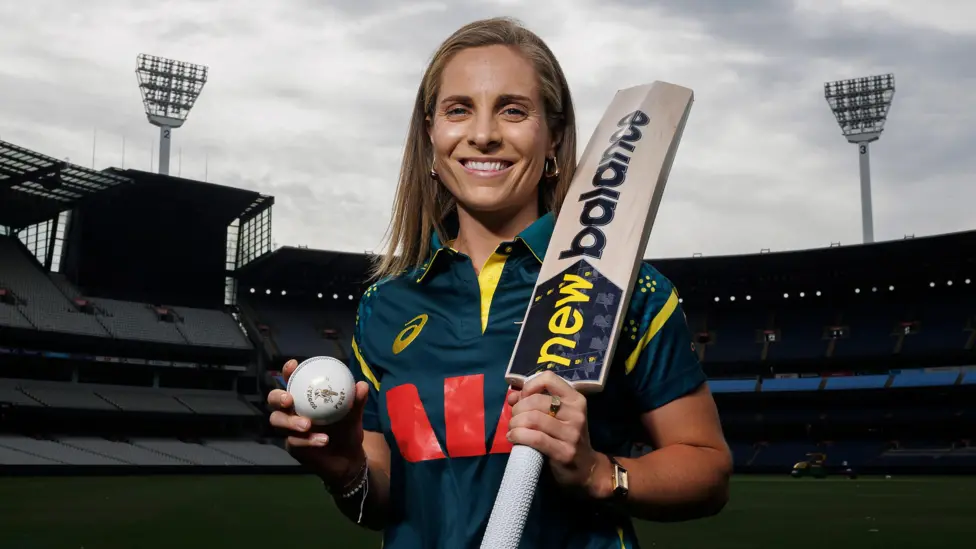
Australia have officially appointed Sophie Molineux as the new women’s national team captain across all formats, marking a significant leadership transition following the retirement announcement of long-serving skipper Alyssa Healy.
Healy confirmed earlier this month that she will step away from professional cricket entirely after Australia’s upcoming multi-format home series against India, bringing an end to a glittering international career that has spanned more than a decade. The 35-year-old wicketkeeper-batter has been one of the most influential figures in women’s cricket, both for Australia and globally.
With Healy not selected for the T20 International squad that opens the series, responsibility will pass immediately to 28-year-old all-rounder Sophie Molineux, who will lead Australia for the first time when the opening T20 is played on 15 February.
Molineux will then revert to the role of vice-captain once Healy returns for the one-day internationals and the one-off Test match in Perth, which is scheduled to be the final appearance of Healy’s professional career. That Test will serve as a fitting farewell for a player who has been central to Australia’s dominance across formats.
Cricket Australia’s decision to hand the captaincy to Molineux across T20s, ODIs and Tests reflects the high regard in which she is held within the squad. Known for her calm presence, tactical awareness and competitive edge, Molineux has steadily grown into a leadership role over recent years.
An experienced left-arm spinner and capable middle-order batter, Molineux has been a consistent performer for Australia and has also captained domestic sides, gaining valuable leadership experience that has prepared her for the demands of international captaincy.
Speaking after the announcement, Molineux described the appointment as a moment of immense pride.
“It’s a real honour to be named Australian captain and something I’m incredibly proud of,” she said. “To follow on from Alyssa, who has had such a massive influence on this team and on women’s cricket more broadly, makes it even more special.”
She also paid tribute to the culture built under Healy’s leadership, emphasising her desire to continue that legacy rather than reinvent it.
“We’ve got a really strong group with plenty of natural leaders, along with some exciting young talent coming through,” Molineux added. “I’m really looking forward to working together as a team, continuing to evolve, and pushing ourselves to the next level—while staying true to the identity that makes this group so special.”
Healy’s impact on Australian cricket cannot be overstated. Since taking over the captaincy, she has overseen sustained success, including major tournament victories and a continuation of Australia’s long-standing dominance in the women’s game. Her aggressive style of play, particularly at the top of the order, has helped redefine expectations for wicketkeeper-batters.
Although Healy will miss the T20 leg of the upcoming series, her return for the ODIs and the Perth Test ensures she will have the opportunity to conclude her career on home soil, in front of Australian fans, and in the traditional format of the game.
The upcoming series against India is a significant one, featuring three T20 Internationals, three One-Day Internationals, and a single Test match, scheduled between 15 February and 9 March. It offers Australia a chance to test their depth, leadership structure and adaptability against one of the strongest teams in women’s cricket.
India arrive as formidable opponents across all formats, making the series an ideal platform for Molineux to begin her captaincy journey under pressure. Leading the side in the opening T20s will provide her with immediate exposure to the tactical and emotional demands of the role.
Cricket Australia officials have expressed confidence that Molineux is well-equipped to handle the transition, highlighting her experience, communication skills and respect within the squad. Her appointment also signals a desire for stability and continuity, rather than a short-term or rotational approach to leadership.
From a broader perspective, the change in captaincy represents a new era for Australia’s women’s team. While the core group of senior players remains strong, the integration of younger talent alongside established stars has been a key focus, ensuring long-term success.
Molineux’s leadership style is expected to complement this approach, balancing competitiveness with inclusivity and player development. Her familiarity with the team environment means the transition from Healy is likely to be smooth, with minimal disruption to on-field performances.
As Australia prepare to host India, attention will naturally fall on how the team responds to life after Healy. While her presence will still be felt during the latter part of the series, the early matches offer a glimpse into the future under Molineux’s leadership.
With major global tournaments on the horizon, including World Cups and multi-nation series, Australia will be keen to ensure their leadership group remains strong, adaptable and forward-looking.
For now, all eyes turn to 15 February, when Sophie Molineux officially begins her tenure as Australia’s women’s captain, taking the first steps in what promises to be a defining chapter for both her career and the national side.
For the latest cricket news, squad updates and in-depth coverage of women’s international cricket, visit https://netsports247.com.