
Novak Djokovic’s pursuit of yet another historic milestone at the Australian Open remains alive, though his passage into the semi-finals came under dramatic and unfortunate circumstances. The Serbian legend advanced only after Lorenzo Musetti was forced to retire injured, despite holding a commanding two-set lead in their quarter-final clash in Melbourne.
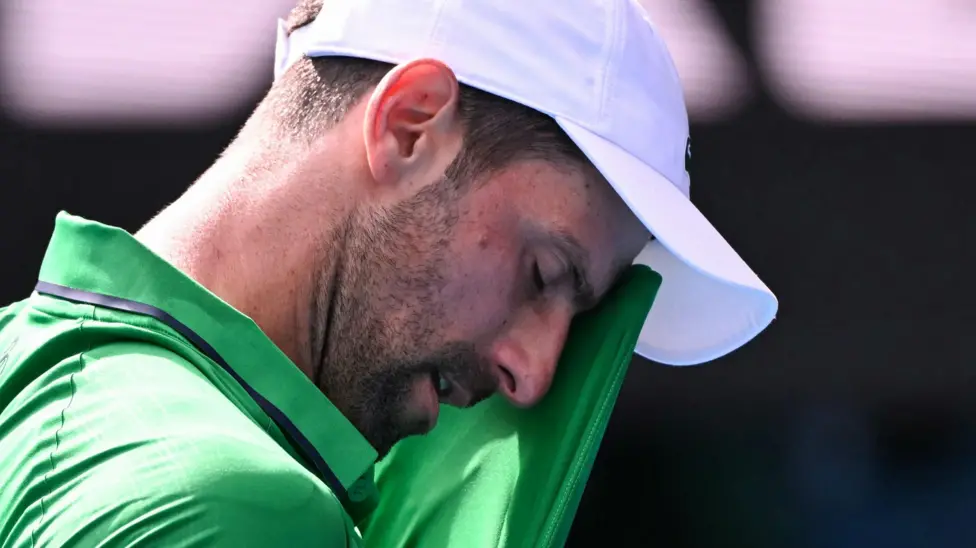
Djokovic, who is chasing a record-breaking 25th Grand Slam singles title, struggled to impose himself for much of the contest. Uncharacteristically loose with his groundstrokes and visibly frustrated, the 38-year-old appeared out of rhythm as Musetti produced one of the finest performances of his career. The Italian played with confidence, aggression and composure, leaving the crowd stunned as he surged ahead.
Musetti claimed the opening set 6-4, capitalising on Djokovic’s mounting errors and inconsistent serve. The second set followed a similar pattern, with the Italian maintaining his intensity to secure it 6-3, placing him firmly on course for a first Australian Open semi-final appearance.
However, the match took a heartbreaking turn early in the third set. Musetti suddenly showed signs of discomfort and struggled to move freely. After losing his opening service games, the fifth seed called for a medical timeout to receive treatment on his thigh. Despite the intervention, it quickly became clear he was unable to continue at a competitive level.
With his movement severely restricted and his serve compromised, Musetti bravely attempted to carry on but ultimately had no choice but to retire. At 3-1 down in the third set, he walked to the net to shake hands with Djokovic, bringing a premature end to a match that had promised so much.
The emotional impact was clear as Musetti left the court. Visibly distraught, he was assisted down the tunnel by a member of his team, knowing a golden opportunity had slipped away through no fault of his own.
Djokovic was quick to acknowledge his opponent’s superiority on the night and showed genuine empathy in his post-match comments.
“He was the better player,” Djokovic admitted. “I was on my way home tonight. I feel really sorry for him and wish him a very speedy recovery. There’s no doubt he deserved to win today.”
The Serbian also acknowledged the element of fortune involved in his progression, describing himself as “extremely lucky” to still be in the tournament.
Djokovic himself was not without physical concerns. At the conclusion of the second set, he received treatment for blisters on his feet, an issue that may have further tested his endurance had the match gone the distance. His movement looked laboured at times, and his frustration was evident as points slipped away.
This was not the first instance of good fortune for Djokovic at this year’s Australian Open. In the fourth round, his scheduled opponent Jakub Mensik withdrew due to injury, handing Djokovic a walkover into the quarter-finals and reducing his time on court.
Remarkably, Djokovic has not won a completed set since his third-round victory over Botic van de Zandschulp on 24 January, an unusual statistic for a player of his pedigree at this stage of a Grand Slam.
Despite these warning signs, Djokovic remains one match away from another Australian Open final. However, the challenge awaiting him in the semi-finals could hardly be more demanding.
On Friday, he will face Jannik Sinner, the two-time defending champion and one of the form players in men’s tennis. The Italian holds a dominant recent record over Djokovic, having won six of their last seven meetings, including several high-profile encounters on hard courts.
Sinner secured his semi-final place by defeating American Ben Shelton in straight sets, winning 6-3, 6-4, 6-4. Although he experienced some physical discomfort during the match, Sinner remained composed and clinical, demonstrating the consistency and maturity that have defined his recent success.
For Djokovic, the semi-final represents both an opportunity and a major test. To overcome Sinner and continue his quest for a historic 25th major, he will need a significant improvement in form, sharper execution, and better physical conditioning than he has shown so far in the tournament.
Still, history has shown that Djokovic is capable of finding his best level when it matters most. Whether experience and resilience can overcome youth, momentum and recent dominance remains one of the most intriguing storylines of this year’s Australian Open.
For more tennis news, Grand Slam coverage, and daily sports updates, visit https://netsports247.com.