
Newcastle United’s players stood waiting in the tunnel at the Etihad Stadium, boots laced and minds focused, eager to get the Carabao Cup semi-final under way. With just minutes left before kick-off, confusion set in. Manchester City were nowhere to be seen.
As Newcastle captain Kieran Trippier glanced around in disbelief, Pep Guardiola’s side were still in their dressing room, taking their time before eventually emerging. The delay mattered little. Once City stepped onto the pitch, they wasted no time asserting their dominance.
Within the opening exchanges, Newcastle were overwhelmed. Manchester City stormed into a commanding 3-0 lead in the second leg, leaving the visitors shell-shocked and effectively ending the contest before it had properly begun.
The night was symbolic of Newcastle’s current situation. Earlier in the day, club CEO David Hopkinson had reaffirmed his belief that Newcastle would be competing for football’s biggest honours by 2030. Yet on this evidence, that vision still feels some distance away.
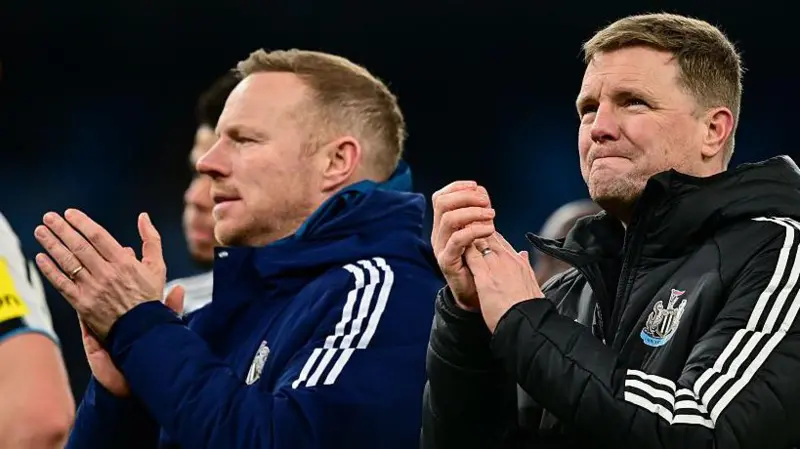
Head coach Eddie Howe did not disguise his frustration. At half-time, he made three substitutions, a rare but telling move.
“I was really annoyed,” Howe admitted afterwards — words that have been heard more than once during a demanding campaign.
Pride amid disappointment
To Newcastle’s credit, the second half showed more fight. Substitute Anthony Elanga pulled a goal back, offering a brief reminder of the attacking threat Newcastle can carry on their day.
Still, the damage was done. A 5-1 aggregate defeat ended their Carabao Cup journey.
Despite the disappointment, the travelling support remained defiant. The 5,400 Newcastle fans inside the Etihad repeatedly sang “Eddie Howe’s black and white army”, a clear show of appreciation for the man who ended the club’s 70-year wait for a major domestic trophy in this very competition last season.
That loyalty underlines the bond Howe has built with the fanbase. However, this season has tested both patience and belief — and there is little sign that the pressure will ease any time soon.
A season that refuses to ignite
On the surface, Newcastle’s campaign does not appear disastrous.
They have reached a third EFL Cup semi-final in four years. They remain strong favourites to progress past Qarabag and reach the Champions League last 16. An FA Cup run is still possible, even if a tricky fourth-round clash with Aston Villa looms.
Yet dig deeper and the concerns become clearer.
Newcastle currently sit 11th in the Premier League, far from the heights they aimed for at the start of the season. Players had spoken openly about making history by qualifying for the Champions League in consecutive campaigns — something the club has never achieved.
Instead, away form has undermined those ambitions. Newcastle have managed just two away wins in the league. Against teams currently above them in the table, they have collected only 11 points from a possible 36.
Perhaps most damaging of all, they have dropped 16 points from winning positions, repeatedly failing to close out matches.
It is little surprise that this campaign has been widely labelled a season of transition — a term Eddie Howe does not shy away from.
Howe embraces the idea of transition
Asked whether he could accept that description, Howe was honest.
“I can,” he said. “We brought players in over the summer, and we lost important players too. Change was always going to happen.
“Transition doesn’t have to be negative. It can be positive. We’re trying to find the rhythm and flow we’ve been searching for all season.”
The departure of Alexander Isak, Newcastle’s leading scorer last season, left a huge void. Replacing his goals, movement and presence has proven far more difficult than expected.
Beyond the pitch, Howe also acknowledged that the club itself is evolving.
“The club is growing and changing constantly,” he added. “That will probably accelerate in the next few years. Newcastle is definitely in transition — but a positive one, in my opinion.”
New signings still adapting
There have been moments that hint at what Newcastle could become.
A devastating first-half performance against Chelsea, an encouraging spell away to Paris St-Germain, and a strong opening half-hour at Anfield all showcased the team’s potential.
But football matches are not won in flashes.
One major frustration for the coaching staff has been the lack of consistent training time. An unforgiving fixture schedule has limited full sessions on the training ground, forcing the squad to rely heavily on video analysis, meetings and tactical walk-throughs instead.
This is the reality for clubs aiming to compete across multiple competitions — something Newcastle had never experienced at this scale heading into February.
The workload has also taken a physical toll. Bruno Guimaraes, Joelinton, Tino Livramento and Fabian Schar are currently injured, while Anthony Gordon limped off with a hamstring issue in midweek.
Injuries have slowed the integration of Newcastle’s summer recruits. Apart from defender Malick Thiaw, most new arrivals are still adjusting.
Thiaw, Jacob Ramsey, Nick Woltemade and Yoane Wissa all arrived late in a chaotic transfer window, during which the club operated without a sporting director and missed out on several primary targets.
Questions in attack remain
Despite spending £179m on attacking players, Newcastle are still searching for a settled front line.
Elanga’s energetic cameo against Manchester City offered encouragement, but Woltemade was withdrawn at half-time after another quiet display and has not scored since December. Wissa, still lacking sharpness, squandered several good opportunities across both legs of the semi-final.
As a result, Newcastle head into a decisive run of fixtures with more uncertainty than clarity.
“Where does that leave our season?” Howe asked. “We’re still competing on several fronts.
“The games are relentless. There’s no break. We have to get back to winning as quickly as possible — that’s the only thing that brings fresh energy.”
Whether Newcastle can rediscover momentum remains to be seen. What is clear is that this transition period will test the club’s resilience, patience and long-term vision.
For more Premier League analysis and Newcastle United news, visit https://netsports247.com