
England Enter T20 World Cup Amid Controversy, Fatigue and Unfinished Business
Just 29 days have passed since the final delivery of the Ashes in Sydney, a turnaround so tight that several England players barely had time to return home before being pulled back into international duty. In that short window, English cricket has struggled to find calm, clarity, or consistency.
The controversies that followed the Ashes have refused to fade. Instead, they have lingered, expanded, and at times overshadowed what should be a fresh beginning. England can take slight comfort in knowing they are not the only nation grappling with unrest, confusion, and external pressures as a new T20 World Cup gets underway.
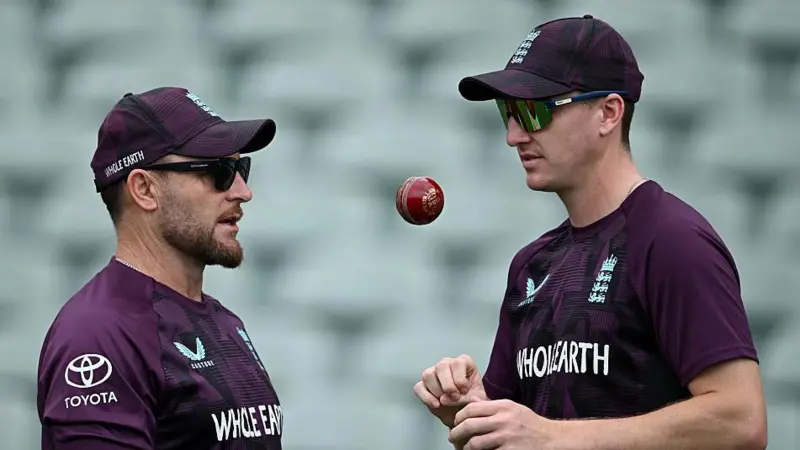
This tournament marks the 10th edition of the men’s T20 World Cup, and the fourth since the Covid-19 pandemic, a frequency that has left parts of the cricketing world feeling exhausted rather than excited. While enthusiasm appears diluted in some quarters, England’s leadership group — captain Harry Brook, head coach Brendon McCullum, and their squad — view this competition as essential, not optional.
Cricket’s Greatest Stage Still Delivers Drama
Despite the surrounding chaos, the cricket itself promises to entertain. The tournament begins on Saturday, with Scotland and India among the teams in action, and the next four weeks are expected to deliver high-quality, high-pressure cricket.
There are few spectacles in sport comparable to watching cricket in India, particularly when the host nation is playing. The intensity, scale, and atmosphere elevate the game to another level. Sri Lanka, co-hosting the tournament, also brings history, passion, and challenging conditions into the mix.
The expansion to 20 teams has added another dimension. One of the standout successes of the previous edition in the Caribbean was broadening participation, a move that allowed Italy to make their first appearance at a major global tournament — a milestone for the sport’s growth.
A Tournament Overshadowed Before It Begins
Yet for all the promise, this World Cup starts beneath a heavy cloud.
Bangladesh have withdrawn, citing political tensions, while Pakistan are expected to boycott their match against India in Sri Lanka, following instructions from their government. These decisions strike at the heart of the tournament’s integrity and commercial viability.
Only eight months ago, two of the most destructive batters in the T20 format — South Africa’s Heinrich Klaasen and West Indies’ Nicholas Pooran — stepped away from international cricket altogether. At 33 and 29 respectively, both chose the stability and rewards of franchise leagues over national duty.
It raises a troubling question: would elite players walk away from international cricket on the eve of a World Cup if the tournament still carried the same prestige it once did?
Oversaturation and Governance Failures
One undeniable factor is oversaturation. Since 2023, the cricketing calendar has been flooded with global events — including a 50-over World Cup, a Champions Trophy, and four women’s World Cups. In just over four years, fans have witnessed 10 major international tournaments, blunting the impact of each.
However, the deeper issue runs far beyond scheduling. The sport is suffering from years of weak governance, particularly in handling political influence within the subcontinent.
Political tensions have not crept into cricket gradually; they have been embedded for over a decade. Throughout this period, the International Cricket Council (ICC) has largely failed to confront the problem.
India’s decision to play the Champions Trophy in Dubai instead of Pakistan, despite Pakistan being the designated host, was predictable from the outset. More recently, Bangladesh bowler Mustafizur Rahman was abruptly removed from the Indian Premier League without explanation — an action that escalated tensions and contributed to the current crisis.
Again and again, cricket’s administrators have chosen the path of least resistance. The result is instability, uncertainty, and a World Cup overshadowed by off-field disputes.
England’s Troubles: Different, But No Less Serious
England’s issues may not carry the same geopolitical weight, but they are equally disruptive.
For weeks, the conversation has centred not on tactics or form, but on nightclubs, curfews, and who was spotted where in New Zealand. What occurred in Wellington has become English cricket’s latest off-field saga.
These distractions overshadowed what was, on paper, a strong tour of the Indian Ocean. England defeated Sri Lanka in a one-day series, ending the hosts’ run of seven consecutive unbeaten home ODI series.
Following criticism after the Ashes, England responded with greater discipline. They won a T20 series on batting-friendly pitches before completing a 3-0 whitewash on turning tracks, conditions closely resembling those they will face throughout the Super 8 phase — if they progress.
Yet despite these positives, the narrative has remained fixated on Harry Brook.
Leadership Under the Microscope
McCullum has argued that Brook’s behaviour in New Zealand has been overanalysed. While the incident was bound to emerge eventually, the decision not to disclose it immediately was understandable. Brook was punished with a significant fine.
However, dishonesty in his apology, and the failure to correct inaccuracies promptly, ensured the issue resurfaced and intensified scrutiny on England’s culture.
The compressed schedule between the Ashes and this World Cup left no room for structural change. There was simply no time to replace coaches or leadership figures. Once this tournament ends, however, England’s men do not play again for three months — a window that would allow major changes if results disappoint.
There is also the possibility that McCullum may choose to step away voluntarily, though he has publicly reaffirmed his desire to continue.
Reflecting on his previous white-ball tournament with England — the winless Champions Trophy campaign — McCullum suggested the players were overly burdened by expectation.
“They care too much,” he said. “They’re too hard on themselves. Sometimes they need to let go so their talent can shine.”
Balancing that philosophy with increased scrutiny and a demand for change is no small challenge.
The Minimum Requirement: Results and Performance
For McCullum and Brook, reaching the semi-finals by early March is the baseline expectation. With 10 wins from their last 11 completed T20 matches, England possess the quality to deliver.
But history offers a warning. In 2024, a semi-final appearance was not enough to save Matthew Mott’s job as white-ball coach. This time, how England play may matter just as much as how far they go.
Will they finally challenge the very best, rather than falter when expectations rise?
They were labelled contenders earlier this winter — and failed badly. Whether to protect their futures or simply reshape the narrative, England must ensure the lessons of the past 29 days since Sydney are not wasted.
For full cricket coverage, tournament analysis, and global sports news, visit:
👉 https://netsports247.com