

Head coach Sarina Wiegman had made her expectations crystal clear before England’s opening Women’s World Cup qualifier — she wanted a “clear win.” Against Ukraine, that is precisely what the Lionesses ultimately produced, even if they needed a half to truly find their rhythm.
With only one automatic qualification spot available from the group for the 2027 Women’s World Cup, there is little margin for error. England know that every point — and potentially every goal — could prove decisive. The looming presence of world champions Spain women’s national football team adds further intensity to the equation, with many anticipating that the two European heavyweights will battle directly for top spot.
So when England went into the half-time interval locked at 0-0 against a Ukraine side ranked 30 places below them in the FIFA standings, anxiety began to ripple among supporters. On paper, this was a mismatch. On the pitch, however, Ukraine’s organisation and discipline made life uncomfortable for the Lionesses.
A Frustrating First Half
Wiegman opted for a refreshed and somewhat experimental starting XI as she continues to manage the return of key players from injury while rewarding those in strong club form. The selection hinted at long-term squad development, but it also meant England needed time to settle.
Manchester City’s Laura Blindkilde Brown was handed a rare start, while London City Lionesses defender Poppy Pattinson later made her senior debut from the bench. The defensive line itself was notably inexperienced in international terms. Although captain Leah Williamson brought leadership and 65 caps to the unit, the entire back four had fewer than 100 caps combined.
Maya Le Tissier was deployed at right-back ahead of Lucy Bronze, while Taylor Hinds started once again on the left. Jess Park, enjoying a superb season with Manchester United, featured out wide rather than in her more familiar central role.
Despite dominating possession — enjoying 85% of the ball and registering 40 touches in the opposition penalty area — England could not break the deadlock. Fifteen attempts on goal yielded nothing. The tempo slowed as Ukraine remained compact and disciplined, closing spaces between the lines and frustrating England’s forward movement.
Former England midfielder Fran Kirby observed that the Lionesses appeared uncertain in their approach during the opening 45 minutes. Ukraine’s defensive structure forced England into repetitive crossing rather than incisive play through central channels. Composure in key moments was missing.
Second-Half Ruthlessness
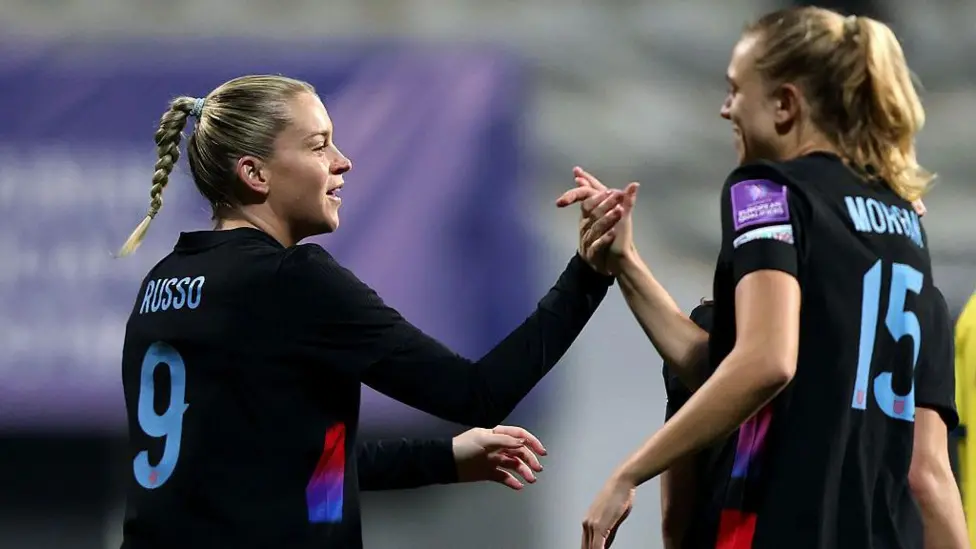
If the first half was about patience and frustration, the second half was about execution. England emerged with renewed clarity and purpose. The breakthrough came courtesy of Arsenal striker Alessia Russo, who scored twice in the space of four minutes to seize control of the match.
Her quick-fire brace shattered Ukraine’s resistance and shifted momentum decisively. Once the defensive block loosened, England’s quality became increasingly evident. Midfielder Georgia Stanway added two more goals, demonstrating her attacking instinct and composure in front of goal.
Jess Park then capped a fine individual display with a double of her own, ensuring Wiegman’s demand for a convincing victory was emphatically met. By the final whistle, England had secured a commanding 6-1 triumph — a result that reflected both dominance and clinical finishing.
Russo later explained that the team never panicked despite the goalless first half. The belief in their quality remained intact; the challenge lay in sharpening the final pass and shot. Once they adjusted their approach, the chances began to convert into goals.
Context and Challenges
The match was staged in Turkey, as Ukraine remain unable to host fixtures due to the ongoing war with Russia. Ukraine’s squad endured a gruelling 15-hour coach journey to reach the Mardan Stadium — a reminder of the broader challenges surrounding the fixture.
Nevertheless, Ukraine approached the game with commendable organisation and resilience. For England, however, anything less than victory would have been unacceptable. As reigning European champions and one of the world’s elite teams, expectations are unrelenting.
Meanwhile, Spain kept pace with a 3-0 victory over Iceland, reinforcing the likelihood that goal difference may become a critical factor in determining automatic qualification. England’s single concession against Ukraine drew visible disappointment from Stanway, who acknowledged the importance of defensive concentration even in dominant performances.
Building Momentum
The Lionesses now sit top of the group, holding a slender goal difference advantage over Spain. Saturday’s fixture against Iceland at Nottingham’s City Ground offers another opportunity to strengthen their position before April’s highly anticipated showdown at Wembley.
That clash with Spain promises to be significant on multiple levels. It will evoke memories of the 2023 Women’s World Cup final, where Spain defeated England, and the Euro 2025 final, in which the Lionesses exacted revenge. The rivalry adds emotional intensity to what is already a pivotal qualification battle.
Wiegman had stressed pre-match that ruthlessness was essential. Her side responded accordingly. While the first half exposed areas for improvement, the second demonstrated England’s depth and adaptability.
The combination of experienced leaders and emerging talents reflects a squad evolving with purpose. Wiegman’s willingness to rotate and experiment suggests confidence in the group’s versatility — a necessary asset in a long qualification campaign.
Ultimately, the 6-1 victory delivered exactly what was required: three points, a healthy goal tally, and renewed momentum. England’s campaign has begun with authority, but sterner examinations lie ahead.
For continued Women’s World Cup qualification coverage and updates, visit:
https://netsports247.com