
Alfie Whiteman stands inside a historic Grade II-listed gallery located within the Tottenham Hotspur Stadium, observing a collection of deeply personal photographs displayed on the walls. These images—featuring moments like him leaning out of a tumble dryer, spending a birthday alone in a forest, or sitting unclothed on a jetty overlooking Sweden’s Lake Mockeln—were never originally meant for public viewing. Reflecting on them now, he laughs and admits that these pictures represent a side of his life he once kept completely separate from football.
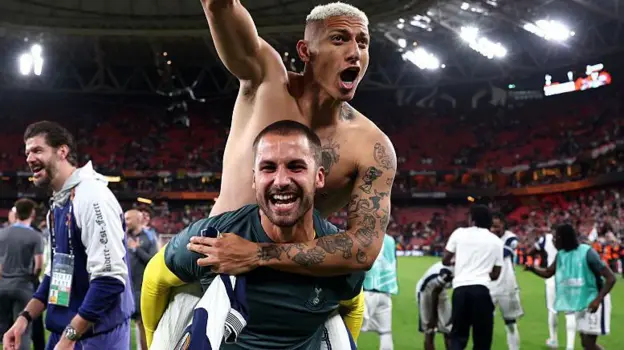
Not long ago, Whiteman was part of Tottenham’s squad that celebrated Europa League success in Bilbao, even making the bench for that memorable occasion. Yet, less than a year later, he made the surprising decision to retire from professional football at just 26 years old. Now, instead of focusing on matches and training sessions, he is unveiling his debut photography exhibition, marking the beginning of a new chapter in his life.
Growing up in north London, Whiteman had a deep connection with Tottenham Hotspur. He joined the club at the age of 10, inspired by watching them lift the League Cup in 2008 alongside his father. His journey with Spurs spanned more than 15 years, culminating in unforgettable moments such as the open-top bus parade celebrating their European triumph. During that celebration, he recalls waving at friends and family as if he were simply passing through his neighborhood, highlighting how surreal the experience felt.
Despite having opportunities to continue his football career after his contract expired, including trials with clubs in the Championship and League One, Whiteman chose a different path. He decided to fully commit to his passion for photography and filmmaking—a decision that surprised many within the football world. One coach even described his early retirement as a “crime,” given his potential to continue playing for many more years.
Making the decision to step away from football was not easy. Whiteman had to inform his agent that he no longer wished to pursue playing opportunities, effectively closing the door on a career he had dedicated his life to. Unlike many athletes, he did not make a public announcement or seek attention for his decision. Instead, he quietly transitioned into a new phase of his life.
Although leaving football meant giving up a lifelong dream, Whiteman describes the months following his retirement as some of the most fulfilling of his life. He immersed himself in creative work, collaborating with talented individuals and exploring new opportunities. However, the transition was not without its challenges. Initially, he found himself assisting photographers and handling equipment on set, embracing the learning process from the ground up.
Throughout his football career, Whiteman had already begun preparing for life beyond the sport. On days off or after training sessions, he would meet with creatives, assist on film sets, and explore various artistic interests. He even hosted a radio show, initially using his mother’s surname to maintain privacy before eventually embracing his true identity.
His diverse interests often set him apart from typical footballers. While many of his peers focused solely on the sport, Whiteman developed a passion for jazz music, film, photography, and acting. He even participated in an experimental theatre production during one summer, choosing to perform on stage rather than travel to luxury holiday destinations like many of his teammates.
Whiteman acknowledges that his journey into the creative world was gradual. Each experience—from acting lessons to photography projects—brought him closer to the realization that he wanted to pursue something different. He admits that he struggled with uncertainty during his football career, often questioning whether it was the right path for him.
Coming from a culturally rich background—his father being a jazz musician—Whiteman always had a strong connection to the arts. However, within the football environment, such interests were sometimes viewed as distractions. He recalls being labeled a “hippie” by teammates and feeling that the sport often encouraged conformity.
Unlike the stereotypical football lifestyle, Whiteman preferred simplicity. He would cycle or take public transport to training instead of driving luxury cars, and he lived close enough to walk to matches. Over time, he realized that while he loved the technical and physical aspects of goalkeeping, his creative passions were equally important to him.
Eventually, the structured nature of professional football began to feel restrictive. The repetitive cycle of training, matches, and short breaks left little room for pursuing other interests. For Whiteman, this routine became increasingly unfulfilling, leading him to consider alternative paths.
Since retiring, he has embraced the freedom to explore new opportunities. He has traveled to Pakistan, connecting with his heritage, and worked on a film project in Ukraine. He has also signed with a production company as a director and photographer and established his own studio in Shoreditch.
His debut exhibition, titled “A Loan,” is particularly meaningful, as it draws inspiration from his time on loan in Sweden with Degerfors. During that period, he lived in a remote cabin by Lake Mockeln, experiencing a stark contrast to life in London. The solitude he experienced there played a significant role in shaping both his artistic work and his personal reflections.
The photographs and diary entries featured in the exhibition capture moments of introspection and self-discovery. Living alone in a foreign environment, especially during the post-Covid period, gave him time to reflect deeply on his life and future. These moments of solitude, though challenging at times, ultimately proved to be valuable.
Whiteman recalls spending evenings by the lake, watching sunsets and contemplating his direction in life. One particular moment—during a storm while eating takeaway—led him to create one of his self-portraits. These images, initially intended as personal experiments, have now become central pieces in his exhibition.
Looking back, Whiteman recognizes that the thoughts and emotions captured in his work were signs of his eventual decision to leave football. At the time, he may not have fully understood them, but with hindsight, they represent a turning point in his journey.
Today, as he presents his work to the public, Whiteman reflects on how his perspective has changed. What once felt uncertain and confusing now appears as a natural progression into a new phase of life. While he acknowledges that questions about the future are inevitable, he finds comfort in embracing change and exploring new possibilities.
His story serves as a reminder that success is not defined by a single path. For Whiteman, leaving football was not an end, but rather the beginning of a different and equally fulfilling journey—one driven by creativity, curiosity, and self-expression.