

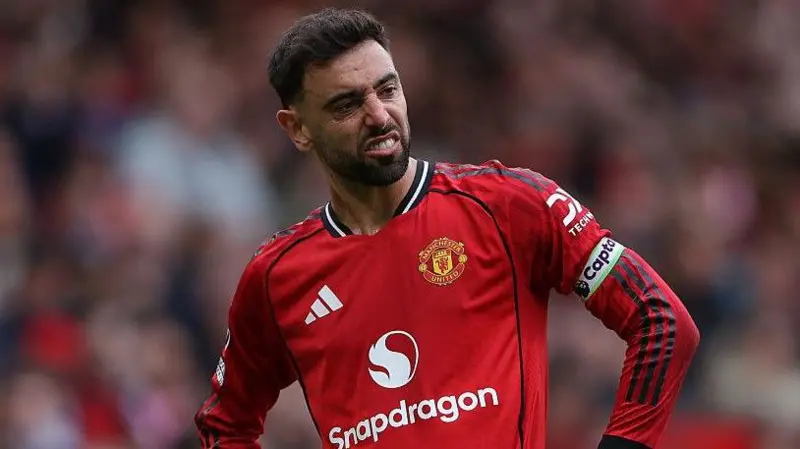
Bruno Fernandes has been one of the most influential figures at Manchester United since his arrival in 2020. Despite his consistent individual brilliance, the club has not achieved major success in the Premier League or the UEFA Champions League during his time. While Fernandes has helped United secure domestic trophies under former manager Erik ten Hag, the overall return in terms of major silverware has been relatively modest.
If United manage to finish third in the league this season, it would mark one of their best performances in the Fernandes era, surpassed only once since he joined. However, for a player widely regarded as one of the club’s finest signings since the departure of legendary manager Sir Alex Ferguson in 2013, many believe his contributions deserve greater collective success.
Recently, Fernandes was honored with the Football Writers’ Association Player of the Year award, recognizing his outstanding performances. However, the Portuguese midfielder has repeatedly emphasized that individual accolades are not his primary motivation. Speaking earlier in the season, he explained that success should not be measured solely by trophies or awards. He pointed out that even the world’s best players do not always win prestigious honors like the Ballon d’Or, highlighting the subjective nature of such recognitions.
For Fernandes, the ultimate goal remains team success. He has consistently expressed a desire to win trophies and contribute to restoring Manchester United’s status among Europe’s elite clubs. Rather than focusing on personal statistics, he values being remembered for the impact he has on the team and the club’s progress.
Although United are unlikely to secure any major trophies this season, Fernandes still has the opportunity to achieve significant individual milestones. He is currently on the verge of equaling the record for the most assists in a single Premier League campaign, needing just one more to match the tally of 20 set by Thierry Henry and Kevin De Bruyne.
Fernandes has been far ahead of his competitors in the assists chart this season, leading by a considerable margin over players like Rayan Cherki and Jarrod Bowen. His creativity and vision have been instrumental in United’s attacking play, making him one of the most effective playmakers in the league.
The importance of this record is evident in Fernandes’ approach on the pitch. In a recent match, a teammate suggested that he might have taken a shot in a similar situation earlier in his career, but instead, he chose to set up striker Benjamin Sesko for a goal. This decision reflects his commitment to creating opportunities for the team rather than prioritizing personal achievements.
In addition to the assist record, Fernandes is also considered a strong contender for the prestigious PFA Players’ Player of the Year award. Both Henry and De Bruyne have won this accolade twice, and joining such company would further cement Fernandes’ reputation as one of the league’s elite players.
However, the question remains whether individual achievements alone are enough to define a player’s legacy. Historically, leading the assists chart has not always been associated with winning major trophies. For example, players like Mohamed Salah, Ollie Watkins, and Harry Kane have topped assist rankings in recent years without necessarily being regarded as traditional playmakers.
A more comparable case to Fernandes might be Cesc Fabregas during his time at Arsenal. Despite leading the assists chart in multiple seasons, Fabregas did not win the Premier League until later in his career with Chelsea. Similarly, players like Matt Le Tissier and Steve McManaman also achieved high assist numbers without securing league titles.
Even Steven Gerrard, widely regarded as one of the greatest midfielders in Premier League history, never won the league title despite winning individual awards and achieving success in other competitions. These examples highlight that a player’s greatness is not solely determined by the number of trophies they win.
Looking ahead, Fernandes’ future at Manchester United remains an important topic for fans and the club alike. His current contract is nearing its final stages, although there is an option to extend it by an additional year. Last summer, he reportedly rejected a lucrative offer from Al-Hilal, choosing instead to remain at Old Trafford.
There had been speculation that Fernandes might consider leaving if United failed to qualify for the Champions League. However, with qualification now secured, discussions about a potential contract extension are expected to take place. The club is willing to negotiate but remains cautious about maintaining financial discipline and controlling wage expenses.
United believe they are in a relatively strong position regarding Fernandes’ future, particularly given his age and the contractual options available. However, a release clause in his contract, set at 65 million euros, could allow him to leave for a club outside England if activated within a certain timeframe.
Despite these uncertainties, Fernandes appears committed to the challenges ahead. He has expressed enthusiasm about continuing his journey with Manchester United and contributing to the team’s development. Interim head coach Michael Carrick has also spoken positively about Fernandes, praising his performances and importance to the squad.
Carrick highlighted that Fernandes is playing some of the best football of his career and remains a key figure in the team. His leadership, creativity, and consistency make him an invaluable asset as United look to build for the future.
A significant factor behind Fernandes’ recent success has been a tactical shift within the team. Under previous management, he often played in a deeper role, sharing responsibilities in midfield and contributing to the build-up play. This position required him to focus on long passes and transitions, which, while effective, limited his ability to create frequent chances.
Under Carrick’s system, Fernandes has been deployed in a more advanced role, operating as a traditional number 10 in a 4-2-3-1 formation. This change has allowed him to play closer to his teammates and the opposition’s goal, increasing his influence in attacking situations.
Being positioned higher up the pitch has given Fernandes more opportunities to create chances. With additional passing options and reduced defensive responsibilities, he has been able to conserve energy and execute decisive plays more effectively, particularly in the later stages of matches.
His assists this season reveal consistent patterns. One common approach involves delivering crosses from the right side, either during open play or from set-pieces. These crosses often create space for teammates to capitalize on aerial opportunities.
Another pattern is his movement from central areas into wider positions. This creates confusion among defenders, as they struggle to decide who should mark him. By exploiting these gaps, Fernandes is able to deliver precise passes and create goal-scoring opportunities.
Additionally, his ability to operate in transition has been crucial. By carrying the ball forward and delaying his passes, he can draw defenders out of position before finding the best option. This skill, developed during his time in a deeper role, has become a key part of his game.
Overall, Fernandes’ evolution as a player reflects both his adaptability and his commitment to improving. While team success has been limited, his individual contributions continue to set him apart as one of the most creative and influential players in the Premier League era.