
The philosophy of Johan Cruyff has long shaped modern football, and no figure embodies that influence more profoundly than Pep Guardiola. As Manchester City prepare for life after Guardiola’s remarkable tenure, his legacy stands not just as a collection of trophies, but as a lasting footballing identity inspired by his mentor.
Cruyff famously emphasized that while winning matters, creating a unique style and leaving a lasting impression is the true achievement in football. Guardiola has carried that philosophy throughout his career, turning it into a defining feature of his managerial journey. His time at Manchester City has been a testament to that belief, combining success with a distinctive and influential style of play that has reshaped the sport.
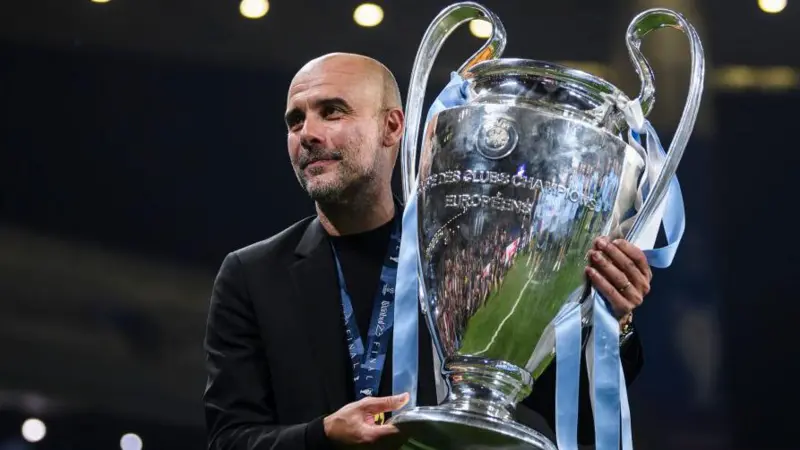
Over a decade in charge, Guardiola has delivered unprecedented success at City. His trophy haul includes six Premier League titles, a long-awaited UEFA Champions League triumph, three FA Cups, five League Cups, as well as the UEFA Super Cup and FIFA Club World Cup. However, beyond the silverware, it is the manner in which these victories were achieved that truly defines his era.
Guardiola himself has often spoken about how little he felt he understood football before encountering Cruyff at Barcelona. Under Cruyff’s guidance, he developed not only as a player but also as a thinker of the game. This relationship reached a peak when Barcelona’s famed “Dream Team” secured their first European Cup victory in 1992 at Wembley. Guardiola, a product of the club’s academy, played alongside stars like Ronald Koeman, Michael Laudrup, and Hristo Stoichkov, absorbing the principles that would later define his managerial philosophy.
Just as Cruyff transformed football in Spain, Guardiola has revolutionized the game in England. His influence extends far beyond the elite level, reaching deep into the football pyramid and even grassroots coaching. Across youth academies and amateur leagues, coaches now attempt to replicate the positional play, passing patterns, and tactical structures that Guardiola popularized.
One of Guardiola’s most significant contributions is his emphasis on possession-based football. His teams are built around controlling the ball, dictating tempo, and minimizing risk through intelligent positioning. This approach contrasts sharply with the high-intensity, direct style employed by rivals such as Jurgen Klopp, whose Liverpool teams often relied on rapid transitions and pressing.
Guardiola has consistently defended his philosophy, arguing that maintaining possession reduces the likelihood of defeat. His belief in controlling the game through the ball has become a cornerstone of modern football tactics. Central to this approach is the concept of quickly regaining possession, often within seconds of losing it—a principle that has influenced countless teams worldwide.
Tactically, Guardiola has introduced innovations that have redefined player roles and formations. One of his most famous contributions is the “false nine,” a system in which a forward drops deeper into midfield to disrupt defensive structures. This strategy was famously executed with Lionel Messi at Barcelona, creating space and confusion for opponents.
Another hallmark of Guardiola’s approach is the use of inverted full-backs, players who move into central midfield areas rather than staying wide. This allows his teams to dominate possession and create numerical advantages in key areas of the pitch. These ideas, once considered unconventional, are now widely adopted across the footballing world.
Guardiola’s willingness to experiment with player positions has also set him apart. He has consistently demonstrated that traditional roles can be reimagined to suit tactical needs. For example, he transformed Javier Mascherano from a defensive midfielder into a central defender at Barcelona, and repositioned Philipp Lahm from right-back into a central midfield role at Bayern Munich.
At Manchester City, this adaptability has been evident in players like John Stones, who has been deployed as a hybrid defender-midfielder. Stones’ ability to step into midfield during matches provided City with additional control and flexibility, particularly during their historic treble-winning season in 2023. Guardiola even utilized him in an advanced midfield role during the Champions League final against Inter Milan, showcasing his trust in players to adapt and evolve.
Similarly, Matheus Nunes underwent a positional transformation under Guardiola, transitioning from midfield to right-back despite initial skepticism. This willingness to challenge conventions has not only benefited individual players but has also expanded the tactical possibilities within the sport.
Guardiola’s influence is also reflected in the careers of numerous coaches who have worked alongside him. Figures such as Mikel Arteta, Enzo Maresca, and Luis Enrique have all drawn from his methods to achieve success in their own managerial roles. Arteta, in particular, has come close to surpassing his mentor by leading Arsenal to the brink of a Premier League title.
Other notable names influenced by Guardiola include Vincent Kompany and Xabi Alonso, both of whom have carried his ideas into their respective coaching careers. This network of protégés ensures that Guardiola’s philosophy will continue to shape football long after his departure.
Despite his success, Guardiola has not been without criticism. At times, he has been accused of overthinking, particularly in high-stakes matches. One notable example was the 2021 Champions League final against Chelsea, where his unconventional team selection backfired in a 1-0 defeat. However, such moments are rare in a career otherwise defined by consistent excellence.
Former players and colleagues have frequently highlighted the depth of Guardiola’s impact. His attention to detail, intensity, and relentless pursuit of improvement have set new standards for coaching. Even opponents have acknowledged the challenge of facing his teams, often describing the experience as both demanding and enlightening.
Guardiola’s legacy extends beyond tactics and trophies. He has encouraged a culture of creativity and innovation within football, inspiring coaches at all levels to think differently and experiment with new ideas. This shift in mindset has made the sport more dynamic and adaptable, ensuring its continued evolution.
As Manchester City prepare for a future without Guardiola, his influence will remain deeply embedded within the club and the wider game. The systems he implemented, the players he developed, and the philosophies he championed will continue to shape football for years to come.
Ultimately, Guardiola’s greatest achievement may not be the titles he has won, but the lasting impression he has left on the sport. Like Cruyff before him, he has redefined how football is played and understood, ensuring that his legacy will endure far beyond his time on the touchline.
For more latest sports news and updates, visit:
NetSports247