
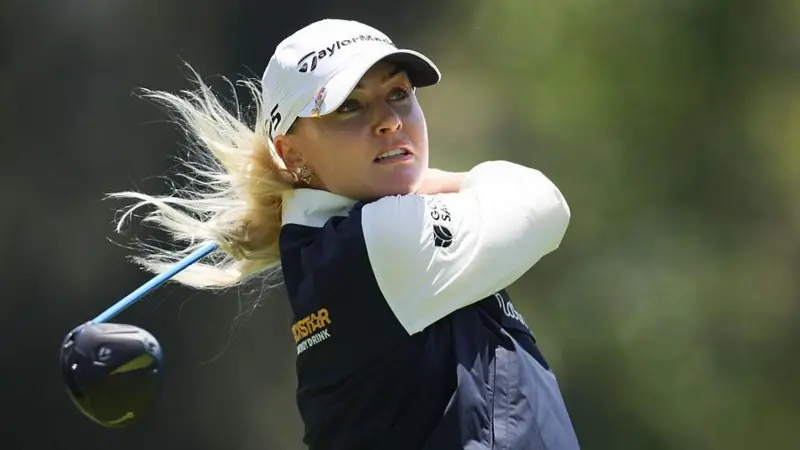
Playing with an aggressive, all-out attacking mindset is not typically considered the ideal strategy for success at the US Open. However, at Riviera Country Club, Charley Hull came incredibly close to proving otherwise. The English golfer delivered a thrilling performance that nearly earned her a long-awaited major championship victory, only to be narrowly denied by the exceptional form of the world number one, Nelly Korda.
Hull’s display during the US Women’s Open in California was nothing short of electrifying. Over the weekend, she produced a stunning charge that equaled the tournament’s best-ever 36-hole score, finishing just one shot behind Korda. It was yet another example of Hull’s tendency to start slowly in major tournaments before mounting an impressive late surge.
This pattern has followed Hull throughout her career. She has often found herself playing catch-up in the early rounds, only to unleash her full potential when it matters most. A similar scenario unfolded three years earlier at Pebble Beach, where she finished as joint runner-up behind Allisen Corpuz. Back then, Hull adopted the bold mantra, “shy girls don’t get sweets,” embracing a fearless approach that saw her finish three shots off the lead.
At Riviera, her mindset remained equally aggressive, although she described it in more straightforward terms. Her approach was simple: attack whenever possible and play without hesitation. This strategy was evident in her remarkable third-round score of 65, the lowest round recorded during the tournament. She followed it up with an equally impressive final-round 67, which began with an eagle and a birdie within the opening three holes, immediately putting pressure on the leaderboard.
Hull explained that her approach evolves as the tournament progresses. During the first two rounds, she tends to play more conservatively, focusing on staying composed and avoiding unnecessary risks. However, once she reaches the latter stages and has little to lose, she allows herself the freedom to play aggressively. According to Hull, this style not only suits her natural instincts but also makes the game more enjoyable.
Her weekend total of 132 matched a long-standing championship record set by Meg Mallon in 2004. A significant factor behind her success was her improved performance on the greens. In the opening rounds, Hull struggled with her putting, recording 63 putts across the first two days despite hitting an impressive 13 out of 14 fairways on Friday. However, she made notable adjustments over the weekend, reducing her total by ten putts during the final two rounds.
Despite this improvement, Hull missed several crucial opportunities during the closing stages of the tournament, including putts on the ninth, twelfth, and fourteenth holes. Nevertheless, her overall performance demonstrated that she possesses the skills and determination needed to secure a major title in the near future.
One of the most telling moments came on the final hole. With the pressure mounting, Hull faced a must-make 10-foot putt to take the clubhouse lead. She executed it with confidence and precision, sinking the putt in a manner that suggested she was ready to claim victory. At that moment, it seemed as though she might finally achieve her breakthrough.
However, Nelly Korda had other plans. The American golfer, who has been in outstanding form, delivered a composed and clinical performance when it mattered most. Her crucial birdie on the par-five 17th hole ensured that she only needed a par on the final hole to secure the title. Even then, the pressure was immense, as her short putt circled the hole before eventually dropping in—a moment she later described as an “ice cream swirl.”
Korda’s victory marked another milestone in what has been an exceptional season. Having already won the Chevron Championship earlier in the year, she now boasts multiple victories and runner-up finishes in 2026, further solidifying her position as one of the dominant figures in women’s golf.
While Hull relied on aggressive play, Korda adopted a more measured and strategic approach. She emphasized the importance of staying focused on one shot at a time, avoiding distractions such as the leaderboard. Her disciplined mindset, combined with her ability to seize opportunities at the right moments, ultimately made the difference.
Korda’s success was also aided by technical adjustments. After a challenging start, during which she struggled with her driving accuracy, she made a subtle grip change on the advice of her sister Jessica. This adjustment helped her regain control and confidence, enabling her to perform at her best throughout the remainder of the tournament.
Another key aspect of Korda’s game was her improved putting. Historically considered a weakness, her performance on the greens during this tournament was exceptional. She gained significant strokes compared to the rest of the field and excelled in scrambling situations, repeatedly saving par under pressure.
The US Women’s Open at Riviera proved to be a demanding test of both skill and mental resilience. The course conditions made it difficult to execute approach shots, as the greens were challenging to hold. Players had to rely on precision and creativity, particularly around the greens. Korda’s ability to maintain composure and execute under pressure ultimately set her apart.
For Hull, the tournament represents both a missed opportunity and a sign of things to come. She has now finished as runner-up in multiple majors and consistently placed among the top contenders. Her performances indicate that she is on the verge of achieving her first major victory.
Hull herself expressed her love for competing in major tournaments, admitting that they bring out the best in her. While she sometimes struggles with motivation during regular events, the heightened stakes and atmosphere of majors inspire her to elevate her game. Even when she starts slowly, she believes she can always mount a significant comeback.
Looking ahead, Hull may benefit from incorporating some of the patience and strategic discipline displayed by Korda. While her aggressive style is undoubtedly effective, balancing it with a more measured approach could help her convert strong performances into victories.
As for Korda, her latest triumph further cements her status as one of the leading figures in the sport. Her ability to handle pressure, adapt to challenges, and deliver consistent results suggests that she is well on her way to achieving even greater success.
In the end, this US Women’s Open will be remembered as a captivating contest that showcased the contrasting styles of two exceptional players. While Hull’s fearless approach nearly secured her a breakthrough, it was Korda’s composure and precision that ultimately prevailed.
For more sports news and updates, visit: https://netsports247.com