
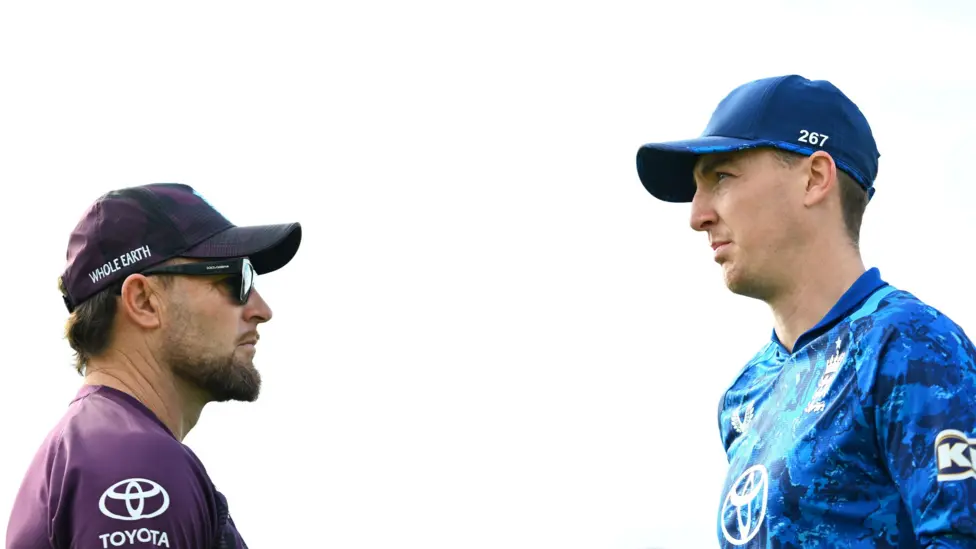
On the eve of an England one-day international in Sri Lanka, Harry Brook found himself answering questions not just about the upcoming match, but about events that took place before England’s previous ODI on the other side of the world.
The incident in question occurred in Wellington during England’s white-ball tour of New Zealand, when Brook was involved in a late-night altercation outside a nightclub and was struck by a bouncer. Though geographically distant, the repercussions of that night followed Brook nearly 7,000 miles to Colombo, resurfacing publicly at a time when English cricket was already under intense scrutiny.
Between the tours of New Zealand and Sri Lanka, England endured one of the most chaotic Ashes series in recent memory. The campaign was defined by dropped catches, poor shot selection, inconsistent bowling and a sense of disorder that left fans and pundits questioning the direction of the national side. In that context, Brook’s off-field incident became symbolic of a wider lack of discipline and focus.
Although the Wellington episode took place before England arrived in Australia, it came to represent the broader shortcomings of the Ashes campaign. The fact that the story only became public through a newspaper report at the end of the fifth Test raised further questions. Had the incident not been revealed, it is unlikely Brook would have been addressing the media in Sri Lanka about his behaviour weeks earlier.
There is an argument that Brook being asked to explain himself is entirely fair. As England’s white-ball captain and Test vice-captain, he holds a leadership role and accountability comes with that responsibility. Previous England captains have been forced to deal with far more serious controversies than the fallout from a night out.
However, what has been equally striking is the silence from the upper levels of English cricket. While Brook has been left to face the media alone, senior figures within the England and Wales Cricket Board (ECB) have remained largely absent from public discussion.
ECB chief executive Richard Gould released a statement announcing a review into the Ashes performance just an hour before the Brook story became public. Earlier the same day, head coach Brendon McCullum played down concerns, stating that players were allowed “a couple of beers now and again”.
Director of cricket Rob Key last addressed the media before the Boxing Day Test in Melbourne. At that point, he acknowledged that Brook and Jacob Bethell had been warned over a separate incident on the same night in Wellington, when they were filmed drinking by a member of the public. Beyond that, there was little transparency.
The apparent attempt to keep the nightclub incident out of the public eye has reflected poorly on all involved. While the ECB may point to confidentiality rules and employment processes as justification, the lack of openness has only fuelled further questions.
Several key issues remain unresolved. Why was Brook alone attempting to enter a nightclub on the eve of an international match? Why did he wait until partway through the following day’s game before informing England’s management? And why, with full knowledge of the incident, were players later given considerable freedom during the Ashes tour, including a heavily publicised social trip to Noosa?
Another major question concerns the timing of England’s response. A midnight curfew has now been imposed during the Sri Lanka tour, yet England were aware of the Brook incident more than two months earlier. Is this new restriction a genuine attempt to enforce discipline, or simply a reaction to the issue becoming public?
Viewed in isolation, Brook’s behaviour is unlikely to directly affect the futures of senior decision-makers such as Rob Key or Brendon McCullum. Both Richard Gould and ECB chair Richard Thompson were aware of the incident while the Ashes collapse was unfolding, and the prevailing belief at the time was that Key and McCullum would be allowed to continue if meaningful changes were made.
Those changes are now beginning to emerge. The curfew in Sri Lanka is one. The short-term return of Carl Hopkinson as a fielding coach for the T20 leg of the tour and the upcoming World Cup is another. Hopkinson had left the England set-up at the end of 2024, coinciding with McCullum taking charge of England’s white-ball teams alongside the Test side.
The reappointment of Troy Cooley as national pace-bowling lead has also been in the pipeline for some time. While Cooley will not work exclusively with the senior team, his return adds another layer of specialist support. There may yet be further adjustments, including the possibility of a dedicated pace-bowling coach for the men’s first team.
Attention may also turn to McCullum’s close allies within the coaching group. Assistant coaches Jeetan Patel and Marcus Trescothick could come under scrutiny, while selection policies may shift back towards stronger emphasis on county cricket performances.
Ultimately, how open McCullum is to these structural and cultural changes will shape his long-term future. The New Zealander is contracted until the end of the 2027 World Cup, and following the final Ashes Test in Sydney he made it clear he wanted to continue—albeit with conditions.
“I’m open to evolution and some nipping and tucking,” McCullum said at the time, “but without being able to steer the ship, maybe there is someone better.”
The coming months will determine whether those adjustments satisfy both the ECB and the wider cricketing public, or whether the Brook incident becomes a symbol of deeper issues within England’s set-up.
👉 Read more at: https://netsports247.com