
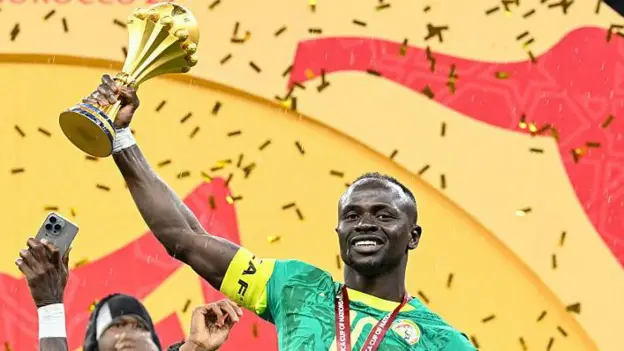
Sadio Mane once again played a decisive role for Senegal, but this time his influence went far beyond scoring goals or creating chances. The former Liverpool and Bayern Munich star emerged as the defining figure in a dramatic and controversial Africa Cup of Nations (Afcon) final, leading his country to a second continental title in extraordinary circumstances against host nation Morocco.
Senegal lifted the Afcon trophy on Sunday after a tense final that will be remembered as much for its chaos as for its football. While Mane’s name will forever be linked with Senegal’s golden era, his heroics in this final came not from his boots, but from his leadership, composure, and deep respect for the game.
The match was locked at 0-0 deep into stoppage time when controversy erupted. In the 98th minute, Morocco were awarded a penalty after Senegal defender El Hadji Malick Diouf fouled Brahim Diaz inside the box. The decision sparked immediate outrage among the Senegalese camp. Emotions boiled over, and head coach Pape Thiaw attempted to lead his players off the pitch in protest, believing the call to be unjust.
As Senegal’s players retreated to the dressing room, the game appeared to be on the brink of abandonment. With tensions rising and the stadium in uproar, the final seemed destined to descend into complete disorder. At that critical moment, Sadio Mane stepped in.
Images soon emerged of Mane entering the dressing room and personally convincing his team-mates to return to the pitch. Assisted by experienced goalkeeper Edouard Mendy, Mane urged calm, reminding his colleagues of the importance of finishing the match and respecting the spirit of football. His intervention proved pivotal, preventing a potential disaster that could have overshadowed the entire tournament.
After a lengthy delay of approximately 16 minutes, play finally resumed. Brahim Diaz stepped up to take the penalty for Morocco, attempting an audacious Panenka effort. However, the moment backfired disastrously. Mendy read the kick perfectly and caught the ball with ease, sending shockwaves through the Moroccan supporters and providing a huge psychological boost for Senegal.
With the score still level at 0-0, the match moved into extra time. The drama was far from over. Senegal maintained their composure and focus, gradually asserting control as fatigue set in. The decisive moment arrived when Pape Gueye unleashed a powerful strike that found the back of the net, sealing a dramatic victory and crowning Senegal champions of Africa once again.
As the final whistle blew, emotions poured out across the pitch. For Senegal, it was a moment of triumph and vindication after surviving chaos and controversy. For Mane, it was a fitting chapter in an extraordinary international career. Having previously stated that this tournament would be his last Afcon appearance, the 32-year-old exited the stage not just as a champion, but as a true leader.
Before the trophy presentation, Mane was handed the captain’s armband by his team-mates — a symbolic gesture that underlined the respect and admiration he commands within the squad. It was a powerful acknowledgment of the role he played in guiding Senegal through one of the most turbulent moments in their footballing history.
Speaking after the match, Mane reflected on the incident with maturity and wisdom. He emphasized that football must always come first, regardless of controversial decisions or emotional reactions.
“Football is something special,” Mane said. “The whole world was watching. People love football, and football is meant to be a pleasure. We must always show a good image of the game.”
He went on to explain why he felt it was essential for Senegal to return to the pitch despite their frustration. “It would be crazy not to play because of a penalty decision. Walking off would be the worst thing, especially for African football. I would rather lose a match than see something like that damage our game.”
Mane also expressed disappointment over the lengthy delay but praised his team for refocusing and finishing the match. “Football should not stop for ten minutes or more, but we had to accept what happened. The most important thing is that we came back, played the game, and the outcome was decided on the pitch.”
Former Nigeria international Daniel Amokachi, speaking on BBC World Service, was full of praise for Mane’s actions. He highlighted how the forward’s leadership had a direct impact on the final result.
“Mane went the extra mile to bring his team back, and it paid off,” Amokachi said. “He is a true ambassador for football. We all know the kind of person he is away from the pitch, and moments like this show that he understands the responsibility that comes with being a role model.”
Former Morocco international Hassan Kachloul echoed similar sentiments, stating that African and world football were at risk of embarrassment until Mane intervened. He singled out Mane as the only Senegal player willing to take responsibility at such a critical moment.
“What impressed me the most was Sadio Mane,” Kachloul said in an interview with E4. “He went into the dressing room and personally brought the players back. That shows what a great man he is. He saved the game.”
The final will go down as one of the most dramatic in Afcon history, not only because of the footballing moments, but because of the leadership displayed when it mattered most. Mane’s actions ensured that the title was decided by skill and determination rather than protest and controversy.
As Senegal celebrate their latest triumph, Mane’s legacy is further cemented. He leaves the Africa Cup of Nations not only as a two-time champion, but as a symbol of integrity, responsibility, and respect for the beautiful game.
For more African football news, exclusive stories, and match analysis, visit
👉 https://netsports247.com