
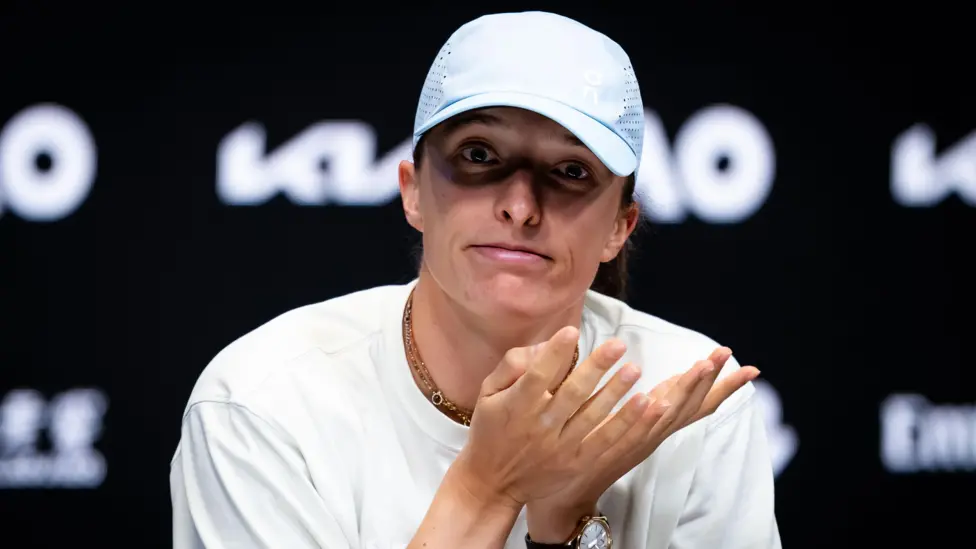
Six-time Grand Slam champion Iga Swiatek has raised serious concerns over player privacy at the Australian Open, claiming that behind-the-scenes camera coverage makes athletes feel like they are being observed “as if they were animals in a zoo.” Her comments add to a growing debate around the extent of broadcast access inside restricted player-only areas at Melbourne Park.
The issue came into sharp focus earlier this week when American star Coco Gauff was shown on television smashing her racquet in a corridor within the players’ area. The footage, captured away from the main courts, quickly circulated online and sparked criticism from Gauff herself, who called for greater privacy for players during emotionally charged moments.
Since 2019, the Australian Open has regularly broadcast footage from inside areas normally closed to the public. These zones include hallways outside locker rooms, warm-up spaces, and gyms beneath Rod Laver Arena. Tournament organisers have argued that the added access gives fans a more immersive experience, but players increasingly feel that the line between coverage and intrusion has been crossed.
Unlike Melbourne, the other three Grand Slam tournaments maintain stricter limits on camera access in player-only sections. At Wimbledon, the French Open, and the US Open, behind-the-scenes footage is far more controlled, with an emphasis on protecting athletes’ private space before and after matches.
Swiatek, who was eliminated in the quarter-finals of this year’s Australian Open, did not hold back when asked about the issue. The world number one expressed frustration at being constantly filmed during moments that should be private, particularly when players are dealing with physical exhaustion, emotional stress, or personal routines.
She questioned whether tennis players are being treated as professionals deserving respect or as spectacles for entertainment, arguing that constant surveillance strips athletes of their dignity. Swiatek suggested that there must be clearer boundaries between what fans see and what should remain off-camera.
American semi-finalist Jessica Pegula echoed Swiatek’s concerns, describing the situation as an “invasion of privacy.” Pegula explained that the feeling of being watched at all times creates unnecessary pressure, especially during a Grand Slam event where emotions already run high.
Pegula added that players often feel as though they are “under a microscope,” unable to escape cameras even when stepping away from the court. She believes the current level of access should be reduced to allow athletes the mental space they need to perform at their best.
Gauff’s incident highlighted how vulnerable players can be in these private zones. While on-court behaviour is expected to be visible and scrutinised, many players feel that moments in locker-room corridors or training areas should not be broadcast to millions of viewers.
The 19-year-old American later expressed disappointment that such footage was aired, emphasizing that players are human beings who experience frustration, disappointment, and stress. She argued that these moments are often taken out of context and can unfairly shape public perception.
Supporters of expanded camera access argue that modern sports audiences crave authenticity and behind-the-scenes insight. However, critics say that this demand should not come at the cost of athletes’ mental health or personal boundaries.
The debate also raises broader questions about how sports broadcasting is evolving. With more cameras, microphones, and digital platforms than ever before, athletes are increasingly exposed beyond the field of play. While this visibility can boost fan engagement, it also risks turning players into constant content rather than competitors.
Several former players have previously spoken about the mental toll of nonstop scrutiny, particularly during major tournaments. The Australian Open’s approach, while innovative, appears to be testing the limits of what current players are comfortable with.
Tournament organisers have yet to respond directly to the latest criticism, but pressure is mounting for a review of filming policies. Players are not calling for a complete ban on behind-the-scenes coverage, but rather clearer rules that protect sensitive areas and emotionally vulnerable moments.
As the sport continues to balance entertainment with athlete welfare, the voices of leading figures like Swiatek, Gauff, and Pegula may prove influential. Their comments reflect a growing desire among players to reclaim some measure of privacy in an era of constant exposure.
With player wellbeing becoming an increasingly important topic in professional tennis, the Australian Open may now face tough questions about whether its current broadcast model truly serves the best interests of the athletes.
For more tennis news, Grand Slam updates, and in-depth sports coverage, visit https://netsports247.com