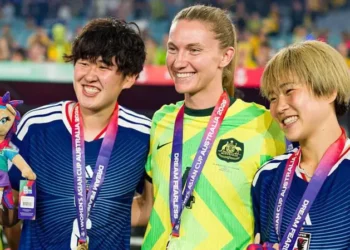

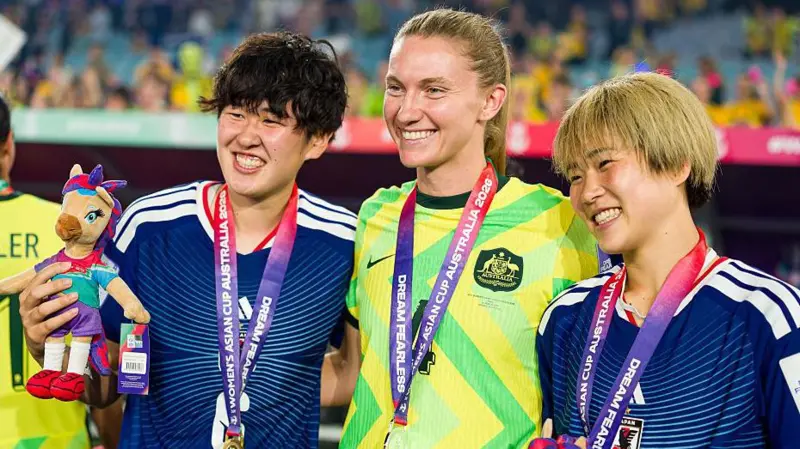
Australia women’s national team and Japan women’s national team have publicly criticized tournament organizers for failing to address concerns over unequal prize money in the Women’s Asian Cup. Despite the tournament’s success both on and off the pitch, the finalists claim their pre-competition efforts to push for fairness were overlooked.
The issue centers on a significant financial gap between the men’s and women’s versions of the competition. Reports indicate that the prize fund for the women’s tournament stood at approximately $1.8 million, while the men’s equivalent offered a substantially larger pool of $14.8 million.
Historic Final Overshadowed by Inequality Concerns
The final match between Australia and Japan delivered a memorable spectacle, with Japan securing a narrow 1-0 victory in Sydney. The match drew a record-breaking crowd of 74,397 spectators, marking the highest attendance in the tournament’s history.
While the event showcased the growing popularity and competitiveness of women’s football in Asia, the celebrations were tempered by ongoing concerns about financial disparity. Both teams acknowledged the tournament’s success but emphasized that progress must extend beyond attendance and visibility.
Joint Statement Highlights Frustration
In a unified stance, Australia and Japan released a joint statement through FIFPRO, expressing disappointment at the lack of response from the Asian Football Confederation.
The teams revealed that they had approached the AFC before the tournament with proposals aimed at improving conditions for players. These included calls for equal prize money, a guaranteed share of revenue for all participants, and collaborative efforts to create a lasting legacy for women’s football in the region.
However, according to the statement, these proposals were not addressed, leaving players feeling that their concerns had been ignored.
The Impact of Prize Money Disparity
The financial gap between men’s and women’s tournaments has long been a point of contention in global football. In this case, the disparity is particularly striking, with the men’s prize pool more than eight times larger than that of the women’s competition.
Australia and Japan emphasized that achieving equal prize money would have far-reaching benefits. Not only would it provide immediate financial support to players, but it would also contribute to the long-term development of football across Asia.
They argued that increased investment in the women’s game could help raise standards, improve infrastructure, and create more opportunities for future generations of players.
A Tournament of Growth and Challenges
Despite the controversy, the Women’s Asian Cup demonstrated significant growth in popularity. According to a report released by FIFPRO, the tournament attracted around 350,000 fans over three weeks and had the potential to generate up to $82.4 million in revenue.
These figures highlight the commercial viability of women’s football and strengthen the argument for more equitable distribution of resources.
However, the tournament was not without its challenges. Several issues emerged that underscored the need for systemic improvements within the sport.
Players Face Difficult Conditions
The joint statement from Australia and Japan pointed to a range of difficulties faced by players during the competition. These included logistical issues, disputes between players and national federations, and broader social challenges.
For instance, members of the Indian team reportedly had to compete in ill-fitting kits, raising concerns about basic standards and professionalism. Meanwhile, players from South Korea were dealing with ongoing conflicts with their football authorities.
These incidents reflect the uneven conditions experienced by teams across the region, highlighting the need for greater consistency and support.
Iranian Players’ Courage Draws Global Attention
One of the most widely discussed stories of the tournament involved the Iran women’s national team. Seven members of the squad sought asylum in Australia after facing backlash at home for refusing to sing the national anthem.
Their actions were seen as a powerful statement of personal conviction and courage, drawing international attention to issues beyond the sport itself.
Australia and Japan praised the Iranian players in their statement, describing their actions as a reminder of the importance of standing up for dignity and belief. The situation added a deeper layer of significance to the tournament, illustrating how football can intersect with broader social and political issues.
Call for Collaboration and Reform
In their statement, the finalists stressed that addressing these challenges requires cooperation between players, governing bodies, and other stakeholders. They urged the AFC to engage in meaningful dialogue and work collaboratively to improve conditions.
The players believe that partnership is essential to achieving lasting change. By involving athletes in decision-making processes, organizers can better understand their needs and develop more effective solutions.
This collaborative approach could help ensure that future tournaments are not only successful in terms of attendance and revenue but also fair and inclusive for all participants.
Looking Toward the Future
The Women’s Asian Cup has highlighted both the progress and the challenges facing women’s football in Asia. While record crowds and strong revenue potential demonstrate growing interest, issues such as prize money inequality and player welfare remain unresolved.
Australia and Japan’s stance reflects a broader movement within the sport, as players around the world continue to advocate for equal treatment and opportunities.
Their call for change is not just about financial rewards but also about respect, recognition, and the long-term sustainability of the game.
Conclusion
The Women’s Asian Cup final between Australia and Japan will be remembered for its historic attendance and competitive spirit. However, it has also brought attention to the ongoing issue of inequality in football.
By speaking out, the players have highlighted the need for reform and set the stage for future discussions. Whether these calls lead to meaningful change remains to be seen, but the message is clear: equality is essential for the growth of the sport.
For more football updates and latest sports news, visit: https://netsports247.com