
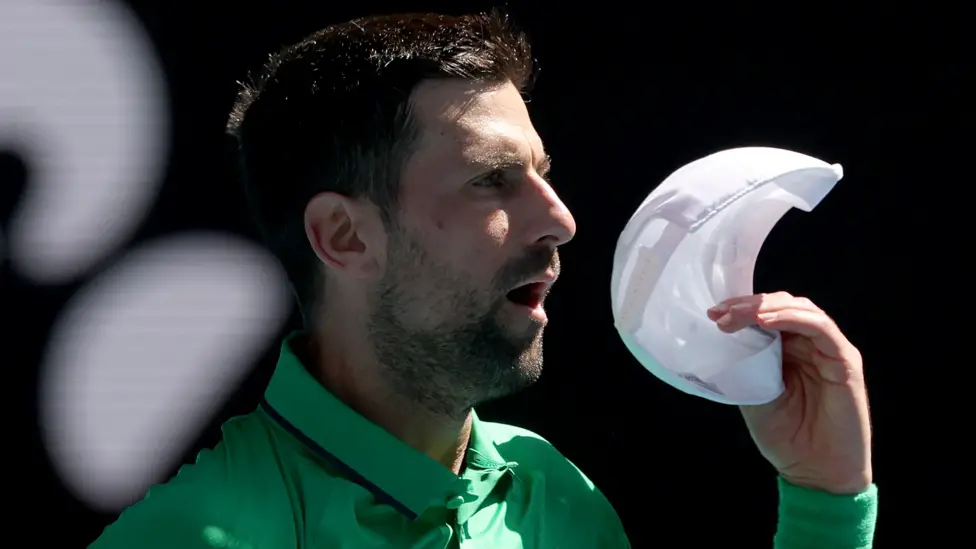
Novak Djokovic is well aware that if he is to achieve an unprecedented milestone at the Australian Open, careful energy management will be just as important as his on-court brilliance.
The Serbian legend is chasing a historic 25th Grand Slam singles title, a triumph that would move him one clear of Margaret Court and make him the most successful singles player in tennis history. At 38 years old, Djokovic understands better than anyone that longevity at the elite level requires not only skill, but smart physical preservation.
Over the past year, Djokovic’s Grand Slam campaigns have been disrupted by physical issues, particularly in the latter stages of tournaments. He was forced to retire early from the Australian Open semi-final last year due to a leg injury, while physical problems also affected him at Wimbledon, where a hip issue limited his movement, and at the US Open, where fatigue took its toll.
Those experiences have reinforced Djokovic’s belief that conserving energy during the early rounds of major tournaments is essential. Spending less time on court early allows him to preserve his body for the demanding matches that come later, when the margins are finest and the stakes are highest.
So far in Melbourne, Djokovic’s plan has been executed to perfection.
After easing through his opening match against Spain’s Pedro Martinez without dropping a set, Djokovic delivered another dominant performance in the second round, defeating Italian qualifier Francesco Maestrelli 6-3, 6-2, 6-2 on a warm afternoon at Melbourne Park. Across the two matches, Djokovic has conceded just 14 games, marking the first time since 2023 that he has won his first two Australian Open matches in straight sets.
Against Maestrelli, ranked 141 in the world, Djokovic was clinical from start to finish. He controlled rallies with depth and precision, neutralised his opponent’s power, and rarely looked troubled. Despite not serving quite as explosively as he did in the first round, Djokovic still won an impressive 86% of points behind his first serve.
He also showed his trademark composure under pressure, saving four of the five break points he faced. While Maestrelli attempted to impose himself with a strong serve and aggressive baseline play, Djokovic’s experience and tactical intelligence proved decisive.
Speaking after the match, Djokovic admitted he was unfamiliar with his opponent until recently, highlighting how quickly the modern game introduces new challengers.
“I didn’t know much about him until a few days ago,” Djokovic said. “That happens more often than not these days. But the respect is always there. I didn’t underestimate him.”
Djokovic praised Maestrelli’s potential, noting that the Italian possesses a powerful serve and an attacking game, but still lacks the experience required to trouble the very best consistently.
“He’s got the game to go far and climb high in the rankings,” Djokovic added. “I wish him the best for the future.”
The victory also extended one of Djokovic’s most remarkable records. He has never lost a Grand Slam match to a qualifier or a lucky loser, improving his flawless record to 37-0. That statistic stands as the best of any male player in the Open era and underlines his consistency against lower-ranked opponents on the biggest stages.
Djokovic’s next match carries further historical significance. If he defeats Botic van de Zandschulp in the third round, he will record his 400th Grand Slam singles victory—an achievement no other player has ever reached. Such a milestone would serve as yet another testament to his dominance, resilience, and longevity.
Looking ahead in the draw, Djokovic is well-positioned but still faces significant challenges. He cannot meet world number one Carlos Alcaraz until the final, but a potential semi-final clash with two-time defending champion and second seed Jannik Sinner looms large. Sinner has emerged as one of Djokovic’s most formidable rivals, particularly on hard courts, making that possible encounter one of the tournament’s most anticipated storylines.
For now, Djokovic’s focus remains firmly on the present. Each efficient victory not only moves him closer to history but also preserves the physical reserves he knows will be vital in the later rounds.
With his body responding well, his confidence growing, and his experience guiding every decision, Djokovic has laid the foundations for another deep run in Melbourne. Whether it ultimately ends with a record-breaking 25th Grand Slam title remains to be seen, but his early performances suggest he is managing the challenge with the precision of a champion who understands exactly what it takes to win.
👉 More tennis news and updates: https://netsports247.com