

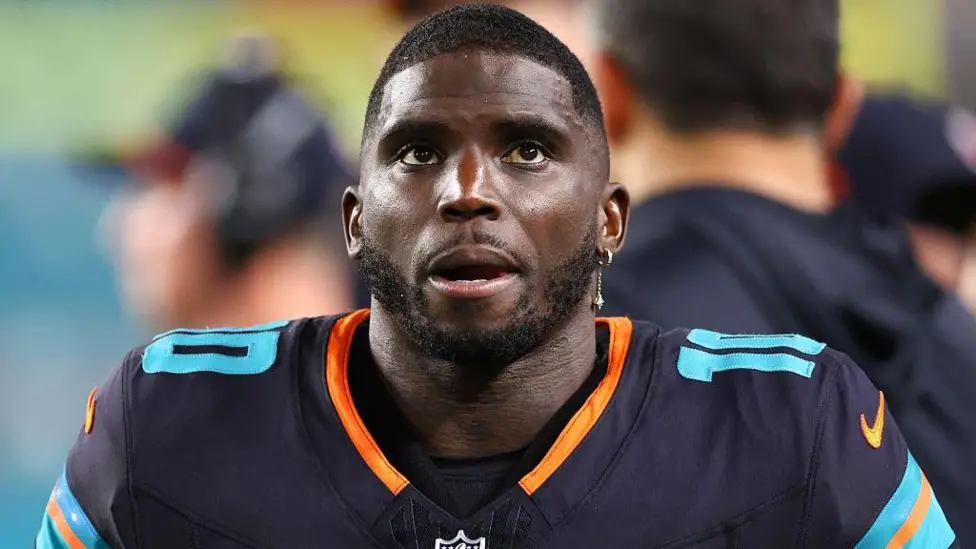
The Miami Dolphins have officially parted ways with star wide receiver Tyreek Hill, releasing the veteran with immediate effect in a move that signals a significant shift for the franchise. The 31-year-old, widely regarded as one of the fastest and most electrifying players in the NFL, departs the team while still recovering from a major knee injury that has sidelined him for months.
According to the Dolphins, Hill’s release was designated as a “failed physical,” indicating that medical evaluations determined he was not ready to return to competitive action. The announcement came alongside additional roster cuts, including offensive lineman James Daniels and wide receiver Nick Westbrook-Ikhine, as the organization continues to reshape its squad ahead of the upcoming season.
Nicknamed “the Cheetah” for his blistering pace, Hill has built a reputation as one of the league’s most dynamic offensive weapons. Since entering the NFL as a fifth-round draft pick in 2016, he has consistently been a nightmare for opposing defenses. Drafted by the Kansas City Chiefs, Hill quickly established himself as a game-changing playmaker thanks to his elite speed, agility, and ability to stretch the field vertically.
During his tenure with Kansas City, Hill became a cornerstone of the Chiefs’ high-powered offense. His partnership with quarterback Patrick Mahomes was particularly lethal, helping propel the team to multiple playoff appearances and a Super Bowl victory in the 2019 season, culminating in a championship win in early 2020. Hill’s ability to turn short passes into explosive gains and outrun entire secondaries made him one of the league’s premier wide receivers.
However, in 2022, the Chiefs made the difficult decision to trade Hill to the Miami Dolphins. The move was largely driven by salary cap considerations, as Kansas City sought financial flexibility to maintain roster balance. Miami capitalized on the opportunity, acquiring Hill to provide a major boost to their offense and to accelerate their competitive ambitions in the AFC.
Hill’s impact in Miami was immediate. He became the focal point of the Dolphins’ passing attack, delivering impressive production and consistently ranking among the league leaders in receiving yards. Since arriving in South Florida, he has placed sixth in the NFL for total receiving yards, underscoring his sustained excellence despite changing teams and systems.
For much of his time with the Dolphins, Hill was remarkably durable. Over his first two seasons in Miami, he missed only one game, demonstrating resilience and consistency. His speed remained intact, and his chemistry with quarterback Tua Tagovailoa was a key element of the team’s offensive identity.
That run of durability ended abruptly last September when Hill suffered a devastating knee injury. The injury included a dislocated knee and multiple torn ligaments, among them the anterior cruciate ligament (ACL), one of the most serious injuries an athlete can endure. The severity of the damage required extensive medical intervention and rehabilitation, casting doubt over his immediate future in the league.
While Hill worked toward recovery, the Dolphins endured a challenging season. The team finished with its second consecutive losing record under head coach Mike McDaniel. Despite flashes of offensive promise, inconsistency and injuries plagued the campaign. Ultimately, the organization decided to move in a different direction, replacing McDaniel with Jeff Hafley as part of a broader reset.
Hafley now faces the task of rebuilding and retooling the Dolphins’ roster. The decision to release Hill, along with other veteran players, reflects a commitment to restructuring both financially and strategically. Moving on from a player of Hill’s stature is never easy, but concerns over his health and long-term availability likely influenced the team’s calculus.
In addition to Hill’s departure, quarterback Tua Tagovailoa has also been linked with a potential move away from Miami. Despite periods of strong play, Tagovailoa has struggled to cement himself as the franchise quarterback the Dolphins envisioned when they selected him in the first round of the 2020 NFL Draft. Questions about consistency and durability have fueled speculation that the team could explore alternative options under center.
For Hill, the immediate future remains uncertain. At 31 and coming off a serious knee injury, he faces a challenging road back to peak condition. Nevertheless, his track record of elite performance may attract interest from teams willing to take a calculated risk on his recovery. Few players in NFL history possess his combination of acceleration and big-play capability.
Should he regain full fitness, Hill could still provide significant value as a veteran presence and deep threat. His experience in high-pressure playoff environments and his history of Pro Bowl selections—eight in his first 10 seasons—underscore the caliber of player he has been throughout his career.
The Dolphins, meanwhile, enter a transitional phase. Releasing one of the league’s most recognizable stars marks the end of a chapter defined by explosive offense and high expectations. As Hafley begins shaping the roster in his image, Miami’s focus appears to be on long-term sustainability and roster balance rather than relying heavily on marquee names.
Hill’s journey from Kansas City standout to Miami centerpiece and now free agent reflects the ever-evolving nature of the NFL. Performance, health, and financial considerations intersect in complex ways, and even the most accomplished players are not immune to difficult business decisions.
While his tenure in Miami concludes under challenging circumstances, Hill’s legacy as one of the most electrifying wide receivers of his era remains intact. Whether he finds a new home in the league or faces a prolonged recovery, his impact on the modern passing game is undeniable.
For more NFL updates and breaking sports news, visit https://netsports247.com