
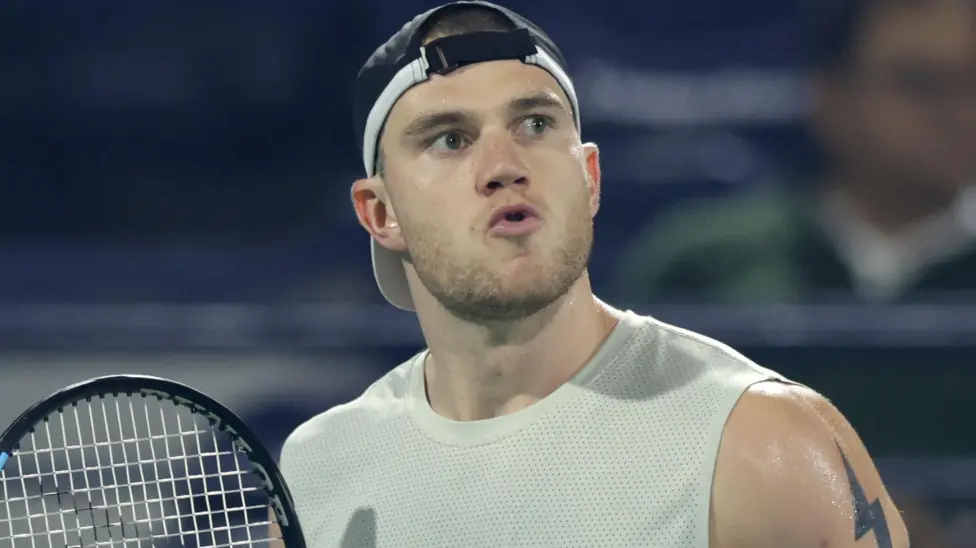
British tennis star Jack Draper expressed deep pride and satisfaction after making a successful return to ATP Tour action following a lengthy injury layoff, securing a straight-sets victory over France’s Quentin Halys at the Dubai Tennis Championships. The win marked a significant milestone for the 24-year-old, who had been sidelined for months due to a troublesome arm injury that forced him out of competition and disrupted what had previously been a promising season.
Draper, currently ranked world number 15 after once reaching a career-best position of fourth in June, had not played a tour-level singles match since the US Open last August. His comeback in Dubai was therefore not just another match, but a long-awaited moment of redemption and resilience. Competing in the prestigious tournament for the first time, Draper demonstrated composure and determination, edging a tense first-set tie-break 7-6 (10-8) before comfortably taking the second set 6-3.
Speaking after the match, Draper admitted he had been longing for the thrill of competition and the emotional rush that comes with being back on court. He explained that returning to competitive tennis felt natural, almost like rediscovering a part of himself that had been missing during his rehabilitation period. For him, the experience was more than just a victory; it was proof that the months of recovery, hard work, and patience were finally paying off.
The British number one highlighted the challenges he faced during the last eight months, describing the period as mentally and physically demanding. He acknowledged the support of his team and those around him, crediting them for helping him navigate difficult moments when setbacks threatened to derail his recovery. Draper emphasized that being back in competitive action was something he could genuinely be proud of, especially considering how uncertain his return once seemed.
His match against Halys was also notable because it came after 164 days without a full ATP Tour singles appearance. Although Draper had participated in the Davis Cup qualifiers earlier in February, defeating Norway’s Viktor Durasovic in straight sets, the Dubai clash represented his true return to the regular tour circuit. That gap between appearances underscored the seriousness of the injury that had kept him away from top-level competition for such an extended period.
The injury itself began during the clay-court season, when Draper started experiencing issues related to a bruised bone in his service arm. Initially manageable, the problem gradually worsened over time, ultimately forcing him to withdraw from the US Open before his second-round match. Medical concerns over the risk of a more severe stress fracture made it necessary for him to prioritize recovery over competition, even if it meant missing key tournaments and valuable ranking opportunities.
Determined to ensure a complete recovery, Draper made the difficult decision to skip the Australian Open in January. Instead of rushing back prematurely, he focused on rehabilitation and conditioning, aiming to return only when he felt physically ready to compete at the highest level. His cautious approach reflected a long-term mindset, recognizing that preserving his health was crucial for sustaining a successful career.
In Dubai, Draper entered the tournament as the fourth seed, a testament to his standing in the game despite his absence. The opening set against Halys proved to be highly competitive, with both players holding serve and creating opportunities. At one stage, Draper faced a set point while serving at 5-4 down, but he displayed remarkable mental strength to hold his nerve and force a tie-break. Falling behind 8-7 in the tie-break, he responded brilliantly by winning three consecutive points to clinch the set.
The second set saw Draper raise his level even further. The decisive moment came in the fourth game when Halys, ranked 68th in the world, made an error that handed Draper a crucial break of serve and a 3-1 lead. From that point onward, the Briton remained firmly in control, serving with authority and conceding just two more points on his serve before sealing the match. His dominance was reflected in an impressive 86% success rate on first serve points, highlighting both his physical readiness and tactical sharpness.
One particularly encouraging aspect of Draper’s performance was the effectiveness of his forehand, the very side that had previously been affected by injury. Of his 24 winners during the match, 19 came from that forehand, suggesting that his recovery had restored confidence in his shot-making ability. Although he wore a protective compression sleeve on his arm, he played freely from the baseline and showed little visible discomfort, a positive sign for his future matches.
Looking ahead, Draper is set to face either Hungary’s Fabian Marozsan or France’s Arthur Rinderknech in the next round. While the victory in Dubai marks a strong return, analysts believe that patience will remain essential as he continues to rebuild match fitness and consistency. Injuries have been a recurring theme in Draper’s career, and managing his workload carefully will likely be key to avoiding further setbacks.
Elsewhere, it was a mixed day for British tennis players competing in Mexico. Katie Boulter enjoyed a solid start at the Merida Open, defeating Brazil’s Beatriz Haddad Maia 6-4 6-4 in her first-round match. Her composed performance highlighted her growing confidence on tour and provided a positive boost for British women’s tennis.
However, Cameron Norrie experienced disappointment at the Mexican Open, suffering a surprising 6-3 6-2 defeat to Spain’s Rafael Jodar. As the seventh seed, Norrie was expected to progress further in the tournament, but he struggled to find rhythm against his opponent and was unable to turn the match in his favor.
From a broader perspective, Draper’s return represents a significant moment not only for his personal career but also for British tennis. His earlier achievements, including winning the prestigious Masters 1000 title at Indian Wells and reaching the fourth round of both the Australian Open and French Open, had established him as one of the sport’s rising stars. The injury setback interrupted that momentum, but his performance in Dubai suggests he remains capable of competing at the highest level.
Analysts have noted that Draper’s calm reaction after victory—marked by a restrained celebration and only a brief smile—reflected a player focused more on the journey than the result. The long absence from the tour had clearly tested his resilience, and returning to competition was as much about mental strength as physical recovery.
Medical experts often warn that a bruised humerus can become a serious concern for tennis players due to the repetitive stress placed on the arm during serving and groundstrokes. Draper’s cautious rehabilitation indicates an awareness of these risks and a commitment to long-term health rather than short-term success.
Ultimately, Draper’s comeback victory in Dubai symbolizes perseverance, discipline, and a renewed sense of purpose. While there may still be challenges ahead as he regains full match sharpness, the performance showed that he has the talent and determination to overcome adversity. If he continues to manage his fitness wisely and build confidence match by match, this return could mark the beginning of another strong chapter in his career.
Read more sports updates: https://netsports247.com