

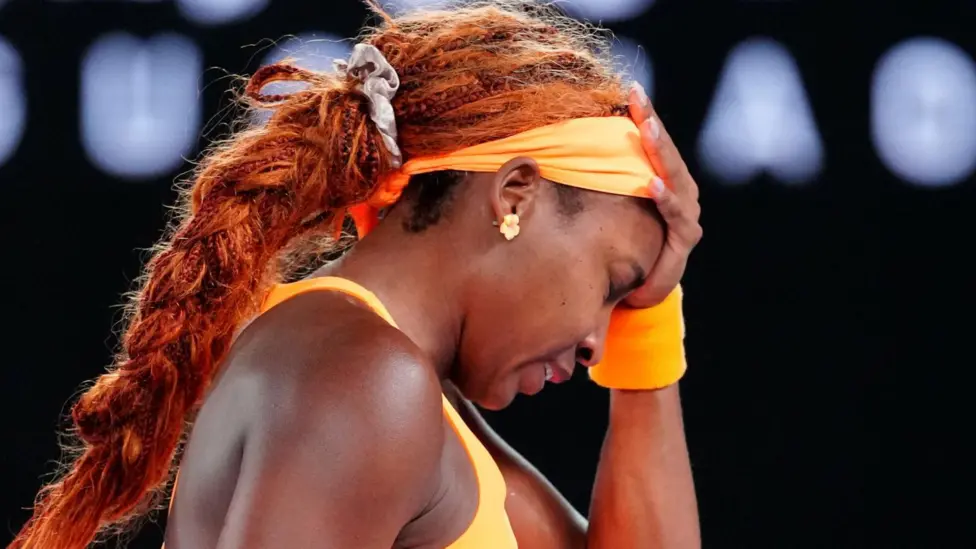
American tennis star Coco Gauff has urged tournament organisers and broadcasters to offer players greater privacy after footage showed her smashing a racquet following a crushing defeat at the Australian Open. The incident occurred after Gauff’s one-sided quarter-final loss to Ukraine’s Elina Svitolina, a match that highlighted both the intensity of elite competition and the emotional toll it can take on players.
Gauff, 21, endured a difficult evening in Melbourne as she was comprehensively beaten 6-1 6-2 in just 59 minutes. The performance was uncharacteristically error-strewn for the world number three, who struggled to find rhythm or momentum throughout the contest. She served five double faults, committed 26 unforced errors, and managed to hit only three winners, statistics that reflected how thoroughly she was outplayed by Svitolina.
Importantly, the racquet-smashing incident did not occur on the court in front of spectators. Instead, it happened in a restricted players’ area away from public view. However, the moment was captured by the tournament’s behind-the-scenes cameras and later broadcast on television and circulated widely on social media platforms. The footage quickly went viral, sparking debate about how much access broadcasters should have to players during emotionally vulnerable moments.
Speaking after the match, Gauff explained that she had made a deliberate effort to hold back her emotions until she believed she was out of sight. The young American said she actively tried to find a space without cameras, only to later discover that the moment had still been recorded and shared.
“I tried to go somewhere where there was no cameras,” Gauff said. “Certain moments don’t need to be broadcast. I feel like some conversations need to happen about that, because at this tournament it feels like the only truly private place we have is the locker room.”
Gauff referenced a similar situation involving Aryna Sabalenka at the 2023 US Open, when the Belarusian was filmed smashing her racquet after losing the final to Gauff herself. That footage was also widely shared, prompting discussions at the time about whether players’ off-court emotional reactions should be part of television coverage.
The American believes these behind-the-scenes moments cross a line, especially when players are processing defeat away from the spotlight. While she acknowledged that on-court reactions are part of professional sport, she argued that players should be allowed space to decompress once they step off the court.
Gauff’s comments have reignited an ongoing conversation about player welfare in modern tennis, where access, content, and storytelling are increasingly prioritised for fan engagement. While behind-the-scenes footage offers fans a deeper look into the sport, critics argue it can come at the cost of athletes’ mental well-being.
The Australian Open, like other Grand Slam tournaments, has expanded its media coverage in recent years, offering exclusive access to player lounges, tunnels, and training areas. While this content is popular with audiences, Gauff’s experience highlights the potential downside of such exposure.
From a sporting perspective, the defeat marked a disappointing end to Gauff’s Australian Open campaign. Entering the tournament as one of the favourites, she had been hoping to add a second Grand Slam title to her resume after winning the US Open in 2023. Instead, she was unable to cope with Svitolina’s aggressive baseline play, defensive solidity, and tactical discipline.
Svitolina, who has shown impressive form throughout the tournament, capitalised on Gauff’s errors and dictated play from the outset. The Ukrainian broke serve early and never relinquished control, closing out the match with ruthless efficiency.
The victory sends Svitolina into the semi-finals, where she will face world number one Aryna Sabalenka. Sabalenka booked her place in the last four with a dominant straight-sets win over American teenager Iva Jovic, defeating the rising star 6-3 6-0. Sabalenka has yet to drop a set in the tournament and is widely considered the favourite to lift the trophy.
Despite the painful loss, Gauff remained composed in her post-match reflections, choosing to focus on the broader issue of player privacy rather than dwelling solely on her performance. Her willingness to speak out has been praised by some fans and fellow professionals, who see her comments as a necessary step toward protecting players’ emotional space.
As tennis continues to evolve in the digital age, balancing fan access with respect for players’ mental health is becoming an increasingly important challenge. Gauff’s call for change adds a powerful voice to that discussion, especially coming from one of the sport’s most recognisable young stars.
More Australian Open news, player reactions, and in-depth tennis coverage are available at https://netsports247.com, your trusted source for global sports updates, match reports, and exclusive insights.