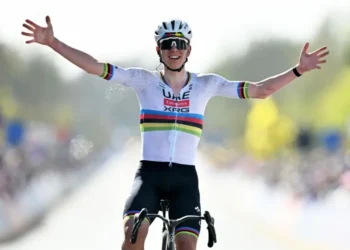

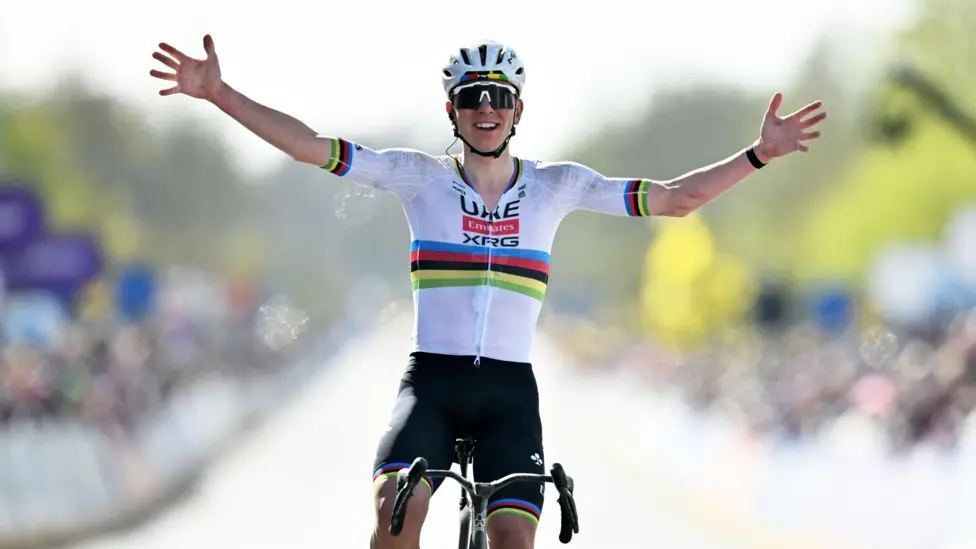
Defending champion Tadej Pogacar delivered another historic performance by claiming a record-equalling third victory at the Tour of Flanders, one of cycling’s most prestigious one-day races. However, despite his remarkable triumph, the Slovenian star’s win has been overshadowed by controversy after he was among a group of riders who allegedly crossed a railway line while the signal was red during the early stages of the race.
The incident occurred in the province of East Flanders with more than 200 kilometers still remaining in the grueling 278km race. According to reports, the peloton had been instructed to stop at a level crossing as warning signals were activated. Despite this, a leading group of riders—including Pogacar and fellow elite competitor Remco Evenepoel—continued forward, crossing the tracks in pursuit of the early breakaway riders.
Authorities have since taken notice of the situation. The East Flanders public prosecutor confirmed that an investigation is underway into the actions of up to 20 cyclists who may have violated safety regulations. Reports in Belgian media suggest that those involved could face penalties ranging from fines of 320 euros to as much as 4,000 euros, along with possible short-term driving bans. Such consequences highlight the seriousness with which authorities treat railway safety violations, even in the context of professional sporting events.
Pogacar later addressed the situation, explaining that the riders had very little time to react. According to him, the warning to stop came too late to safely halt the momentum of a fast-moving peloton. He described a sudden and confusing moment in which race officials appeared in the road, signaling for riders to stop with minimal prior notice.
“Everything happened very quickly,” Pogacar explained in post-race comments. “When you are riding at speed, you cannot just stop instantly. It felt like the signal came too late.” He added that better race organization—such as stopping the riders earlier—might have prevented the incident entirely. Pogacar also admitted that, in the moment, he briefly thought the commotion might have been caused by something unexpected, such as protesters on the course.
Despite the controversy, Pogacar’s performance on the road was nothing short of extraordinary. At just 27 years old, he continues to build a legacy as one of cycling’s all-time greats. His latest victory at the Tour of Flanders marks his third win in the race, equaling the record held by Mathieu van der Poel and several other legends of the sport. Pogacar had previously claimed victory in 2023, further cementing his dominance in the cobbled classics.
This win also adds to an already impressive tally in Monument races—the five most prestigious one-day events in professional road cycling. Pogacar now has 12 Monument victories, placing him second on the all-time list behind only the legendary Eddy Merckx, who holds the record with 19 wins. Such achievements underline Pogacar’s consistency and ability to perform at the highest level across different terrains and race conditions.
Reflecting on the race itself, Pogacar described it as one of the toughest he has experienced. The Tour of Flanders is renowned for its challenging profile, featuring steep climbs and cobbled sections that test both endurance and technical skill. Pogacar admitted that the race was “super hard” from an early stage, emphasizing the relentless nature of the competition.
Interestingly, Pogacar also spoke about the pressure he feels when competing. Unlike some riders who participate in numerous races throughout the season, he tends to be more selective with his appearances. This approach means that expectations are high whenever he lines up at the start, adding an extra layer of pressure to deliver strong results.
“So far this season, everything has gone perfectly,” he said, expressing satisfaction with his form and achievements. Indeed, Pogacar has won all three of his races this season, including his triumph at Milan-San Remo in March. This exceptional run of form positions him as a strong favorite heading into upcoming competitions.
The race itself featured a thrilling battle among some of the sport’s biggest names. With around 57 kilometers remaining, Pogacar, Van der Poel, and Evenepoel broke away from the main group during an acceleration on the Oude Kwaremont, one of the race’s most iconic climbs. The trio quickly established a gap, setting up a dramatic showdown.
However, the race began to shift on the next climb, the Paterberg. Evenepoel was unable to keep pace with the leading duo and gradually fell behind, leaving Pogacar and Van der Poel to battle it out for victory. The two riders rode together for nearly 40 kilometers, showcasing their strength and tactical awareness.
The decisive moment came during the final ascent of the Oude Kwaremont. Pogacar launched a powerful attack that Van der Poel could not match. Cresting the climb with a small advantage, Pogacar extended his lead over the remaining kilometers to secure a convincing win. His Dutch rival was forced to settle for second place, finishing 34 seconds behind.
This victory not only denied Van der Poel a record fourth Tour of Flanders title but also reinforced the growing rivalry between the two cyclists. Together, they have dominated the event in recent years, winning six of the last seven editions.
Looking ahead, Pogacar has the opportunity to achieve an even greater milestone. If he wins Paris-Roubaix next weekend, he will become only the fourth cyclist in history to win all five Monument races. This elite group currently includes Merckx, Rik van Looy, and Roger de Vlaeminck, all of whom are considered legends of the sport.
Pogacar came close to victory at Paris-Roubaix last year, finishing second on his debut. However, he will face stiff competition, particularly from Van der Poel, who has won the last three editions of the race. The upcoming contest promises to be another exciting chapter in their rivalry.
Meanwhile, the women’s race at the Tour of Flanders also produced a standout performance. Demi Vollering claimed victory, securing her third Monument title. The European champion executed a decisive move similar to Pogacar’s, breaking away from her rivals on the Oude Kwaremont.
Vollering built a significant lead and maintained her advantage to cross the finish line comfortably ahead of Pauline Ferrand-Prevot and Puck Pieterse, who finished second and third respectively. Pre-race favorite Lotte Kopecky had to settle for fourth place.
In conclusion, the 2026 Tour of Flanders will be remembered for both its thrilling racing and the controversy surrounding the railway crossing incident. While Pogacar’s victory adds another remarkable chapter to his career, the ongoing investigation serves as a reminder of the importance of safety in professional cycling. As the season continues, all eyes will be on Pogacar as he aims to further cement his legacy in the sport.
For more cycling news, updates, and in-depth sports coverage, visit https://netsports247.com