
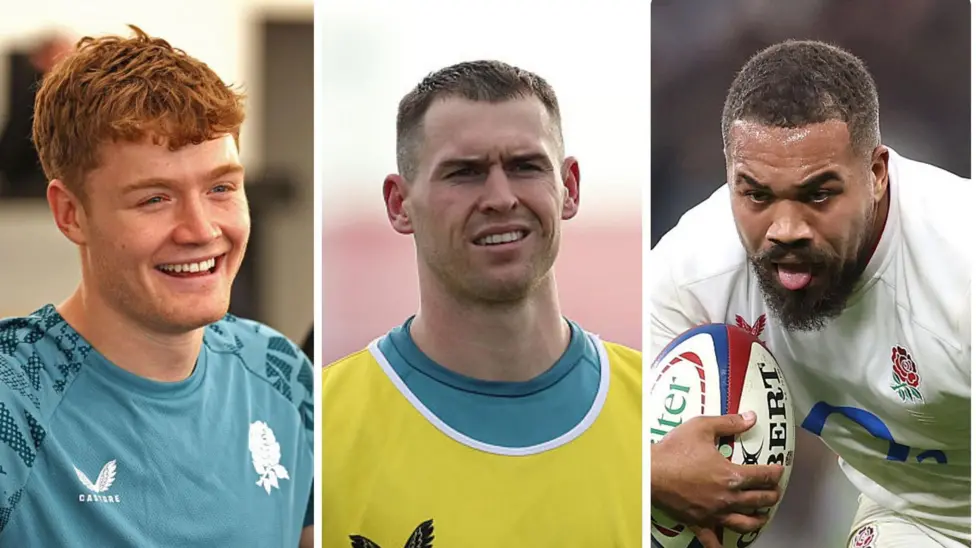
England head coach Steve Borthwick has provided encouraging updates on the fitness of several key players as the national team prepares for next weekend’s Calcutta Cup clash against Scotland at Murrayfield. Although these players will miss this weekend’s Six Nations opener against Wales, all signs point to their availability for the second round, offering England a significant boost in both experience and quality across the backline and midfield.
Among those nearing full recovery are wing Tom Roebuck, fly-half Fin Smith, and centre Ollie Lawrence, each sidelined with separate injuries that have kept them out of competitive action in recent weeks. Roebuck, who has not played since sustaining a broken toe against New Zealand in November, has impressed in training and is reportedly ahead of schedule in his rehabilitation. The 24-year-old has become one of England’s most dynamic wingers since making his international debut in the summer of 2024, known for his pace, agility, and finishing ability.
Borthwick highlighted Roebuck’s progress but noted that he still requires a few more days of preparation before being considered fully ready for Test action. In his absence, Henry Arundell has been selected to start on the wing against Wales, bringing a wealth of international experience with 12 caps already to his name. Arundell’s presence ensures England remain competitive on the flanks while Roebuck completes his final stages of recovery.
Fly-half Fin Smith, who played a pivotal role as England’s starting number 10 during last year’s Six Nations, is now back in full training. Smith had been sidelined due to a calf injury, but his return to fitness provides Borthwick with a major tactical option in the pivotal playmaker role. The England head coach emphasized that having Smith back in contention adds a “fantastic player into our mix,” giving the team more attacking versatility and decision-making quality as they progress through the tournament. Smith’s ability to control the tempo, distribute effectively, and execute accurate kicks from hand will be particularly valuable in high-pressure situations such as the Calcutta Cup clash.
Centre Ollie Lawrence, meanwhile, has been diligently working on his recovery from a knee injury sustained while playing for Bath last month. Borthwick praised Lawrence’s determination and work ethic in rehabilitation, noting that the midfielder is “working exceptionally hard” to return to full fitness and add depth to England’s midfield options. Lawrence’s return is anticipated in the “very, very near future,” meaning he could be available for selection as early as the match against Scotland. His physicality, defensive reliability, and ability to break the gain line make him a crucial asset for England, particularly when facing the physically imposing Scottish midfield.
While these three backs are on track to feature in next weekend’s Calcutta Cup, flanker Ben Curry remains a long-term concern. Curry, who had to withdraw from the squad last month due to a hamstring issue, is unlikely to play in the Six Nations this season. He has been replaced in the squad by Jack Kenningham, who provides cover in the back row. Borthwick stated that Curry would need “everything to go right” for him to feature at the back end of the Championship, highlighting the cautious approach the management is taking with players returning from serious muscle injuries. Curry’s absence is significant given his dynamic ball-carrying ability, defensive work rate, and breakdown skills, which had previously made him a valuable contributor to England’s forward pack.
England’s Six Nations campaign begins this weekend with the opening game against Wales, a traditional and fiercely contested fixture. Following that, the team travels to Scotland to contest the Calcutta Cup, a historic rivalry that dates back over a century. The fixture at Murrayfield promises to be intense, and the potential returns of Roebuck, Smith, and Lawrence will provide England with added firepower and tactical flexibility. After the Scotland encounter, England face Ireland at Twickenham on 21 February. The remainder of the tournament sees England visiting Italy and France, sandwiching these games around a break week designed to provide players with rest and recovery in an otherwise tightly packed schedule.
Hooker Jamie George, who will lead England in the absence of injured counterparts against Wales, spoke about the demanding nature of the tournament. He described the Six Nations as “really challenging but also exciting,” emphasizing that the compressed schedule—with five tough matches, three of which are back-to-back, including three away games—tests not only physical preparation but also mental resilience. George suggested that the intensity of the competition could bring out the best in the team, providing an opportunity to showcase depth, adaptability, and tactical acumen.
The strategic integration of returning players like Roebuck, Smith, and Lawrence will be critical to managing the challenges posed by consecutive high-stakes fixtures. Roebuck’s speed and finishing capability will help stretch opposition defenses, while Smith’s playmaking skills at fly-half can dictate the pace of games and improve England’s attacking efficiency. Lawrence’s presence in midfield offers defensive solidity and the ability to break lines at crucial moments. Together, they are expected to significantly enhance England’s ability to compete in the physically and tactically demanding environment of the Six Nations.
Borthwick and his coaching team have emphasized patience and precision in managing player workloads. Roebuck’s gradual return, Smith’s reintegration into full training, and Lawrence’s methodical rehabilitation all underscore the coaching staff’s commitment to ensuring players are fully prepared to contribute at the highest level, without risking re-injury. The careful monitoring of fitness levels is particularly important in a competition where consecutive international fixtures can quickly test a player’s endurance and resilience.
The absence of Curry and other injured players also highlights the importance of squad depth. England’s management has relied on emerging talents and experienced replacements to maintain performance standards while navigating the physical demands of the tournament. Players like Henry Arundell, Jack Kenningham, and other bench options are expected to play pivotal roles, providing cover in critical positions and ensuring the team maintains its competitive edge across multiple matches.
Looking ahead, the return of Roebuck, Smith, and Lawrence could be a game-changer for England as they aim to challenge for the Six Nations title. Their availability will not only strengthen the starting XV but also provide Borthwick with flexibility in rotation, tactical adjustments, and contingency planning. Each player brings a unique skill set that complements the existing squad, enhancing England’s chances of success in one of rugby’s most fiercely contested tournaments.
In conclusion, England face a mixture of challenges and opportunities as they head into the Six Nations. While injuries and suspensions have forced some difficult selection decisions, the near returns of key players Roebuck, Smith, and Lawrence provide a timely boost ahead of the high-profile Calcutta Cup clash against Scotland. Strategic player management, squad depth, and tactical flexibility will all be critical as England seek to navigate a demanding schedule and pursue victory in one of rugby’s premier competitions.
For more updates, in-depth analysis, and live coverage of the Six Nations, visit netsports247.com