
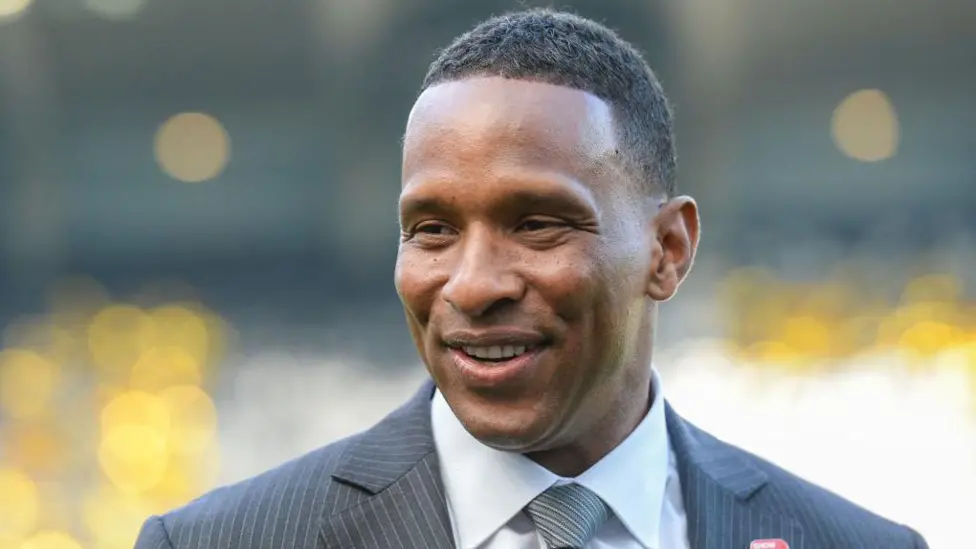
Former Premier League and Trinidad & Tobago goalkeeper Shaka Hislop has raised serious concerns about the way prostate cancer testing is handled in the United Kingdom, describing the current system as “deeply worrying” and outdated. Hislop believes routine screening should be standard practice, rather than something men have to actively request or qualify for based on age or symptoms.
Now 56, Hislop was diagnosed with prostate cancer in 2024 after personally asking for a prostate-specific antigen (PSA) blood test during a routine medical check-up in the United States, where he currently lives. The test ultimately revealed the presence of cancer, allowing him to receive treatment at an early stage.
In contrast, the UK’s National Health Service does not offer PSA tests as part of regular health screenings. Instead, men are usually only tested if they are over 50, show symptoms, or have a known family history of prostate cancer. Hislop believes this approach leaves too many men vulnerable, particularly those who may not realise they are at risk.
According to Prostate Cancer UK, around one in eight men will be diagnosed with prostate cancer at some point in their lives. However, the statistics are even more alarming for black men, where the risk rises to one in four. Hislop argues that these figures alone should justify a more proactive and inclusive screening policy.
Speaking on BBC Radio 5 Live Breakfast, Hislop said he was stunned that prostate cancer testing is still not routinely offered, especially given how common the disease has become.
“I honestly can’t understand why this isn’t already a regular, standardised test,” he said. “We know how prominent prostate cancer is, particularly in minority communities. To still rely on men asking for a test or showing symptoms feels dangerously behind the times.”
Hislop also revealed that he had no family history of prostate cancer, a fact that further reinforces his belief that relying on genetic background alone is insufficient. Despite ticking none of the traditional risk boxes, he was still diagnosed — a situation he believes many other men could unknowingly be in.
Since his diagnosis, Hislop has approached his treatment with the same mindset that defined his football career. Having played professionally for several English clubs, including West Ham United and Newcastle United, he treated cancer as an opponent to be confronted head-on.
“For me, it was a fight,” he explained. “The moment I heard the diagnosis, my only thought was: ‘Right, this is another battle.’ I never felt sorry for myself. I never felt beaten. It was just me and my medical team against cancer.”
However, he admitted the experience was emotionally more challenging for his wife, who has a painful family history with the disease. Her father died of prostate cancer, making the diagnosis especially difficult to process.
“I can’t imagine what she was going through,” Hislop said. “She had already lost someone to this disease, and now she had to be strong for me as well.”
Hislop acknowledges that many men experience an overwhelming emotional shock when first diagnosed. While he processed the news through a competitive and combative lens, he recognises that others struggle deeply with fear and uncertainty in the early stages.
This is not the first time former elite athletes have spoken out about prostate cancer screening in the UK. In 2024, six-time Olympic cycling champion Sir Chris Hoy publicly urged the NHS to lower the age threshold for PSA testing, calling it a “no-brainer.”
Hoy himself was diagnosed at the age of 49 with prostate cancer that had already spread to his bones. Doctors told him he had between two and four years to live — a prognosis that shocked the sporting world and highlighted the potential consequences of late detection.
Despite such high-profile cases, the UK National Screening Committee decided in November 2025 not to recommend mass prostate cancer screening. The committee argued that PSA tests are not always reliable and can lead to over-diagnosis, resulting in unnecessary treatments that may cause life-changing side effects such as incontinence or impotence.
Health Secretary Wes Streeting, speaking to BBC Radio 5 Live, said the government is still evaluating the evidence and has not ruled out future changes.
“There are serious health inequalities here, particularly for black men,” Streeting said. “But we also need to avoid a situation where men are over-treated and suffer permanent consequences from treatment they may not have needed.”
Hislop understands the complexity of the issue but believes education and early testing must be prioritised. He hopes that former athletes speaking openly about their experiences will encourage more men to take ownership of their health.
“Cancer can affect anyone,” Hislop said. “That’s the simple truth. The earlier you catch it, the better your chances — not just of survival, but of continuing to live a full and meaningful life.”
He emphasised that a cancer diagnosis does not automatically mean the end. When detected early, prostate cancer is often highly treatable, allowing patients to live long and active lives.
“If you catch it early enough, it’s not a life sentence,” he added. “I fully expect to live a long life, and that’s because my cancer was caught in time.”
Hislop believes the key lessons are awareness and action: understanding that anyone can be affected, recognising personal risk, and seeking testing sooner rather than later.
This powerful discussion forms part of BBC Radio 5 Live’s ‘You, Me and the Big C’ legacy day, aimed at raising awareness around cancer experiences and education. A new episode of the podcast is now available on BBC Sounds, continuing the conversation around early detection, survival, and life beyond diagnosis.
For more sports news and health-related stories, visit https://netsports247.com