
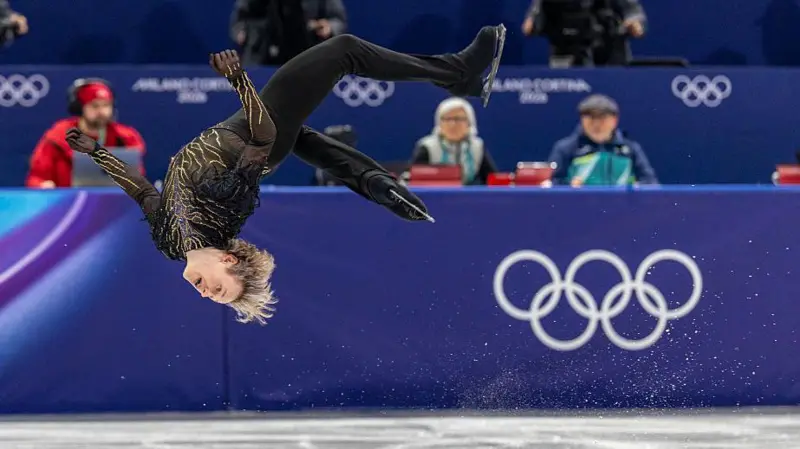
After igniting the Milan-Cortina arena with a breathtaking backflip during the figure skating team event, American sensation Ilia Malinin has firmly positioned himself as the standout attraction of the Winter Olympics. With individual competition still to come, anticipation is building around whether the sport’s most electrifying talent can crown his Olympic debut with gold.
Although Malinin committed a few errors in the team event, his overall brilliance still shone through. He was the only skater to surpass the 200-point mark, a performance that ultimately helped the United States clinch team gold by the narrowest of margins over Japan. The moment captured the essence of Malinin’s career so far — occasionally imperfect, but overwhelmingly dominant.
At just 21 years old, Malinin has already become the face of modern men’s figure skating. His rise to global superstardom seems inevitable as Milan-Cortina 2026 unfolds.
“This is his Olympics to lose,” said former Olympic champion Robin Cousins while speaking to BBC Sport. Cousins highlighted Malinin’s rapid evolution over the past several seasons, praising both his raw athleticism and unconventional style.
“Yes, it can look chaotic at times,” Cousins admitted. “But that’s part of what makes him special. He’s not overly polished, and he doesn’t need to be. When you see him live, it just clicks. People who witness his performance in Milan will remember it forever.”
Malinin arrives at the Games unbeaten in competitive events for nearly two and a half years — a remarkable run that underscores his consistency at the highest level. Known globally as the “Quad God,” he remains the only skater in history to successfully land the quadruple axel, the most difficult jump ever performed in figure skating.
The quadruple axel demands extraordinary physical and mental precision. A skater must leap forward, rotate four-and-a-half times mid-air, and land backward on a single blade. While Malinin opted not to execute the jump during the team event, it remained listed in his planned program. Instead, he delivered flawless triple axels that still earned him strong technical rewards.
He more than compensated for the missing quad axel by delivering another historic moment — landing the first legal backflip at an Olympic Games since 1976. The move had been banned for decades due to safety concerns, but rule changes inspired by trailblazers like Surya Bonaly paved the way for its return. Malinin’s one-footed landing made the moment even more extraordinary.
Despite already making history, Malinin insists he is not yet operating at full capacity. Initially scheduled to skate only in the short program, he agreed to also compete in the free skate after Japan threatened the USA’s grip on team gold.
“It was an honour to skate for my team,” Malinin told the BBC. “We all share this passion, and for many of us, this is just the beginning. I didn’t want to go all out — the individual event is still to come.”
The free skate is where Malinin truly separates himself from the field. While Japanese star Yuma Kagiyama has occasionally outperformed him in short programs, Malinin’s technical superiority in the free skate is unmatched. At the Grand Prix Final, he entered the free skate in third place but still finished with a commanding 30-point lead.
Judges reward Malinin’s ambition. His routines feature significantly higher base technical scores than his rivals, and his fearlessness translates into elevated component marks. The risk-reward balance almost always works in his favour.
So what makes Ilia Malinin so extraordinary?
The answer lies in a rare combination of genetics, training, and innovation. Born in Virginia to Uzbek parents, Malinin grew up immersed in elite skating culture. His mother, Tatiana Malinina, and father, Roman Skorniakov, both represented Uzbekistan at the Olympics. His maternal grandfather is also a respected skating coach in Russia.
Even Malinin’s name reflects careful consideration — his parents chose a version that would be easier for American audiences to pronounce, while still honouring family tradition.
From a biomechanical perspective, Malinin may be the ideal male figure skater. Scientific analysis reveals just how astonishing his physical abilities are. At recent World Championships, the average skater performing a triple axel covered nearly 2.8 metres horizontally and reached a height of around 60 centimetres.
Malinin’s quadruple axel, however, is different. While he travels slightly less distance, he launches himself nearly 90 centimetres into the air — comparable to the vertical leap of a professional basketball player.
To complete the jump, Malinin must rotate at approximately 350 revolutions per minute — similar to the speed of a kitchen blender. And then comes the hardest part: landing. All that rotational force must be absorbed through a single leg, on ice, using a razor-thin metal blade — without losing balance or form.
Most sports rely on cushioned surfaces or footwear to reduce impact. Figure skating offers no such protection. Yet Malinin executes these landings repeatedly, without visible disorientation.
That is why he dominates. That is why he captivates audiences. And that is why Milan-Cortina could well become Ilia Malinin’s Games.
For more elite winter sports coverage and Olympic analysis, visit https://netsports247.com