
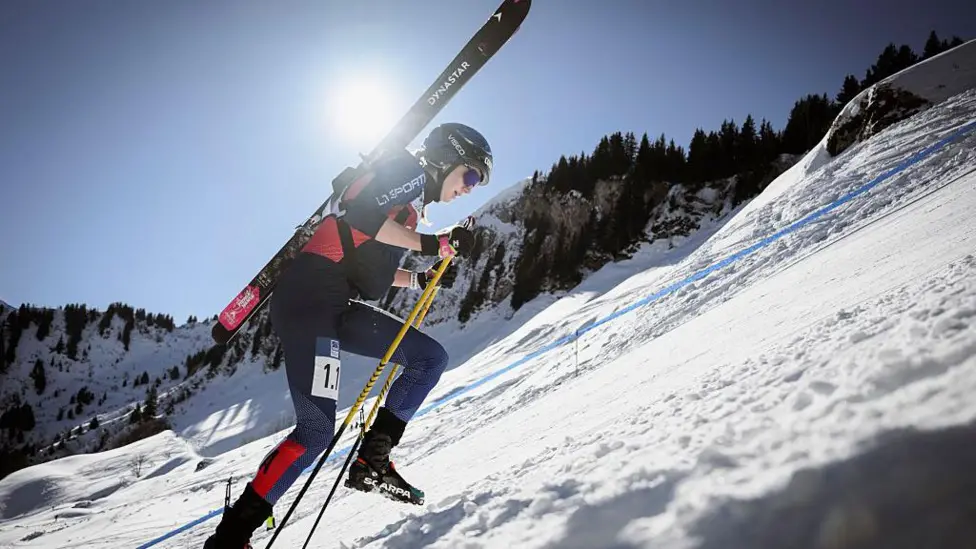
Emily Harrop often jokes that she entered the world “with bindings on her feet and poles in her hands.” Raised in the heart of the French Alps, skiing has always been more than a sport for her — it has been a way of life. Now, at 28, she stands on the brink of history. When ski mountaineering makes its Olympic debut at the Milan-Cortina Winter Games, Harrop is widely tipped to claim a medal.
A three-time world champion in ski mountaineering — often shortened to “skimo” — Harrop is among the favourites heading into the Games. Yet her journey carries a fascinating twist of identity. Though she competes under the French flag, her roots are deeply British.
Harrop was born in the Alps to English parents, growing up bilingual and culturally connected to both nations. In another scenario, she might have represented Team GB, with the Union Jack raised in celebration of her achievements. But the path she ultimately chose was shaped by environment, opportunity, and circumstance.
“My dad wanted me to go with the Brits,” Harrop revealed in an interview with BBC World Service’s More Than The Score podcast. However, she had been immersed in the French sporting system from an early age. Her coaches, teammates, and training network were all based in France. Turning away from that support structure felt impossible.
Before skimo entered her life, Harrop was an accomplished alpine skier. In fact, she became British downhill champion in 2015, showcasing her talent on the slopes. At that time, her sporting identity could have leaned toward Britain. But injuries disrupted her alpine skiing ambitions, forcing her to reconsider her future.
It was at 20 that she discovered ski mountaineering — a sport that would ultimately redefine her career. Back then, the British skimo setup was virtually nonexistent and did not compete on the World Cup circuit. The question of national allegiance barely arose, because France offered the only realistic high-performance pathway.
From that moment forward, Harrop never looked back.
She has since built an extraordinary résumé. She is a three-time world champion in the mixed relay and team disciplines and has added individual silver and bronze medals at world level. She has also won the prestigious Pierra Menta twice — often described as the “Tour de France” of ski mountaineering — and secured four overall World Cup titles. Her dominance has placed her at the forefront of a sport about to receive its biggest stage.
What Is Ski Mountaineering?
Ski mountaineering was officially added to the Olympic programme in 2021 for the Milan-Cortina 2026 Winter Games. Events will be staged in Bormio, located in the Dolomites. Although no athletes from Team GB will compete in the inaugural Olympic edition, the sport is expected to capture global interest.
Skimo blends endurance, technical precision, and alpine expertise. It demands explosive power uphill and fearless control on descents. According to its governing body, the discipline merges athletic performance with mountain adventure.
There will be three medal events: men’s sprint, women’s sprint, and mixed relay.
The sprint race is short but punishing, lasting roughly three minutes. Competitors ascend steep terrain using skis fitted with skins — strips attached to the base to prevent sliding backward. Midway through the ascent, athletes remove their skis, strap them to backpacks, and continue climbing on foot before transitioning back onto skis for another uphill section. At the summit, skins are removed in seconds before a high-speed descent to the finish line.
The mixed relay involves teams of one male and one female athlete. Each competitor completes multiple uphill and downhill segments, combining ski ascents, boot-packing sections on foot, and technical descents.
“It is a brutal sport,” Harrop has said. “It’s probably one of the hardest ones out there.” The blend of aerobic endurance, muscular strength, and rapid transitions makes it uniquely demanding.
A Career Nearly Abandoned
Ironically, Harrop was close to walking away from skimo before it achieved Olympic recognition. Balancing elite training with work commitments proved exhausting. Financial stability was uncertain, and the sport lacked the global exposure enjoyed by more established winter disciplines.
Then came the announcement: ski mountaineering would debut at Milan-Cortina.
“That changed everything,” Harrop explained. Olympic inclusion transformed not only the sport’s visibility but also the practical realities of pursuing it professionally. Funding improved, support networks strengthened, and long-term planning became viable.
Harrop turned professional and joined the “Army of Champions,” the elite sports division of the French military. The programme supports more than 200 top-level athletes preparing for the Olympic and Paralympic Games. Holding the rank of sergeant, Harrop now benefits from structured training, financial security, and national backing.
The shift was dramatic. What once felt like a struggling niche discipline suddenly became an Olympic opportunity — and Harrop became one of France’s leading medal hopes.
Identity and Optimism
Despite competing for France, Harrop maintains a strong connection to her British heritage. She grew up watching British television and spending time immersed in her parents’ culture. French friends have even joked that her “British blood” makes her especially optimistic.
That optimism may prove vital as she prepares for the pressure of the Olympic spotlight.
Being labeled a favourite can be daunting, especially in a debut Olympic event where unpredictability is high. Yet Harrop appears to embrace the expectation rather than fear it.
She recognizes the unique timing of her career. Ski mountaineering has existed for decades, with many talented athletes paving the way. Others will follow in future generations. But only this cohort can say they were present at its Olympic birth.
“We’re so lucky to be in this generation where the Olympics have come,” she reflected. “We’re right here in this historic moment and we have the capacity to fight for something.”
For Harrop, pressure is not a burden but a privilege. It signifies that something meaningful is at stake. Competing for an Olympic medal validates years of sacrifice, resilience, and reinvention.
The Road to Milan-Cortina
As Milan-Cortina approaches, Harrop’s preparation is meticulous. Skimo demands not just fitness but flawless transitions, strategic pacing, and mental toughness. One small error — a misapplied skin, a delayed transition, a mistimed descent — can cost precious seconds in a race measured in minutes.
Her experience at world championships and World Cup circuits gives her a crucial edge. She has faced high-stakes environments before. Yet the Olympic stage is unmatched in scale and scrutiny.
Should she reach the podium, it would symbolize more than personal achievement. It would represent the arrival of ski mountaineering as a legitimate Olympic discipline. It would also highlight the cross-cultural journey of an athlete shaped by two nations but committed to one competitive path.
Whether draped in the French tricolour or carrying echoes of her British upbringing, Emily Harrop embodies the spirit of modern sport: global, adaptive, and relentlessly driven.
For more winter sports news, Olympic features, and in-depth athlete stories, visit:
https://netsports247.com