
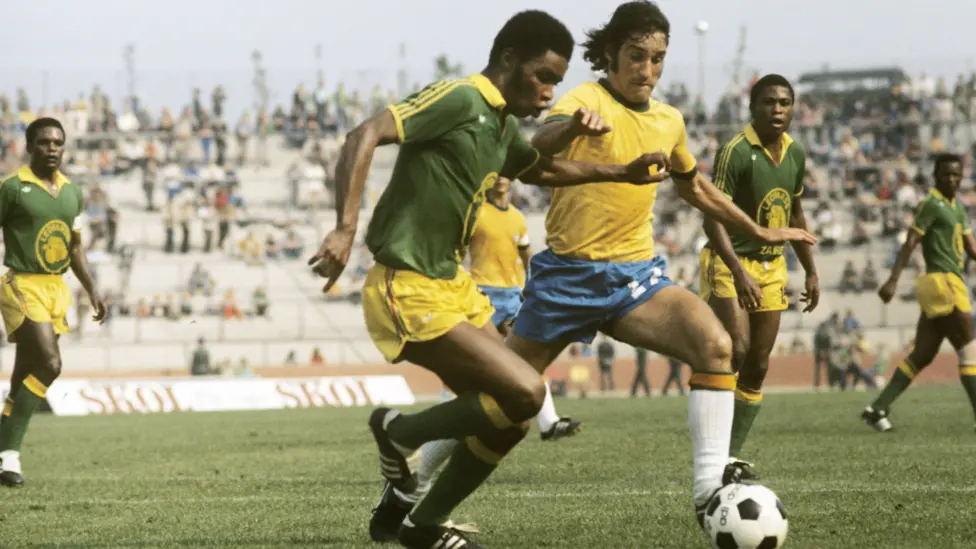
Football supporters in the Democratic Republic of the Congo have endured decades of waiting to correct the painful memories of their only appearance at the FIFA World Cup, which dates back to 1974. That tournament remains a defining yet troubling chapter in the nation’s football history, and now a new generation has the opportunity to rewrite that narrative.
The year 1974 was significant globally for many reasons. Political turmoil in the United States saw President Richard Nixon resign following the Watergate scandal. The Rubik’s Cube was introduced to the world, and boxing legend Muhammad Ali famously defeated George Foreman in the iconic “Rumble in the Jungle,” held in Kinshasa, the capital of DR Congo. Amid these historic moments, the Congolese national football team—then known as Zaire—made their only World Cup appearance.
Fast forward to the present, and the stakes could not be higher. The Leopards are now just one victory away from securing a place at the FIFA World Cup 2026. A win against Jamaica in the intercontinental play-off final would end a 52-year absence and ensure Africa has an additional representative at the tournament.
For players and fans alike, this match carries immense significance. Defender Axel Tuanzebe described it as the most important game of his career, while former captain Gabriel Zakuani called it the biggest match in the nation’s football history. The anticipation is shared by millions, both within the country and among the global Congolese diaspora.
The memory of the 1974 World Cup still lingers. Competing in West Germany, Zaire struggled throughout the tournament. They began with a 2-0 defeat to Scotland, suffered a heavy 9-0 loss to Yugoslavia, and concluded with a 3-0 defeat against Brazil. One particular moment from that campaign became infamous in football history.
During the match against Brazil, defender Mwepu Ilunga ran out of the defensive wall during a free-kick and kicked the ball away before it was taken. The incident baffled viewers and commentators, including John Motson, who questioned the player’s actions on live broadcast. While Ilunga received a yellow card, the moment unfairly reinforced stereotypes about African teams lacking tactical understanding.
However, those who were part of that squad have long defended their abilities. Goalkeeper Mohamed Kalambay later insisted that the team deserved to be at the World Cup and was not as poor as results suggested. Behind the scenes, there were deeper issues affecting performance, including unpaid bonuses and alleged threats from officials.
Today, the current generation of players is determined to move past those painful memories and create a new legacy. A victory over Jamaica would place DR Congo in a group alongside Portugal, Uzbekistan, and Colombia. But qualification alone is not the ultimate goal.
According to Zakuani, the ambition is to compete strongly and make a lasting impact rather than simply participate. The aim is to demonstrate that DR Congo can perform at the highest level and earn respect on the global stage.
The nation’s football journey has been shaped by complex historical and political factors. When Zaire qualified for the 1974 World Cup, they were only the third African nation to do so, following Egypt and Morocco. At that time, the team was supported by President Mobutu Sese Seko, whose regime invested heavily in football as a means of national pride.
Mobutu rewarded players with houses and cars after their success in the Africa Cup of Nations. However, his rule was also marked by corruption and authoritarianism, which had long-term consequences for the country. Following his downfall, DR Congo experienced years of conflict, including the devastating Congo wars between 1996 and 2003, involving multiple African nations and resulting in millions of deaths.
Even today, instability continues in parts of the country, particularly in the eastern regions where armed groups remain active. Despite these challenges, football continues to serve as a unifying force. During the 2023 Africa Cup of Nations, players such as Yoane Wissa used their platform to raise awareness about ongoing conflict, making symbolic gestures during the national anthem.
For many citizens, football offers hope and a sense of unity. Fans living in conflict-affected areas often face difficult conditions, yet they remain passionate supporters of the national team. The upcoming match against Jamaica will be watched by millions, even though safety concerns may prevent fans from gathering publicly.
The current squad reflects the global nature of modern football. Many players were born or raised in Europe, including France, Belgium, Switzerland, and England. This diaspora has played a crucial role in strengthening the team, bringing experience from top leagues around the world.
Players like Aaron Wan-Bissaka have embraced the opportunity to represent their heritage. He has spoken about his pride in playing for the country of his parents, highlighting the emotional connection that drives many diaspora players.
However, the reliance on overseas talent also underscores challenges within domestic football. Limited infrastructure, insufficient funding, and organizational issues have hindered the development of local players. Many talented individuals are forced to move abroad at a young age to pursue their careers.
The domestic league system has faced significant difficulties, including financial constraints that have disrupted competitions. Administrative challenges within the national federation have further complicated efforts to improve the sport’s structure.
Despite these obstacles, the government has invested heavily in international partnerships, sponsoring major European clubs such as Barcelona, AC Milan, and Monaco. While these deals aim to promote the country’s image globally, they have also drawn criticism from those who believe resources should be directed toward developing local football.
Amid these complexities, the national team remains a source of pride and hope. For players like Tuanzebe, the opportunity to represent DR Congo goes beyond sport. It is about creating a moment that will be remembered for generations.
He emphasized that this match represents something greater than football—a chance to leave a lasting legacy and bring joy to millions. Success would not only secure a place at the World Cup but also symbolize resilience and unity for a nation that has faced numerous challenges.
As the Leopards prepare for their निर्णing clash, the entire country and its global community will be watching with anticipation. A victory would mark the beginning of a new chapter, one that replaces past disappointments with hope and achievement.