
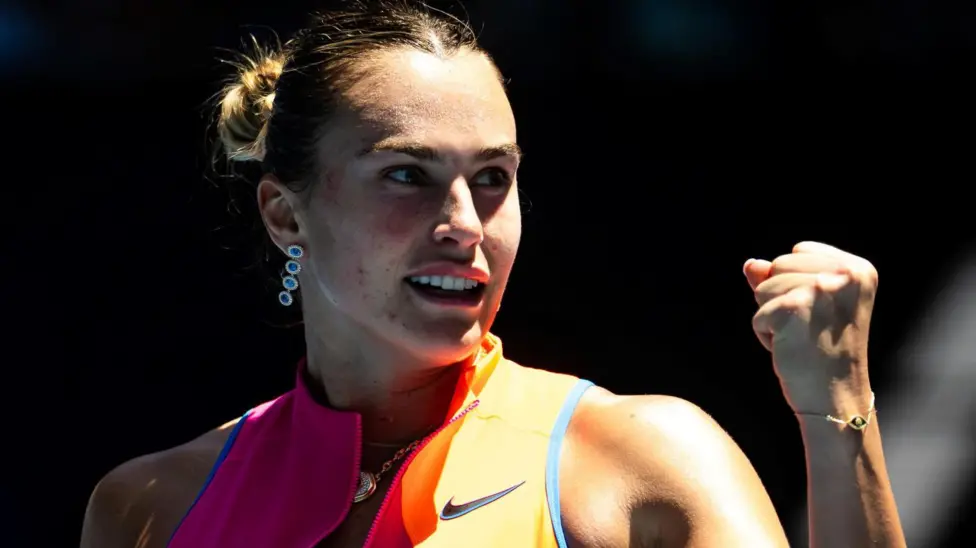
World number one Aryna Sabalenka has made it clear that her mindset at the Australian Open is uncompromising: it is all about lifting the trophy. The Belarusian powerhouse continued her relentless march towards a potential third Australian Open title in four years with an emphatic quarter-final win over teenage sensation Iva Jovic in Melbourne.
Sabalenka produced a dominant display, overpowering the young American 6-3, 6-0 to book her place in the semi-finals. The 27-year-old barely allowed Jovic any breathing room, using her trademark power, precision, and relentless intensity to control the match from start to finish. With the victory, Sabalenka moved one step closer to reclaiming the Australian Open crown she previously won in 2023 and 2024.
The top seed will now face either third seed Coco Gauff or Ukraine’s Elina Svitolina in the semi-finals, setting up what promises to be another high-quality encounter. Regardless of her next opponent, Sabalenka enters the final stages of the tournament in formidable form and with supreme confidence.
Already a four-time Grand Slam singles champion, Sabalenka has established herself as one of the most consistent players in modern women’s tennis. Her latest win marked her 14th semi-final appearance in the last 17 Grand Slam tournaments she has competed in — an extraordinary record that underlines her dominance at the sport’s biggest events.
In fact, Sabalenka has joined elite company by becoming only the third woman in the past 38 years to reach eight consecutive singles semi-finals at Grand Slams. The only other players to achieve that feat are former world number ones Lindsay Davenport and Martina Hingis, both widely regarded as legends of the game.
Reflecting on her achievements, Sabalenka admitted she sometimes struggles to fully comprehend the scale of her success.
“I think it’s unbelievable what I’ve been able to achieve,” she said. “What really helps me stay at this level all the time is my focus. Concentrating on the right things makes a huge difference when it comes to consistency.”
That focus has been evident throughout the tournament. Sabalenka has yet to drop a single set at this year’s Australian Open, extending her winning streak at the start of the 2026 season to 10 matches. Even more impressively, she has now won 20 consecutive sets, underlining her control and composure under pressure.
Her ruthless efficiency in Melbourne comes after a mixed year in Grand Slam finals during the previous season. Sabalenka fell short in two major finals in 2025, first at the Australian Open and later at the French Open, moments that left her visibly disappointed. However, she responded in emphatic fashion by successfully defending her US Open title in September, proving her ability to bounce back stronger after setbacks.
That resilience has become a defining feature of her career. Known for her powerful groundstrokes and aggressive baseline play, Sabalenka has also matured mentally, learning how to manage expectations and pressure on the biggest stages.
She is now widely regarded as the favourite to win the Australian Open, particularly given her remarkable record on hard courts. Of her 22 career singles titles, 19 have come on hard surfaces — a statistic that highlights just how dangerous she is on the Melbourne courts.
Despite her dominance, Sabalenka insists that her mindset remains the same as any other competitor entering a Grand Slam.
“I think every player, when they come into a tournament, has the same mentality — it’s trophy or nothing,” she explained. “Of course, you always want to win. That thought is always in the back of your mind.”
However, Sabalenka says she has learned to channel that ambition more effectively, focusing on controllable factors rather than outcomes.
“I’m trying to shift my focus to the right things and just give my best in every match, every point, every game, every set,” she said. “That’s my mentality now.”
This refined approach has paid dividends, allowing her to maintain an extraordinary level of consistency while still playing with freedom and confidence. Against Jovic, Sabalenka showcased not only her power but also her tactical awareness, varying her shots and dictating rallies with ease.
As the tournament reaches its decisive stages, Sabalenka appears physically strong, mentally sharp, and fully committed to her goal. With her blend of experience, hunger, and momentum, she stands as the player everyone else must beat.
Whether she ultimately lifts the trophy or not, Sabalenka’s latest performance reinforces her status as the dominant force in women’s tennis — a player driven by ambition, sustained by focus, and fuelled by an unwavering belief that anything short of the title is simply not enough.