
Gabriel Martinelli of Arsenal has expressed regret for attempting to force injured Liverpool defender Conor Bradley off the field following the clubs’ 0-0 draw on Thursday.
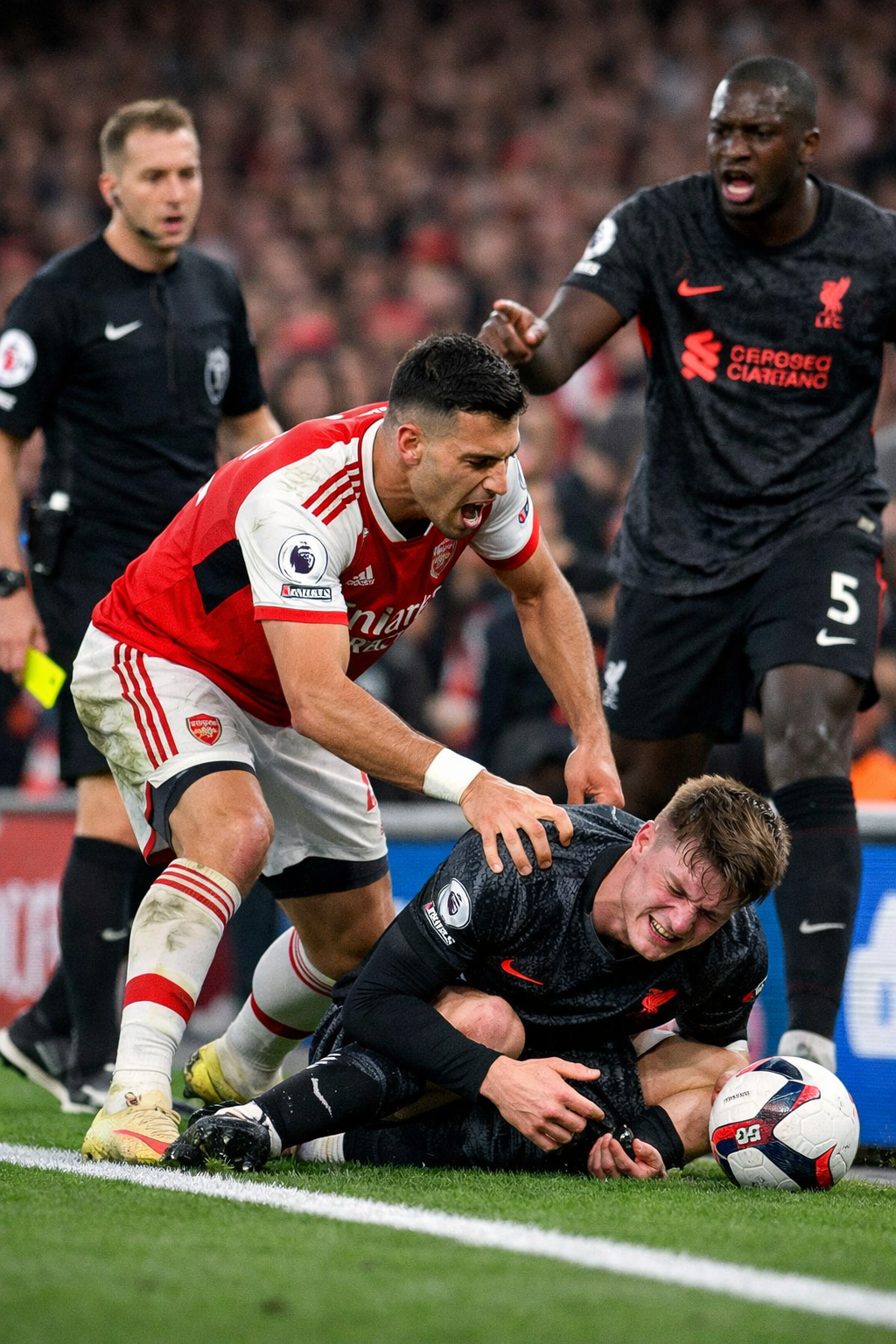
While chasing the ball in stoppage time, Bradley, a Northern Ireland international, landed awkwardly close to the touchline. He fell to the ground and clutched his knee right away.
In an effort to remove the full-back off the playing field so the game could continue, Martinelli then dumped the ball on him and shoved him in the back.
Martinelli and Ibrahima Konate of Liverpool both received yellow cards for their roles in the altercation that broke out between the two groups of players.
Bradley was pictured leaving Emirates Stadium on crutches and wearing a knee brace after being transported on a stretcher for treatment. Both former Manchester United players Gary Neville and Roy Keane harshly criticized Martinelli; Neville called the Arsenal winger a “idiot” and called his conduct “absolutely disgraceful”.
Later, Martinelli apologized on social media, claiming that he had already apologized and that the two players had communicated.
Martinelli wrote, “I really didn’t understand he was seriously injured in the heat of the moment,” on Instagram.
“I want to express my sincere regret for my reaction. Again, I’m wishing Conor a speedy recovery.”
After the game, Liverpool manager Arne Slot supported Martinelli, speculating that the flashpoint might have been caused by the larger problem of time-wasting in football.
“I don’t know Gabriel Martinelli, but he comes across as a nice guy,” Slot remarked.
“I believe the issue with him, as well as with football in general, is that there is a lot of time-wasting and players feigning injuries both during and after the game, which can occasionally irritate you if you want to try to score a goal and you believe the player is wasting time.”
“You cannot ask Martinelli to think so clear in the 94th minute.”
Although the entire nature of Bradley’s injuries is yet unknown, Slot expressed fear that it might be serious and stated that Martinelli would have behaved differently if he had known.
“I am 100% sure that if he knew what the injury might be, then he would never do that,” Slot stated. However, if he has the injuries that we suspect he may have, it doesn’t look good.
“But squandering time, diving… Martinelli may have felt that this was a waste of time as well because I have witnessed it occur against us numerous times this season.
“He couldn’t have thought about ‘this is Liverpool, they don’t do this’.” Martinelli was called a “incredible, lovely guy” by Arsenal manager Mikel Arteta, whose team leads Manchester City and Aston Villa by six points at the top of the standings.
He agreed with Slot that the winger most likely was unaware of the severity of Bradley’s issue.
“I don’t know what happened to Conor, but hopefully it’s not bad,” Arteta replied. “But obviously there is no intention from Gabi to do anything bad to him.”
The right-back “didn’t want to come back on the pitch for time-wasting” and “he couldn’t even think where he rolled” before Martinelli shoved him, according to Bradley’s teammate Dominik Szoboszlai. “I understand you want to win, we want to win as well, but I think the health of a player is much more important than something else,” Szoboszlai said.
All things considered, this episode emphasizes once more how difficult it is to balance sportsmanship and competitive zeal in contemporary football. Players may later regret their emotional responses during high-stress situations, particularly during stoppage time of a close game. Even though Martinelli’s behavior drew harsh criticism, it is impossible to overlook the game’s background and the persistent problem of football players wasting time. However, player safety continues to be the primary concern. Any action involving an injured player will inevitably draw criticism, regardless of the circumstances or intent of the game. The intense responses from previous players and commentators demonstrate how seriously these incidents are taken, particularly when the injured athlete is subsequently spotted using crutches. Both bosses’ backing and Martinelli’s prompt apology imply that the situation was more the result of miscommunication than malice. Moments like these start vital discussions about discipline, empathy, and the responsibilities players bear during pivotal moments on the field as football continues to change.