
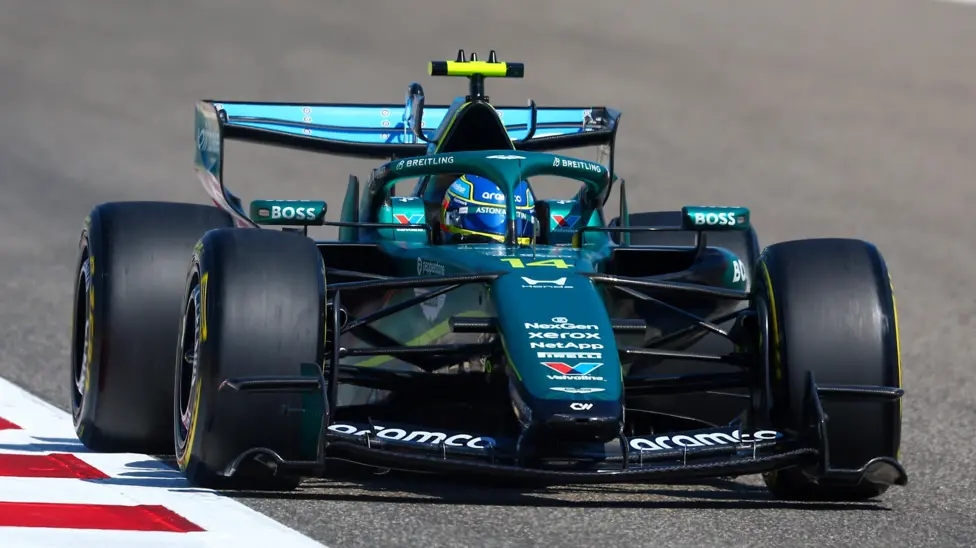
Aston Martin’s new Formula 1 car initially generated excitement and intrigue when it first appeared during testing at the end of January. Painted in a striking temporary all-black livery, the car stood out visually and technically from the rest of the grid. Observers across the pit lane noticed its unconventional design elements, many of which reflected the signature creativity of renowned designer Adrian Newey, who had joined Aston Martin as managing technical partner in March the previous year. On the surface, the machine looked aggressive, innovative, and potentially competitive. However, the optimism quickly faded once the car actually began running on track.
Reality struck almost immediately during its first outing in Barcelona. The car was already behind schedule and managed to complete only four laps before suffering a mechanical failure at the pit lane entry. This early setback foreshadowed deeper issues that would continue throughout testing. Since then, Aston Martin’s situation has shown little sign of improvement. By the conclusion of pre-season testing, the car had covered the fewest miles of any team and was also the slowest on the timing sheets. Reliability problems repeatedly interrupted running, and when the car did make it onto the track, it appeared difficult to handle and unpredictable for the drivers.
Team owner Lawrence Stroll’s visible frustration in the Bahrain paddock reflected the gravity of the situation. His demeanour suggested both disappointment and concern as the team struggled to get meaningful track time. While Aston Martin and engine partner Honda maintained a cautious public stance, insiders privately acknowledged that the team was facing serious technical and developmental challenges. The consensus within the paddock was clear: the project was in trouble, and resolving the issues would take significant time and effort.
The disappointment is especially striking considering how promising the long-term project once appeared. Heading into the 2026 era, no team arguably had higher expectations than Aston Martin. On paper, the ingredients for success were all present. Lawrence Stroll had assembled what looked like a dream lineup, investing heavily in infrastructure, talent, and partnerships aimed at transforming the team into a championship contender.
One of the most significant milestones in that plan was the recruitment of Adrian Newey in September 2024. His arrival was widely viewed as the missing piece in Aston Martin’s ambitious puzzle. Newey’s legendary reputation for mastering regulation changes and producing groundbreaking designs during past rule shifts—such as with McLaren in 1998 and Red Bull in both 2009 and 2022—raised hopes that he could replicate similar success under the new 2026 regulations.
In addition to Newey’s appointment, Aston Martin secured Honda as its factory engine partner, a manufacturer that had powered Red Bull to four consecutive drivers’ titles and two constructors’ championships between 2021 and 2024. The team also invested heavily in cutting-edge facilities, including a brand-new factory equipped with a state-of-the-art wind tunnel and advanced driver-in-the-loop simulator. Financial backing appeared virtually limitless, bolstered by major sponsorship deals and strong global partnerships. With two-time world champion Fernando Alonso still delivering competitive performances despite being in his mid-40s, the lineup looked formidable.
Despite these advantages, the on-track results have not matched expectations. The first car produced under Newey’s leadership has so far failed to deliver the step forward many anticipated. Rather than emerging as a competitive machine, it has looked slow, inconsistent, and underdeveloped compared to rival teams.
Looking at Aston Martin’s recent history provides important context. The team experienced a strong surge at the start of 2023 when Alonso joined, securing six podium finishes in the opening eight races and even coming close to victory in Monaco before a strategic tyre decision cost them the win. However, their development pace slowed dramatically in the second half of that season as rivals progressed faster. The same pattern continued in 2024, and by 2025 the team had slipped further down the competitive order, eventually finishing seventh in the championship after previously placing fifth.
Newey’s arrival was meant to reverse that downward trajectory, particularly with the introduction of the sweeping 2026 regulation changes—the biggest technical overhaul in Formula 1 history. These new rules presented an opportunity for teams with strong design leadership to gain a competitive advantage. However, Aston Martin’s internal instability may have undermined that potential.
Formula 1 success relies heavily on continuity and organisational stability, something Aston Martin has lacked in recent years. The team has undergone significant leadership changes, including new hires and internal restructuring at the highest levels. Chief technical officer Enrico Cardile only joined in July after a prolonged gardening leave from Ferrari, while Andy Cowell, previously a key figure behind Mercedes’ dominant hybrid-era engines, was appointed CEO in October 2024 before being reassigned after reported disagreements with Newey. Cowell now spends much of his time in Japan assisting Honda with engine-related issues.
Even before the car’s debut, Aston Martin had been cautiously lowering expectations during their official launch in early February, stressing that the project would require patience. Newey himself acknowledged that his March start date left the team several months behind its competitors in terms of development progress. Although the 2026 aerodynamic regulations were formally published in January 2025, teams had already been working on their concepts long before that. Many had inside knowledge of the regulatory direction through ongoing collaboration with the FIA and internal development programs.
Reports suggest that when Newey officially began work, he initiated a major redesign based on his own design philosophy. While potentially beneficial in the long run, this decision meant the current car is significantly behind rival teams in development terms. With such a gap, even a designer of Newey’s calibre cannot produce instant miracles.
Newey has described the current Aston Martin as one of the more radical interpretations of the new rules. However, in its current state, the car is clearly underdeveloped and lacks competitiveness. It remains slow and difficult to drive, though there is still a possibility that ongoing development could unlock its potential over time.
Another major factor complicating Aston Martin’s situation is the performance of the Honda power unit. The challenges faced by Honda have drawn comparisons to its troubled return to Formula 1 with McLaren in 2015, when the engines were both unreliable and lacking in performance. The parallels are concerning, particularly given Honda’s previous success with Red Bull in recent seasons.
Honda officially exited Formula 1 at the end of 2021 before announcing its return with Aston Martin in May 2023. During the interim period, much of its F1 engine division was reportedly dissolved, with engineers reassigned to other projects. This restructuring meant that when the new engine project began, Honda effectively had to rebuild its F1 development team from the ground up.
However, the situation is complex. Honda engines continued to be used by Red Bull teams until recently, and although development freezes were in place, manufacturers were still allowed to introduce reliability-related updates that often translated into performance gains. Honda also remained involved in regulatory discussions regarding the new engine rules, suggesting it was not entirely disconnected from F1’s technical evolution.
Even so, without a fully dedicated engine department focused on the new regulations, Honda appears to have lost valuable development time. This has resulted in a power unit that currently lacks both performance and reliability compared to its competitors. While some argue that rebuilding from scratch explains the delay, comparisons with Red Bull Powertrains—who established an entirely new engine facility within a similar timeframe—raise further questions about Honda’s readiness.
Ultimately, Aston Martin’s struggles stem from a combination of factors: delayed development, internal restructuring, an underprepared engine partner, and the ambitious redesign initiated under Newey’s leadership. While the long-term project still holds promise, the early signs of the 2026 campaign indicate that the team faces a steep climb before it can realistically challenge at the front of the grid.
For more latest sports updates and Formula 1 news, visit: https://netsports247.com