
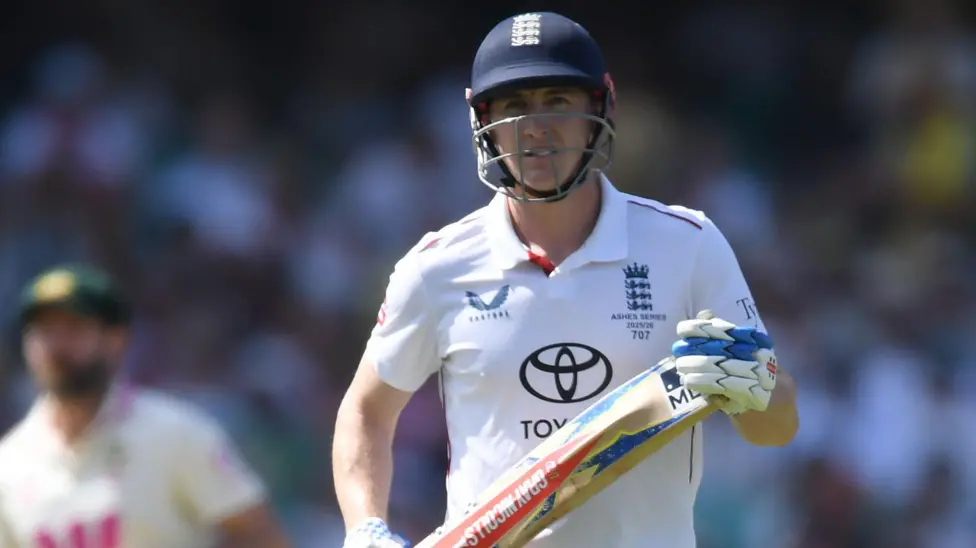
England white-ball captain Harry Brook has acknowledged that supporters were right to feel disappointed and frustrated following revelations about an off-field incident during England’s tour of New Zealand, which came to light only after a difficult Ashes campaign in Australia.
The 26-year-old Yorkshire batter was involved in an altercation with a nightclub bouncer in Wellington on 1 November, the night before the third one-day international against New Zealand. Brook was struck during the incident, which occurred while he was away from the team. England went on to lose the match, and although disciplinary action was taken at the time, the details only became public more than two months later.
Brook was fined a substantial amount and issued with a final warning by the England and Wales Cricket Board (ECB). The matter was dealt with internally before England’s Ashes tour, but its delayed disclosure intensified scrutiny of England’s preparation and behaviour after they suffered a heavy 4-1 series defeat to Australia.
Speaking openly in Colombo ahead of England’s white-ball series against Sri Lanka, Brook addressed the controversy for the first time in detail and accepted responsibility for his actions.
“Fans have every right to be annoyed,” Brook said. “I made a serious mistake and put myself in a situation I shouldn’t have been in. I understand the criticism completely.”
Despite being England’s second-highest run-scorer in the Ashes with 358 runs, Brook admitted he did not perform to his usual standards. He passed fifty only twice in the series and often played shots that suggested a lack of discipline at crucial moments. However, he insisted that the New Zealand incident did not affect his cricket.
“I don’t think it changed how I played,” he explained. “I went about my cricket the same way I always do. I didn’t get the scores I wanted, but that’s part of the game.”
Brook expressed deep regret for letting supporters, team-mates and the wider England set-up down, particularly given his leadership role.
“I’m extremely sorry to the fans for what happened in New Zealand,” he said. “I’ve got to earn back trust — not just with my performances on the field, but with how I conduct myself off it too. I want to be more professional, and that’s something I’ll carry with me for the rest of my career.”
At the time of the incident, Brook had recently been appointed England’s white-ball captain, with the tour of New Zealand marking his first overseas assignment in the role. He confirmed that he was not accompanied by any other England players when the altercation occurred and said he immediately informed team management during the ODI match the following day.
Brook admitted he feared the consequences could be severe.
“I genuinely thought there was a chance I might be sacked,” he said. “That was definitely on my mind.”
However, he added that resigning as captain never crossed his thoughts.
“I left that decision to the hierarchy. If they had removed me as captain but allowed me to keep playing for England, I would have accepted that.”
Brook declined to go into full detail about the incident itself but explained that it began innocently enough.
“We went out to get some food,” he said. “There was no plan to go out drinking or put ourselves in a bad situation. I decided to stay out a bit longer on my own, and that’s where I made the mistake.”
He said he had attempted to enter a nightclub when the confrontation occurred.
“I was trying to get into a club and the bouncer just hit me,” Brook said. “I wouldn’t say I was completely drunk, but I’d had one too many.”
The following day, Brook was dismissed for just six runs as England collapsed to 44-5 before narrowly losing the match. Midway through the game, he reported the incident to England management. The disciplinary process concluded before the Ashes tour began, with Brook fined approximately £30,000 and warned that any further misconduct would lead to severe consequences.
The controversy added fuel to ongoing criticism of England’s approach during the Ashes, particularly their decision to spend several days in the Queensland resort of Noosa while already trailing 2-0 in the series. Brook was among several players photographed drinking during the break, and footage of opener Ben Duckett appearing disoriented outside a bar circulated on social media.
Brook rejected claims that England has a problematic drinking culture, although he acknowledged that mistakes were made.
“We weren’t happy about being photographed,” he said. “We were constantly aware of cameras around us. Apart from one situation, we were drinking responsibly.”
He explained that the Noosa break included more than just socialising.
“We played golf, went to cafés, had coffees. We did normal things. We had a few drinks here and there, but we weren’t going out every night getting smashed.”
Nevertheless, England have since introduced a midnight curfew for players and staff, which is currently in place during the Sri Lanka tour.
“That was a group decision,” Brook said. “We felt it was the best thing moving forward to put ourselves in the right position to win games and perform at our best.”
Brook said he had apologised privately to his team-mates and accepted that rebuilding trust within the squad would take time.
“As a player it’s unacceptable, but as a captain it’s even worse,” he admitted. “I hold my hands up. I know I’ve got work to do.”
Test captain Ben Stokes, who missed the 2017-18 Ashes after his own high-profile nightclub incident in Bristol, offered Brook support after learning of what had happened.
“He wasn’t happy, of course,” Brook said. “But he tried to help me through it. He knows exactly what it feels like to be in this situation.”
Brook said those conversations helped him refocus ahead of the Ashes, though the series ultimately proved disappointing for England.
Looking ahead, Brook could become the only England player to feature across all formats throughout the winter, including tours of New Zealand, Australia and Sri Lanka, followed by the T20 World Cup.
While he believes players need ways to relax away from cricket, Brook acknowledged he must make better choices.
“I still need to switch off sometimes,” he said. “But I’ll be doing it in a more professional way.”
England head coach Brendon McCullum and director of cricket Rob Key have both defended the squad’s culture, insisting discipline and accountability remain central to the team environment.
As England prepare for their upcoming white-ball fixtures, Brook says his focus is firmly on cricket and proving he deserves the trust placed in him.
“I just want to play as well as I can and help England win games,” he said. “That’s the best way I can make things right.”
For more cricket news, analysis and updates, visit
👉 https://netsports247.com