
The Confederation of African Football (CAF) has handed Senegal manager Pape Thiaw a five-match suspension following the chaotic conclusion of the 2025 Africa Cup of Nations final against Morocco earlier this month. Along with the ban, Thiaw has been fined $100,000 (£72,000) for what CAF described as “unsporting conduct” and actions that “brought the game into disrepute.”
The ruling comes amid a series of disciplinary measures issued after one of the most dramatic and controversial finals in recent African football history. In total, fines approaching £1 million were imposed on several individuals and federations connected to the match.
The final, held on 18 January in Rabat, was initially expected to be a thrilling conclusion to the tournament. Senegal ultimately emerged victorious, winning 1-0, but the match descended into turmoil when the players left the field following a contentious stoppage-time penalty award to Morocco.
The controversy began moments earlier when Senegal felt aggrieved by a referee decision that awarded a foul against them on Morocco captain Achraf Hakimi. Before that, Senegal forward Ismaila Sarr had scored, giving his team the lead. Frustrated and angry at the sequence of decisions, Thiaw instructed his squad to abandon the pitch, igniting a tense standoff with match officials.
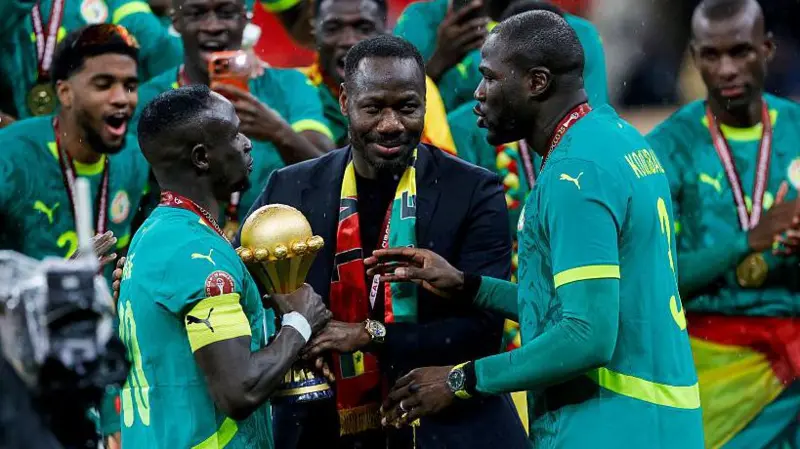
The game was halted for approximately 17 minutes, during which officials attempted to calm both sides and restore order. Eventually, Senegal’s talisman Sadio Mane intervened, persuading his teammates to return to the field. His leadership prevented the abandonment of the match and allowed the final minutes to proceed, albeit under extraordinary tension.
Once play resumed, Morocco’s Brahim Diaz stepped up to take the penalty with a delicate Panenka attempt. Senegal goalkeeper Edouard Mendy made a crucial save, preserving Senegal’s narrow lead. Immediately following the penalty save, referee Jean-Jacques Ndala blew the final whistle, confirming Senegal’s triumph. Later, Pape Gueye scored in the fourth minute of extra time, officially securing Senegal’s second Afcon title in five years.
CAF’s disciplinary review did not stop at Thiaw. Senegal’s Iliman Ndiaye and Ismaila Sarr were both given two-match bans for “unsporting behaviour towards the referee,” reflecting their roles in the pitch-side protest. In addition, the Senegal Football Federation (FSF) was penalised with a fine totaling $615,000 (£444,000).
Moroccan players were also sanctioned for their conduct. Forward Ismael Saibari received a three-match suspension and a $100,000 (£72,000) fine, while Hakimi was handed a two-match ban, with one game suspended for twelve months. CAF emphasized that these measures are strictly limited to continental competition and will not affect preparations for the upcoming 2026 FIFA World Cup in the United States, Canada, and Mexico.
In addition to individual sanctions, the Royal Moroccan Football Federation (FRMF) attempted to challenge the final result, requesting that CAF overturn Senegal’s victory due to the temporary abandonment of the match. However, CAF’s disciplinary committee rejected the appeal, confirming the legitimacy of Senegal’s win despite the on-field disruptions.
The incident underscores the high stakes and intensity surrounding major continental tournaments. While the match showcased Senegal’s resilience and determination, it also highlighted the pressures referees face and the thin line between competitive passion and unsportsmanlike conduct. Thiaw’s ban, alongside those of his players, sends a strong message regarding conduct during CAF-sanctioned matches.
For Senegal, the title represents a remarkable achievement and reaffirms their dominance in African football. Despite the controversy, the team has demonstrated both individual brilliance and tactical discipline under pressure. The leadership of Sadio Mane, in particular, proved pivotal in calming the situation and ensuring that the team completed the match.
CAF’s ruling has been widely discussed across the continent. Analysts note that while Senegal deserved the title based on performance, disciplinary breaches—particularly abandoning the pitch—cannot be ignored. Thiaw’s decision to withdraw the team, albeit out of frustration, is now a significant cautionary tale for coaches and players across Africa.
The fines and suspensions are part of CAF’s broader effort to uphold professional standards in African football. Beyond individual punishment, the measures aim to preserve the reputation of the tournament and maintain respect for referees and governing bodies. CAF has consistently reiterated that all stakeholders are accountable for maintaining decorum, and that misconduct will not be tolerated, regardless of the match’s importance or outcome.
Moving forward, Senegal will now focus on consolidating their squad for future tournaments and international fixtures, including preparations for the World Cup qualifiers and other CAF competitions. The suspended players and Thiaw will be eligible to return after serving their bans, allowing the team to regroup while learning from the disciplinary experience.
Meanwhile, Morocco will look to rebuild and move past the controversial final. The FRMF has indicated that they will continue to invest in player development and referee education, aiming to avoid similar incidents in future competitions. Both nations’ experiences highlight the delicate balance between competitive intensity and sportsmanship in modern African football.
For football fans and analysts, the 2025 AFCON final will remain a case study in high-pressure decision-making, player psychology, and the importance of leadership on the pitch. It also underscores the vital role of governing bodies like CAF in enforcing discipline and maintaining the integrity of continental competitions.
Ultimately, Senegal’s victory, Thiaw’s suspension, and the series of player bans serve as reminders that while football thrives on passion and intensity, the rules and spirit of the game must be respected. The outcome of the final, though controversial, provides lessons for players, coaches, and federations across Africa.
For more coverage on African football, major tournaments, and disciplinary news, visit https://netsports247.com.