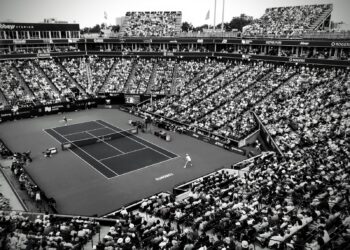


Santiago Bernabéu Set for Historic Transformation as Madrid Open Brings Tennis to Football’s Iconic Stage
The legendary Santiago Bernabéu Stadium, home of Real Madrid, is preparing for a remarkable transformation as it temporarily swaps its famous grass pitch for clay. In an innovative move, the stadium will host a practice tennis court during the upcoming Madrid Open, offering a unique crossover between two of the world’s most popular sports.
This initiative highlights both the evolution of modern sports venues and the increasing emphasis on creating memorable, multi-sport experiences for athletes and fans alike.
A new setting for tennis preparation
During the Madrid Open, which runs from 20 April to 3 May, a specially designed clay practice court will be installed inside the Bernabéu. The court will replicate the playing conditions found at the tournament’s primary venue, the Caja Mágica, ensuring that players can train under familiar conditions.
Top tennis stars, including Spain’s world number one Carlos Alcaraz, are expected to make use of the facility as they prepare for matches. However, unlike traditional practice sessions at tournament venues, these sessions will be private and not open to the public.
Importantly, the Bernabéu will not host any official Madrid Open matches. Its role is limited to serving as an अतिरिक्त тренировочный space, easing pressure on existing facilities while offering a distinctive training environment.
Blending tradition with innovation
Tournament organizers have described the project as a symbolic fusion of tennis tradition and modern innovation. Clay courts are deeply rooted in the history of the sport, particularly in European tournaments, while the Bernabéu represents cutting-edge stadium design and global sporting prestige.
By bringing these elements together, the Madrid Open aims to create a powerful visual and cultural statement. It reflects a broader trend in sports where iconic venues are repurposed and reimagined to deliver new experiences.
Strategic timing and logistics
The timing of this transformation has been carefully planned. Real Madrid do not have any home fixtures scheduled during the week when the practice court will be in use, allowing for uninterrupted preparation and usage.
There remains a possibility that the club could be involved in the quarter-finals of the UEFA Champions League around 28 or 29 April, depending on their progress against Bayern Munich. However, scheduling arrangements mean that any such fixture would take place away from home if they advance to face teams like Liverpool or Paris Saint-Germain.
This ensures that the stadium can be fully dedicated to its temporary role in supporting the tennis tournament.
Marketing innovation and global appeal
The decision to use the Bernabéu is also part of a broader marketing strategy by the Madrid Open. By leveraging the global recognition of Real Madrid and their iconic stadium, the tournament aims to increase its visibility and appeal to a wider audience.
Tournament director Feliciano López has emphasized the event’s history of innovation. Over the years, the Madrid Open has experimented with various bold ideas, including the controversial introduction of blue clay courts, the use of fashion models instead of traditional ball kids, and even hosting a virtual edition during the COVID-19 in 2020.
These initiatives demonstrate a willingness to take risks and push boundaries in order to keep the tournament fresh and engaging. The Bernabéu project is the latest example of this forward-thinking approach.
Addressing practical challenges
While the move has clear promotional benefits, it also serves a practical purpose. The Madrid Open has expanded significantly in recent years, with larger singles draws and an extended schedule.
The Caja Mágica, located a few miles from central Madrid, features multiple courts but has struggled to accommodate the growing number of players. Practice court availability has become a particular issue, leading organizers to utilize additional venues across the city.
By introducing a practice facility at the Bernabéu, the tournament can alleviate some of this الضغط and provide players with more convenient training options.
A showcase for a futuristic stadium
For Real Madrid, this initiative is another opportunity to demonstrate the versatility of their недавно renovated stadium. The Bernabéu has undergone a major redevelopment, transforming it into a state-of-the-art venue capable of hosting a wide range of events beyond football.
One of its most impressive features is a retractable pitch system. The grass surface can be divided into sections and stored underground in a controlled environment, allowing the stadium floor to be repurposed for other uses.
This technology enables the Bernabéu to host events such as concerts, exhibitions, and now tennis. It reflects a growing trend among modern stadiums to maximize usage and generate additional revenue streams.
Club president Florentino Pérez has long been interested in bringing tennis to the stadium. As a regular attendee at the Madrid Open, he previously proposed hosting a high-profile exhibition match between Rafael Nadal and Roger Federer in 2019.
Although that idea did not materialize at the time, the current project represents a step toward realizing that vision.
Expanding the stadium’s role
The Bernabéu’s transformation for tennis is part of a broader strategy to position the venue as a multi-purpose entertainment hub. In addition to football matches, it is scheduled to host an NFL International Series game later this year.
The stadium has also been used for major concerts, including performances by global superstar Taylor Swift in 2024. However, those events sparked controversy due to noise concerns from local residents, leading to a pause in music events for the time being.
Despite these challenges, the Bernabéu continues to evolve as one of the most versatile and technologically advanced stadiums in the world.
A unique moment in sport
The installation of a clay court inside a football stadium of such stature is a rare and fascinating development. It underscores the increasing convergence of different sports and the creative ways in which venues are being utilized.
For players, it offers a distinctive training experience. For organizers, it provides valuable logistical support and global exposure. And for fans, even if they cannot attend the sessions, it represents an exciting blend of tradition and innovation.
Conclusion
The transformation of the Santiago Bernabéu into a temporary tennis facility is more than just a novelty—it is a reflection of how modern sport is evolving. By combining cutting-edge infrastructure with creative thinking, both Real Madrid and the Madrid Open are pushing the boundaries of what is possible in sports आयोजन.
As the tournament approaches, this initiative will undoubtedly capture global attention, reinforcing Madrid’s status as a hub for world-class sporting events.
For more sports news and updates, visit: https://netsports247.com/