
England’s international friendly against Uruguay may not have delivered high-quality entertainment, but it certainly provided a series of strange and controversial moments that left players, fans, and analysts puzzled. The 1-1 draw at Wembley was filled with questionable refereeing decisions, VAR confusion, and incidents that sparked widespread debate.
One of the most dramatic moments of the match came late in the game when Ben White appeared to have secured victory for England. The Arsenal defender reacted quickly inside the box to convert from close range following a corner, giving Thomas Tuchel’s side the lead. However, the joy was short-lived.
Deep into stoppage time, White found himself at the center of controversy once again. He was penalized for a challenge inside the penalty area on Federico Vinas. After a VAR review, the referee awarded a penalty, which Federico Valverde calmly converted to level the score. The decision left many questioning the consistency and accuracy of officiating during the match.
The confusion didn’t end there. One of the most talked-about incidents involved Manuel Ugarte, who appeared to receive two yellow cards during the game but was not sent off. The first incident occurred in the 70th minute when broadcast graphics indicated that Ugarte had been booked for a foul on Cole Palmer. Later, in the 81st minute, he seemed to receive a second yellow card for dissent following England’s goal.
Under normal circumstances, this would result in a red card and dismissal. However, Ugarte remained on the pitch, showing no signs of confusion or protest, and play continued as if nothing unusual had happened. This led to widespread bewilderment among viewers and commentators.
Subsequent clarification revealed that the initial booking had actually been issued to Jose Gimenez rather than Ugarte. Statistical data confirmed that Ugarte had only received one official yellow card, which explained why he was not sent off. However, the lack of clear communication during the match contributed to the confusion and criticism of the officiating team.
The goals themselves were also surrounded by controversy. England’s opener, scored by White, was subject to a VAR review due to a potential foul in the build-up. Adam Wharton appeared to obstruct Gimenez while attempting to create space in the penalty area. Despite this, the goal was allowed to stand.
Pundits were divided on the decision. Former England striker Ian Wright suggested that in a high-stakes tournament like the World Cup, such an incident would likely be ruled as a foul. Similarly, Emma Hayes expressed surprise that the goal was not disallowed, noting that blocking a defender in that manner is often penalized.
Uruguay’s equalizer brought even more debate. Initially, the referee allowed play to continue after the coming together of White and Vinas in the penalty area. However, following intervention from VAR, he was instructed to review the incident on the pitch-side monitor. After watching the replay, he reversed his original decision and awarded a penalty.
This reversal sparked criticism from former professionals. Ex-goalkeeper Paul Robinson argued that the referee had been well-positioned to make the initial call and should not have changed his decision. He described the challenge as clumsy rather than malicious and suggested that such incidents should not be overturned unless there is a clear and obvious error.
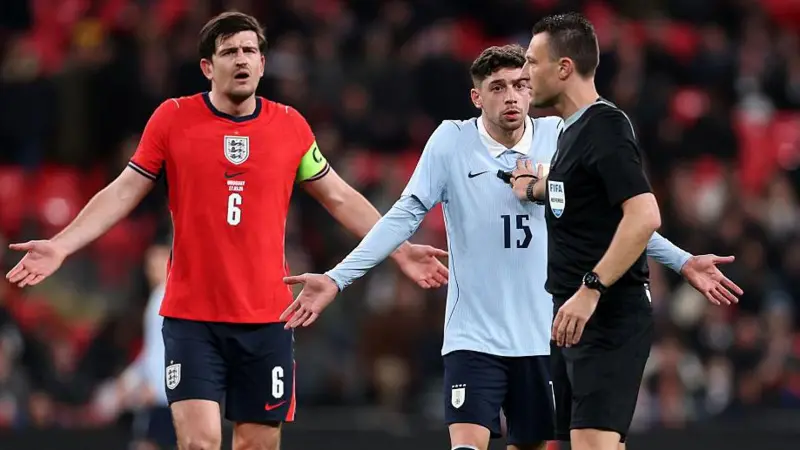
Another flashpoint occurred earlier in the second half, involving Ronald Araujo and Phil Foden. Araujo made a dangerous studs-up challenge on Foden, which many believed warranted a red card. Surprisingly, the referee did not even issue a yellow card, and VAR did not intervene.
Foden was unable to continue playing after the challenge, adding to the frustration among England players. Harry Maguire voiced his disbelief, stating that tackles of that nature are typically punished with a red card. He expressed concern that such decisions could have serious implications, especially with the World Cup approaching.
Tuchel also criticized the officiating, describing it as substandard. While he was relatively satisfied with his team’s overall performance, he did not hold back in his assessment of the referees. He questioned how a challenge like Araujo’s could go unchecked and described the late penalty decision as extremely soft.
The German coach further highlighted the confusion surrounding Ugarte’s apparent double booking, emphasizing that such inconsistencies undermine the credibility of officiating. According to Tuchel, the match was marred by poor decision-making that affected both teams.
Despite the controversies, the match itself was largely uneventful in terms of quality football. Both teams struggled to impose themselves, resulting in a scrappy and disjointed contest. England showed flashes of attacking intent, but Uruguay’s disciplined approach made it difficult for them to create clear scoring opportunities.
Ultimately, the game will be remembered less for the football and more for the series of puzzling incidents that unfolded. From disputed goals to unclear bookings and unpunished challenges, the match highlighted ongoing concerns about the consistency of refereeing and the use of VAR in modern football.
As England prepares for the World Cup, these issues will undoubtedly be a source of concern. Players and coaches alike will hope for greater clarity and consistency in officiating at the tournament, where the stakes will be significantly higher.
For now, the draw against Uruguay serves as a reminder that even friendly matches can produce moments of drama and controversy that leave lasting impressions. While the result may not have been decisive, the debates surrounding the match are likely to continue for some time.