
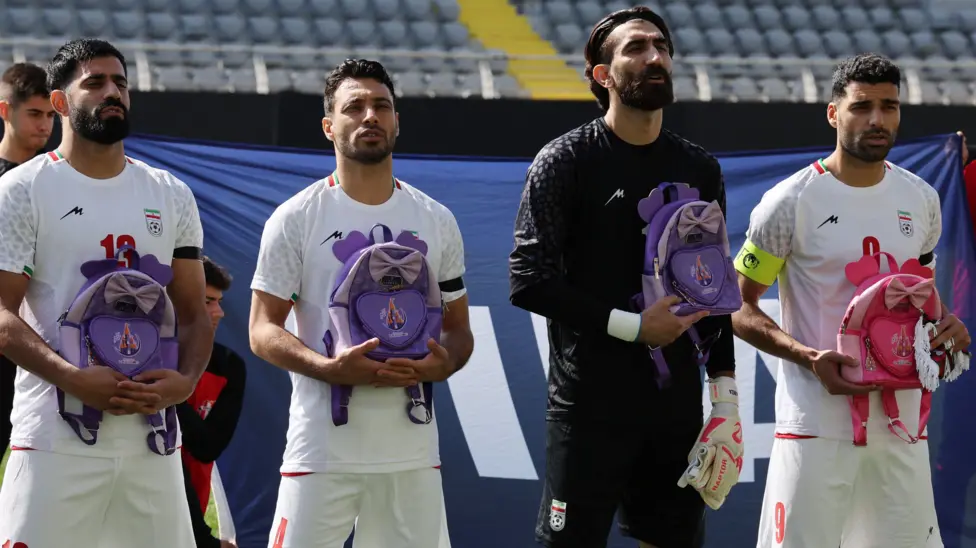
The Iran national men’s football team delivered a powerful and emotional statement before their recent friendly match against Nigeria national football team, using the global stage of sport to highlight a tragic event that has deeply affected the nation. As their national anthem played ahead of kickoff, the players stood in silence wearing black armbands and holding colorful schoolbags, creating a striking image of remembrance and protest.
This symbolic gesture was in response to a devastating strike on the Shajareh Tayyebeh School in southern Iran. The attack, which occurred on the first day of the ongoing conflict, resulted in the deaths of at least 168 individuals, including approximately 110 children, according to Iranian authorities. The scale of the tragedy has sparked widespread grief and anger within the country.
The players’ decision to carry schoolbags—some decorated in bright pink and purple with ribbons—was a deliberate tribute to the young victims of the attack. A team media representative explained that the gesture was meant to honor the memory of the children who lost their lives, particularly the girls who were among the casualties. By holding the bags close to their chests, the players sought to convey both mourning and solidarity.
Among those participating in the tribute was Mehdi Taremi, a well-known striker who has previously played for top European clubs. The presence of high-profile players added further visibility to the message, drawing international attention to the incident.
The strike itself has been the subject of intense scrutiny and controversy. Reports from American media outlets have suggested that US military investigators believe their own forces may have been responsible for the strike, though it was described as unintentional. The school was located near a compound associated with the Islamic Revolutionary Guard Corps, which may have contributed to the targeting error.
Despite these reports, no official responsibility has been accepted by either the United States or Israel, both of whom Iranian officials have blamed for the attack. The lack of a clear and definitive explanation has only heightened tensions and calls for accountability.
The international community has also taken notice. United Nations human rights officials have urged the United States to complete its investigation into the incident and make its findings public. There is growing pressure for transparency, particularly given the high number of civilian casualties, including children.
While the players’ protest was focused on remembrance, it also underscored broader concerns about Iran’s participation in upcoming international competitions. The country has qualified for the next FIFA World Cup, which is set to be hosted jointly by the United States, Mexico, and Canada. However, political tensions and security concerns have cast doubt over whether Iran will take part.
Iran’s World Cup schedule includes matches against New Zealand and Belgium in Los Angeles, followed by a final group-stage game against Egypt in Seattle. These fixtures would require the team to travel to the United States, a prospect that has become increasingly uncertain.
Earlier this month, Donald Trump expressed reservations about Iran’s participation in the tournament. He suggested that it might not be appropriate for the team to compete in the US, citing concerns about their safety and the broader political climate.
In response, Mehdi Taj, the head of Iran’s football federation, stated that the team would refuse to travel to the United States under such conditions. He emphasized that without guarantees of security, participation would not be feasible.
Taj also revealed that discussions had been held with FIFA regarding the possibility of relocating Iran’s matches to Mexico. However, these proposals appear to have been rejected, leaving the situation unresolved. The uncertainty surrounding Iran’s participation adds another layer of complexity to an already sensitive issue.
On the pitch, Iran’s friendly against Nigeria ended in a 2-1 defeat. Despite the result, the focus remained on the symbolic actions taken before the match rather than the performance itself. The team is scheduled to play another friendly against Costa Rica in Turkey, continuing their preparations amid ongoing uncertainty.
This is not the first time Iranian footballers have used their platform to express their views. Earlier in the month, members of the women’s national team staged their own form of protest during the AFC Women’s Asian Cup. They chose not to sing the national anthem before one of their matches, a decision that sparked significant backlash within Iran.
The reaction from some quarters was severe, with a presenter on Iranian state television labeling the players as “traitors.” The incident highlighted the risks athletes may face when expressing dissent, particularly in politically sensitive contexts.
Following their protest, several members of the women’s team reportedly explored the possibility of seeking humanitarian visas in Australia. They were concerned about potential repercussions upon returning home. However, all players ultimately decided to withdraw their applications and return to Iran, ending speculation about possible asylum claims.
The actions of both the men’s and women’s teams demonstrate how sport can intersect with political and humanitarian issues. Athletes are increasingly using their visibility to draw attention to causes that matter to them, even when doing so carries personal and professional risks.
In the case of the men’s team, their tribute served as a reminder of the human cost of conflict and the importance of remembering those who have been lost. The image of players standing with schoolbags in hand resonated far beyond the football pitch, symbolizing grief, احتجاج, and a call for justice.
As investigations into the school strike continue, the hope remains that clarity and accountability will emerge. For now, the Iranian team’s gesture stands as a poignant expression of solidarity with the victims and their families, ensuring that their memory is not forgotten.