

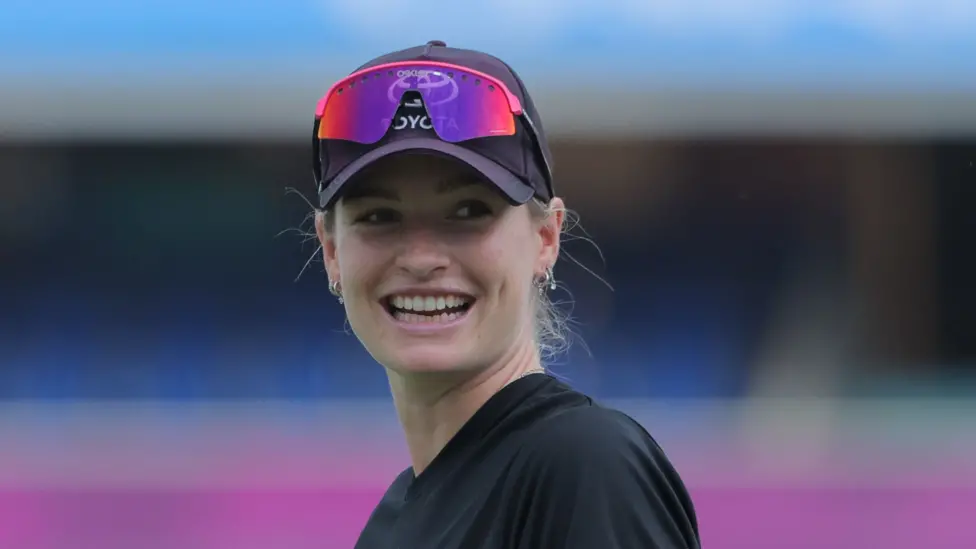
The rise of Lauren Bell in international cricket has been nothing short of remarkable. In just a few years, she has transitioned from an exciting young prospect into the leader of England’s pace attack, a role once held by some of the most iconic fast bowlers in women’s cricket.
Bell’s journey began to gain serious attention during the inaugural season of The Hundred in 2021. Her performances in the tournament marked her as one of the most promising fast bowlers in England. It wasn’t long before she earned her international debut the following year, opening the door to a whirlwind period in her career that included participation in three World Cups and two Ashes series.
In a relatively short span, Bell has experienced the intensity and pressure of top-level cricket, gaining invaluable experience along the way. Her rapid progression has not only been evident on the field but also off it. Securing a £140,000 deal in The Hundred and winning the Women’s Premier League with Royal Challengers Bengaluru elevated her profile significantly. As a result, her social media following surged to an impressive 2.2 million on Instagram—surpassing even established England men’s stars like Joe Root and Harry Brook combined.
Despite her growing fame, Bell has remained grounded, focusing on her development and responsibilities within the England team. At just 25 years old, she now finds herself leading the pace attack—a position previously occupied by legendary seamers such as Anya Shrubsole and Katherine Brunt, and more recently by Kate Cross.
Reflecting on her new role, Bell admitted that the transition happened almost without her realizing it. What once seemed like a distant possibility has now become her reality. As experienced players gradually stepped away, she naturally grew into the leadership role, taking on greater responsibility within the squad.
Her rise was further accelerated when England made the decision to drop Kate Cross last summer. This left Bell as the most experienced seamer in a relatively young bowling group that includes talents like Issy Wong and Lauren Filer, along with all-rounders such as Danielle Gibson, Em Arlott, and Freya Kemp.
Bell often speaks about the influence of Kate Cross, who played a significant role in her early days with the national team. She describes Cross as a mentor and a “big sister” figure who helped her settle into the international environment. Even now, Bell values her guidance and remains in touch for advice when needed.
In recent months, Bell’s leadership qualities have become even more apparent. Since Christmas, England have not played many competitive matches following their exit in the semi-finals of the 50-over World Cup in India. However, preparations for upcoming tournaments have been in full swing under the guidance of head coach Charlotte Edwards.
Edwards organized an extensive training camp in South Africa, bringing together a group of 30 players that included both experienced internationals and promising youngsters. The squad was divided into two teams for a five-match series, designed to simulate the intensity of international cricket and kickstart preparations for the upcoming T20 World Cup on home soil.
According to Bell, the camp was highly competitive and provided valuable insights into team dynamics. Playing against teammates added an extra layer of challenge, as players were already familiar with each other’s strengths and strategies. This environment helped sharpen skills and foster healthy competition within the squad.
Fitness has also been a major focus under Edwards’ leadership. Following criticism during last year’s Ashes series, new fitness standards were introduced to improve the team’s overall performance. While the topic initially sparked debate, Edwards believes the improvements have addressed those concerns effectively.
As England continue their preparations, players like Bell are balancing national duties with domestic commitments. Bell, who represents Hampshire, is set to feature in early rounds of the domestic 50-over competition before fully shifting focus to international fixtures.
The schedule ahead is demanding. England will play six T20 matches—three against New Zealand and three against India—before launching their T20 World Cup campaign against Sri Lanka on 12 June. These matches will be crucial in fine-tuning strategies and building momentum.
It has been nine years since England last lifted a major trophy, winning the 50-over World Cup in 2017. This drought is something that weighs heavily on the team, including Bell. She acknowledges that not winning titles is frustrating but believes it has also fueled the squad’s determination to turn things around.
Meanwhile, England’s men’s team is also navigating its own challenges following a difficult Ashes series. The women’s team experienced a similar situation after their 16-0 defeat in Australia, prompting a period of reflection and rebuilding.
Bell’s perspective reflects a team eager to evolve and compete at the highest level once again. She understands the importance of support from grassroots cricket, having recently participated in the ECB’s Get Set Weekend at St Albans Cricket Club. Events like these highlight the vital role local clubs and volunteers play in sustaining the sport.
Looking ahead, the competition at the international level remains fierce. Teams like India and Australia continue to set high standards, with Australia in particular maintaining dominance in women’s cricket. However, Bell is optimistic about England’s chances, especially with the advantage of playing at home during the World Cup.
Her journey from a rising star to a key figure in England’s bowling lineup is a testament to her hard work, resilience, and passion for the game. As she embraces her role as the leader of the pace attack, Bell represents the future of English cricket—a player capable of inspiring both her teammates and the next generation of cricketers.
For more cricket news, updates, and in-depth coverage, visit: https://netsports247.com