
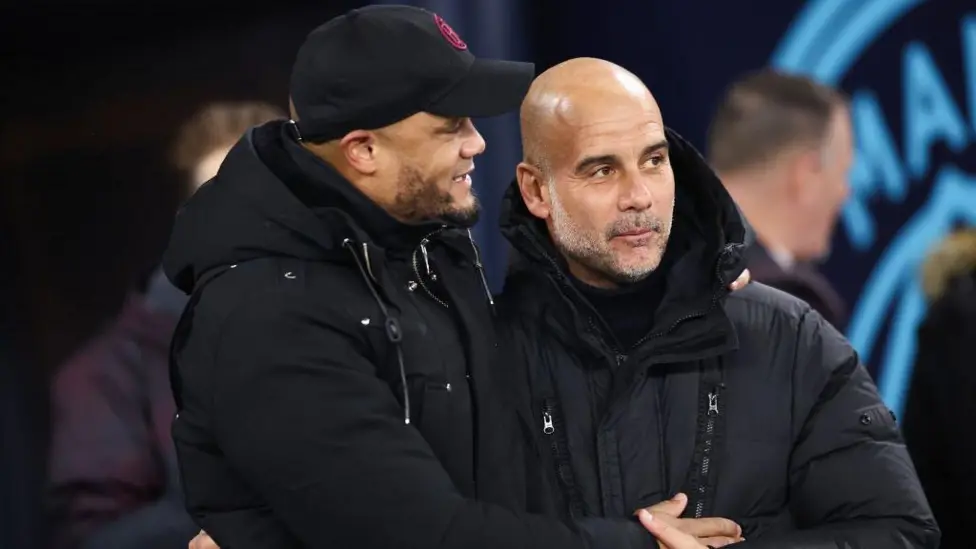
Vincent Kompany built a legendary reputation during his playing days at Manchester City—so much so that he has a statue outside the Etihad Stadium honoring his contributions. Now, as a manager at Bayern Munich, he is crafting a new chapter in his career, one that could potentially rival his achievements on the pitch.
When Kompany was appointed Bayern manager in May 2024, the decision surprised many in the football world. After all, he had just overseen Burnley’s relegation from the Premier League. For a club with Bayern’s stature, expectations are always sky-high, and the appointment raised doubts about whether Kompany was ready for such a demanding role.
However, those doubts have quickly faded. Under his leadership, Bayern secured the Bundesliga title in his first season and are now on track to defend it, sitting comfortably 12 points clear at the top of the table. Their domestic dominance has been complemented by an impressive European campaign, with Bayern holding a 2-1 advantage over Real Madrid heading into the decisive second leg of their Champions League quarter-final.
A Tactical Identity Built on Boldness
One of the defining features of Kompany’s Bayern Munich side is their fearless approach to football. While many elite teams have recently become more cautious—especially when facing tightly organized man-to-man defensive systems—Kompany has encouraged his players to embrace risk.
His team plays with fluidity and freedom, both in possession and without the ball. Every player is involved in the build-up, starting from the goalkeeper and defenders. This philosophy reflects Kompany’s belief that football should be proactive rather than reactive.
A perfect example of this approach came during Bayern’s Champions League last-16 tie against Atalanta. The Italian side attempted to disrupt Bayern’s rhythm with aggressive man-marking across the pitch. Instead of resisting this pressure in a conventional way, Kompany instructed his players to rotate positions constantly.
Players such as Serge Gnabry even dropped into defensive areas to receive the ball, dragging their markers out of position. This created confusion in the opposition’s structure, leaving gaps for Bayern to exploit. The result was a dominant 10-2 aggregate victory, showcasing the effectiveness of Kompany’s innovative tactics.
Movement as a Core Principle
If there is one concept that defines Kompany’s system, it is movement—particularly off the ball. His players are constantly shifting positions, creating overloads and opening passing lanes that unsettle even the most disciplined defenses.
Against Real Madrid in the first leg of their quarter-final, Bayern demonstrated this perfectly. Midfielder Joshua Kimmich frequently dropped deep to form a back three alongside the central defenders. This created a numerical advantage against Madrid’s two-man forward line of Vinicius Junior and Kylian Mbappe.
At the same time, Bayern’s full-backs moved into more central and advanced positions, drawing Madrid’s wide midfielders out of position. This clever manipulation of space allowed players like Michael Olise to receive the ball in dangerous areas with minimal pressure.
Olise’s ability to carry the ball forward at pace added another dimension to Bayern’s attack. His direct runs forced Madrid’s defense to retreat, creating space for teammates to exploit.
A Balanced and Dynamic Attack
Bayern’s attacking trio is carefully structured to maximize effectiveness. Olise provides creativity and ball progression, while players like Luis Diaz make penetrating runs behind the defense. Meanwhile, Harry Kane offers a versatile presence as a striker.
Kane’s ability to drop into deeper areas while also posing a threat inside the box makes him a key figure in Kompany’s system. In Bayern’s second goal against Real Madrid, this combination of movement and positioning was on full display. As Olise drove forward and other attackers stretched the defense, Kane found space at the edge of the box and finished clinically.
This blend of creativity, movement, and finishing mirrors the attacking dynamics seen in other successful teams, including Barcelona’s forward line featuring Robert Lewandowski, Lamine Yamal, and Raphinha.
Defensive Intelligence and Flexibility
While Bayern are known for their attacking flair, their defensive organization is equally impressive. Kompany has implemented a high-pressing system that often starts with man-to-man marking. This approach disrupts opponents’ build-up play and forces mistakes.
However, what sets Bayern apart is their ability to adapt. When opponents manage to progress into advanced areas, the team seamlessly transitions into a more structured defensive shape, often shifting between formations like 4-4-2 and 5-2-3.
This flexibility was evident against Real Madrid, where Bayern alternated between aggressive pressing and compact defensive organization. Players were willing to track opponents into deeper areas, while teammates adjusted their positions to maintain balance.
For example, when a central defender stepped forward to press, another player would drop back to fill the gap, ensuring the defensive line remained intact. This level of coordination reflects the team’s tactical discipline and understanding of Kompany’s system.
From Burnley to Bayern: A Managerial Evolution
Kompany’s journey as a manager began at Burnley, where he achieved remarkable success in the Championship during the 2022–23 season. Guiding the team to the title with a record 101 points, he demonstrated his ability to implement an attractive and effective style of play.
Although Burnley struggled in the Premier League, that experience proved valuable. Managing a top club like Bayern requires not only tactical expertise but also the ability to handle high expectations and elite players.
Kompany’s success at Bayern suggests that he has adapted quickly to this new environment. His background as a player, combined with his leadership qualities, has earned him the respect of his squad.
Leadership Beyond the Pitch
Kompany’s influence extends beyond tactics. Known for his intelligence and thoughtful approach, he has long been a student of leadership. During his time at Manchester City, he even explored concepts from business literature, including books like When Teams Collide, which focuses on managing diverse groups effectively.
This intellectual curiosity has translated into his managerial style. He emphasizes clear communication, accountability, and a collective sense of responsibility within the team.
A Promising Future
At just 40 years old, Kompany is still in the early stages of his managerial career. Yet, his achievements with Bayern Munich suggest that he has the potential to become one of the top coaches in world football.
Speculation has already begun about his future, particularly in relation to Manchester City and the eventual succession of Pep Guardiola. While such a move remains uncertain, Kompany’s connection to the club and his growing reputation make him a natural candidate.
For now, however, his focus remains on continuing Bayern’s success. Whether he builds a long-term legacy in Germany or returns to England in the future, Kompany’s journey is one to watch closely.
For more football news, insights, and updates, visit: https://netsports247.com