
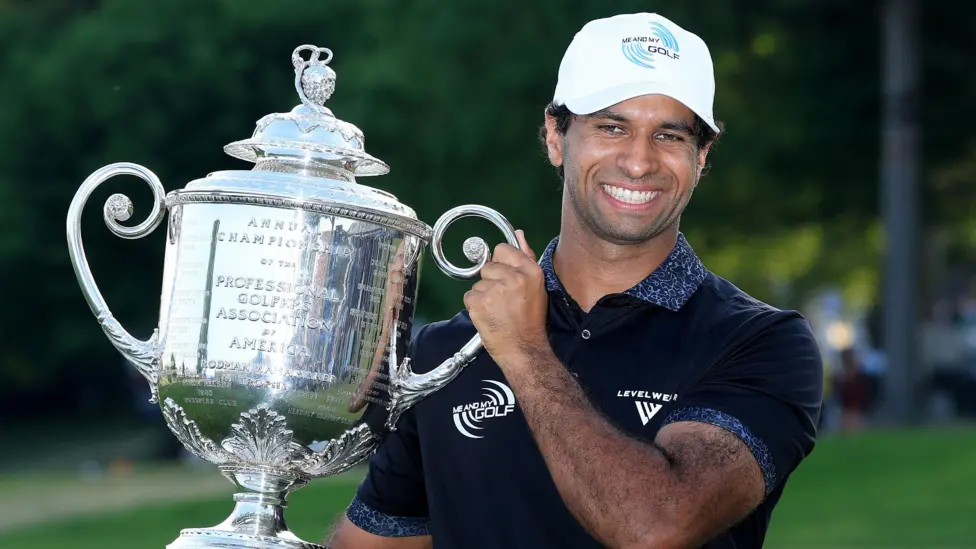
It felt almost poetic that an underdog with unconventional habits emerged victorious at a demanding and gritty edition of the US PGA Championship, held in Philadelphia—a city forever associated with the fictional boxing icon Rocky Balboa. As Aaron Rai stood in the clubhouse at Aronimink, awaiting the official confirmation of his triumph, the famous track “Eye of the Tiger” echoed in the background, adding a cinematic touch to a life-changing moment.
Rai’s journey to becoming a major champion is anything but typical. Unlike most professional golfers, he stands out for a unique habit—wearing two gloves instead of one. While the vast majority of golfers use a single glove for grip, Rai has stuck with his unusual approach since childhood. What began as a simple coincidence turned into a permanent part of his game.
As Rai explained, he initially started using two gloves after being given them early in his golfing days. When he was once forced to play with just one glove because the other had been forgotten, he struggled significantly. The lack of familiarity affected his feel and confidence, convincing him never to abandon his two-glove routine again.
However, his distinctive style is just one aspect of a remarkable story that took him from humble beginnings in Wolverhampton to the pinnacle of global golf.
Interestingly, Rai’s introduction to golf was entirely accidental. As a toddler, he played with his older brother’s hockey sticks, which led to an unfortunate injury when he was struck on the head. Concerned for his safety, his mother Dalvir decided to buy safer plastic alternatives. Instead of purchasing toy hockey sticks, she returned home with plastic golf clubs—a decision that would ultimately shape her son’s future.
During his early years, Rai had dreams far removed from the golf course. He was fascinated by Formula 1 racing and idolized Michael Schumacher. His admiration was so strong that he would wear Ferrari-branded clothing during junior golf tournaments. However, by the time he reached the age of eight or nine, his passion for golf had overtaken all other ambitions.
Rai’s talent became evident at a very young age. He began frequenting the 3 Hammers Golf Complex in Wolverhampton when he was just four years old. Under the guidance of coach Darren Prosser, he honed his skills while also practicing extensively on the facility’s par-three course.
Even as a child, Rai displayed an extraordinary level of focus and determination—qualities that would later define his professional career. Coaches who worked with him during those formative years recall his ability to concentrate intensely, even at such a young age.
As he progressed, Rai began working with coaches Andrew Proudman and Piers Ward, both of whom have remained key figures in his development. Their long-term partnership has been instrumental in shaping Rai’s technical skills and mental approach to the game.
When Prosser encountered Rai again years later during a regional qualifying event for The Open, he was struck by how much the young golfer had matured. Rai had grown physically stronger and demonstrated the mental readiness required to compete at a professional level. It became clear that he was destined for bigger stages.
Throughout his journey, Rai has consistently emphasized the importance of his support system, particularly his parents. His father, Amrik, made a significant sacrifice by leaving his job to dedicate more time to his son’s development. Meanwhile, his mother worked tirelessly to provide financial stability for the family.
Rai has often spoken emotionally about the role his parents played in his success, acknowledging that their unwavering support and belief were crucial in helping him reach the top. Without their sacrifices, he believes his achievements would not have been possible.
As a British Asian athlete, Rai’s journey also carries broader cultural significance. Historically, there have been relatively few players from similar backgrounds competing at the highest levels of golf. In some cases, pursuing a professional sports career may not be encouraged within certain communities, where traditional career paths are often prioritized.
Rai himself acknowledged that such expectations existed, noting that education and stable professions were typically valued more highly. However, his parents encouraged him to follow his passion, allowing him to pursue a path that ultimately led to success on the world stage.
Since turning professional in 2012, Rai has steadily built his career, overcoming challenges along the way. Early struggles on developmental tours tested his resilience, but he gradually established himself, earning opportunities on both the European Tour and the PGA Tour.
His early experiences in major championships were also challenging, as he failed to make the cut in his first two appearances. However, he used those setbacks as learning opportunities, refining his game and building the mental toughness required to compete at the highest level.
All of that hard work came together at Aronimink, where Rai delivered a composed and precise performance under pressure. He finished nine under par, securing victory by three strokes against a strong and competitive field. His final-round score of 65 highlighted his ability to perform when it mattered most.
The win earned him the prestigious Wanamaker Trophy and marked a breakthrough moment in his career. It was not just a personal achievement but also a testament to years of dedication, discipline, and perseverance.
Fellow professionals were quick to praise Rai’s achievement. Rory McIlroy noted that there was widespread happiness for Rai’s success, reflecting the respect he has earned within the golfing community.
Similarly, Xander Schauffele highlighted Rai’s work ethic, describing him as someone who consistently puts in effort behind the scenes. According to Schauffele, Rai’s commitment to training—both on the range and in the gym—sets him apart and exemplifies what it takes to become a major champion.
The conditions at Aronimink were far from forgiving. The course was designed to challenge even the best players, with difficult pin positions, fast and sloping greens, and thick rough that punished mistakes. Rai, like many others, faced moments of adversity during the tournament.
However, his ability to remain composed and continue pushing forward proved decisive. His victory embodied the spirit often associated with Rocky Balboa—the idea that success is not about avoiding setbacks, but about enduring them and continuing to fight.
In the end, Rai’s triumph was more than just a win; it was the culmination of a unique journey defined by individuality, resilience, and determination. His story serves as inspiration not only for aspiring golfers but for anyone pursuing their dreams against the odds.