

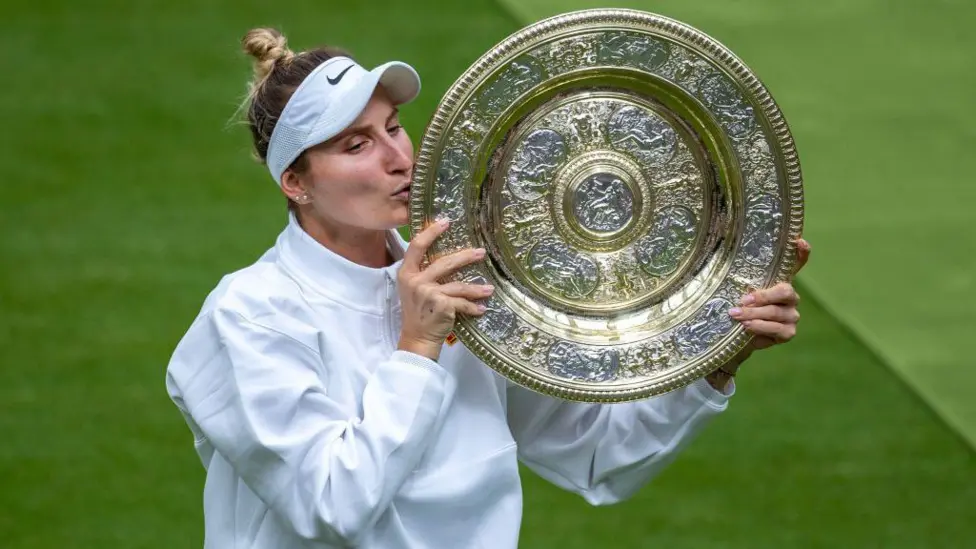
Former Wimbledon champion Marketa Vondrousova has been handed a four-year suspension after refusing to undergo an anti-doping test, a decision that has sent shockwaves throughout the tennis world. The 26-year-old Czech player, who famously claimed the Wimbledon women’s singles title in 2023 as an unseeded competitor, was charged by the International Tennis Integrity Agency (ITIA) following an incident that occurred in December 2025.
According to reports, a doping control officer attempted to conduct a routine out-of-competition test at Vondrousova’s residence. However, the player denied the officer entry into her home. This refusal ultimately led to formal charges being brought against her. Although Vondrousova later explained her concerns regarding safety and alleged procedural irregularities, an independent tribunal concluded that her justification did not meet the threshold required to excuse such a refusal.
In April, Vondrousova publicly addressed the situation, stating that she had been frightened by the circumstances surrounding the visit. She claimed that the officer arrived late in the evening and failed to properly follow identification protocols, which raised alarm for her personal safety. In that moment, she said, her reaction was driven by fear rather than any intention to evade testing.
Despite her explanation, the tribunal ruled that her reasoning lacked sufficient evidence to be considered a “compelling justification.” As a result, the standard penalty for refusing a doping test was applied. Under current anti-doping regulations, refusal or evasion of testing is treated as a serious violation, often carrying the same consequences as a positive test result. Consequently, Vondrousova received a four-year ban from professional tennis, which will remain in effect until 21 June 2030.
The decision has sparked debate within the tennis community. Many observers have pointed out that Vondrousova never tested positive for any banned substances, raising questions about the severity of the punishment. However, officials from the ITIA have emphasized that maintaining the integrity of the sport requires strict enforcement of anti-doping rules. Allowing players to refuse tests without consequence would undermine the entire system designed to ensure fair competition.
ITIA chief executive Karen Moorhouse acknowledged that doping control procedures can be intrusive and uncomfortable for athletes. She also recognized the additional challenges players face due to constant travel and competition schedules. Nevertheless, she stressed that compliance with testing protocols is essential to protect the credibility of the sport. According to Moorhouse, the rules must be applied consistently to all players, regardless of their status or circumstances.
During the hearing, Vondrousova also cited mental health struggles as a contributing factor in her decision-making. She explained that stress and anxiety had affected her judgment at the time of the incident. While the tribunal considered this argument, it ultimately determined that the evidence presented did not justify her refusal. The panel noted that exemptions are typically reserved for extreme situations, such as medical emergencies or unavoidable personal crises.
The ITIA further clarified that its officers are required to carry proper identification and authorization documents at all times. Players also have the option to verify an officer’s credentials using a unique identification code. In Vondrousova’s case, the agency maintained that all procedures were followed correctly. They also revealed that the player signed a refusal form after declining the test, which further strengthened the case against her.
This type of violation remains rare in professional tennis. Instances of players refusing doping tests are uncommon, which is why such cases attract significant attention. A similar situation occurred in 2024 when Russian player Vladislav Ivanov received a four-year ban for refusing to provide a sample during a competition. These cases highlight the strict stance governing bodies take on compliance.
The ruling has had a major impact on Vondrousova’s career. Once ranked as high as world number six, she has since dropped to 122nd in the rankings and has not competed since January. The ban effectively removes her from the sport during what should be the peak years of her professional life. In a statement following the decision, she expressed uncertainty about her future, admitting that she currently has no clear plan moving forward.
“I have never doped, and I have never returned a positive test,” Vondrousova stated. She emphasized her history of cooperation with anti-doping authorities and insisted that she has always competed with a clear conscience. Despite her frustration, she acknowledged the ruling and confirmed that she is considering her options, including a potential appeal.
Vondrousova has the right to challenge the decision at the Court of Arbitration for Sport (CAS). However, such appeals can take several months to resolve, meaning she is likely to miss multiple seasons regardless of the outcome. This includes another opportunity to compete at Wimbledon, the tournament where she achieved the greatest success of her career.
The case has also drawn attention to broader issues surrounding player safety and mental well-being. Vondrousova referenced the 2016 attack on fellow Czech player Petra Kvitova as a reason for her heightened caution. Kvitova was injured during a home invasion, an घटना that shocked the tennis world and remains a stark reminder of the risks athletes can face.
While some sympathize with Vondrousova’s concerns, others argue that professional athletes must adhere strictly to established protocols. The balance between ensuring safety and maintaining fairness continues to be a topic of discussion. Ultimately, the tribunal’s decision reinforces the message that compliance with anti-doping rules is non-negotiable.
As the tennis world reacts to this high-profile case, it serves as a reminder of the importance of integrity in sport. Whether or not Vondrousova’s appeal succeeds, the consequences of her decision will have a lasting impact on her career and reputation. For now, one of tennis’s most remarkable recent champions faces an uncertain future away from the court.
For more sports news and updates, visit:
NetSports247