

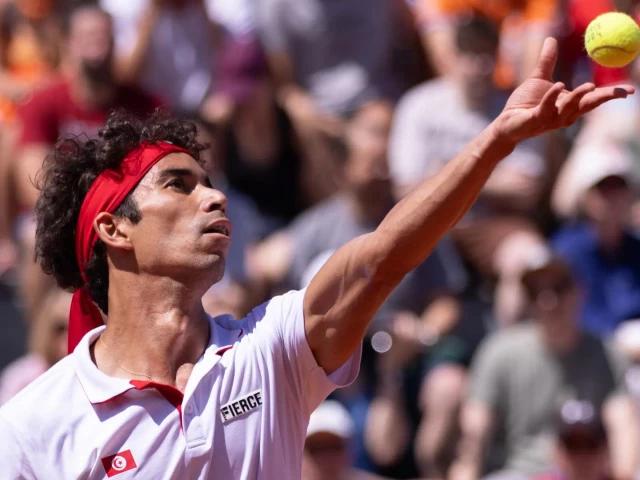
For every global tennis superstar like Jannik Sinner or Carlos Alcaraz, there are hundreds of professional players grinding away on the sport’s lower tiers, competing week after week for modest prize money and uncertain futures. These players travel constantly, often far from the spotlight, chasing ranking points and the hope of one breakthrough that could change everything.
Moez Echargui of Tunisia is one such player — but now, after years of perseverance, he finds himself on the brink of a career-defining moment.
Just a year ago, Echargui was ranked outside the world’s top 500 and earned a little over $2,000 for winning an ITF event in Monastir. Fast forward 12 months, and the 30-something journeyman has surged to world No. 134, earned his place in Australian Open qualifying, and is preparing for his first-ever appearance at a Grand Slam tournament.
For many players at a similar stage of life, retirement plans are already forming. For Echargui, however, the dream is very much alive.
A remarkable run on the ATP Challenger Tour during the past season transformed his career trajectory. Those results not only boosted his ranking but also opened doors that once seemed firmly closed. While he must still win three matches in Melbourne to reach the main draw, simply being part of the qualifying field represents a victory in itself — a reward for refusing to give up when others might have walked away.
“When I arrived at Melbourne Park to pick up my accreditation, I just stopped for a moment,” Echargui told Reuters by phone. “I thought, ‘Wow, I’ve really made it here.’ Seeing the Australian Open branding everywhere was emotional. I felt like a little kid again.”
Currently the highest-ranked African player in the world, Echargui admitted that the scale and professionalism of the Australian Open was a stark contrast to the Challenger and ITF circuits where he usually competes. Based in Milan, the Tunisian holds a degree in mechanical engineering from the University of Nevada — a reminder that tennis was never guaranteed to be his lifelong career.
“Everything here is so well organised,” he said. “Food, transport, laundry — everything is taken care of. There are people everywhere to help. Compared to the smaller tournaments, it actually feels easy to be here.”
That sense of ease, however, was earned the hard way.
Echargui showed promise as a junior, once hovering near the world’s top 100 at that level. But injuries, combined with limited financial support, forced him to reassess his path. Rather than diving headfirst into professional tennis, he chose to prioritise his education before eventually committing fully to the tour in 2017.
In 2019, seeking a fresh start, he relocated to Milan to train at the MXP Academy under coach Paolo Moretti. What followed was one of the most challenging periods of his career. A serious wrist injury, along with knee and hamstring problems, left his future in doubt and threatened to end his professional ambitions altogether.
For a time, it seemed his biggest moment might already have passed. In 2024, Echargui qualified for the Paris Olympics through an ITF allocation after winning gold at the African Games. That achievement earned him a spot at Roland Garros, where he faced Britain’s Dan Evans in the first round. Although he lost the match, the appearance on one of tennis’s biggest stages stood out as a career highlight.
What many might have viewed as a final chapter instead became a turning point.
Rather than slowing down, Echargui began producing the best tennis of his life. With renewed confidence, improved fitness, and tactical maturity, he pieced together a stunning Challenger Tour campaign. Results followed, rankings climbed, and belief returned.
“People often think that once you reach your late 20s, it’s time to think about the end,” Echargui said. “When I was 29 and decided to move to Milan, a lot of people would have said, ‘Why bother? Why leave your family and start again in another country?’”
“It wasn’t easy. There were tough moments — physically and mentally. But there were also great moments. Looking back now, I think I made the right decision.”
Like a fine wine, Echargui’s game has matured with age. His experience allows him to manage matches more intelligently, while his resilience has been forged through years of setbacks. Now, standing on the cusp of Grand Slam tennis, he has a genuine chance to establish himself at ATP Tour level — something that once seemed highly unlikely.
The Australian Open qualifying draw represents more than just three matches; it symbolises the payoff for years of unseen effort. Win or lose, Echargui’s journey serves as a reminder that tennis success does not follow a single path. Not every story is written in teenage prodigies and overnight breakthroughs.
For African tennis, his rise is also significant. As the continent’s top-ranked player, Echargui carries hopes beyond his own ambitions, proving that players from emerging regions can still compete on the global stage with persistence and belief.
As he prepares to step onto the courts at Melbourne Park, Echargui does so with gratitude, excitement, and quiet determination. Whether he reaches the main draw or not, his presence alone marks a personal triumph — and perhaps the beginning of an unexpected late-career surge.
For more tennis features, player stories, and global sports coverage, visit https://netsports247.com/.