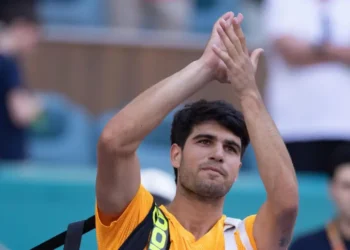

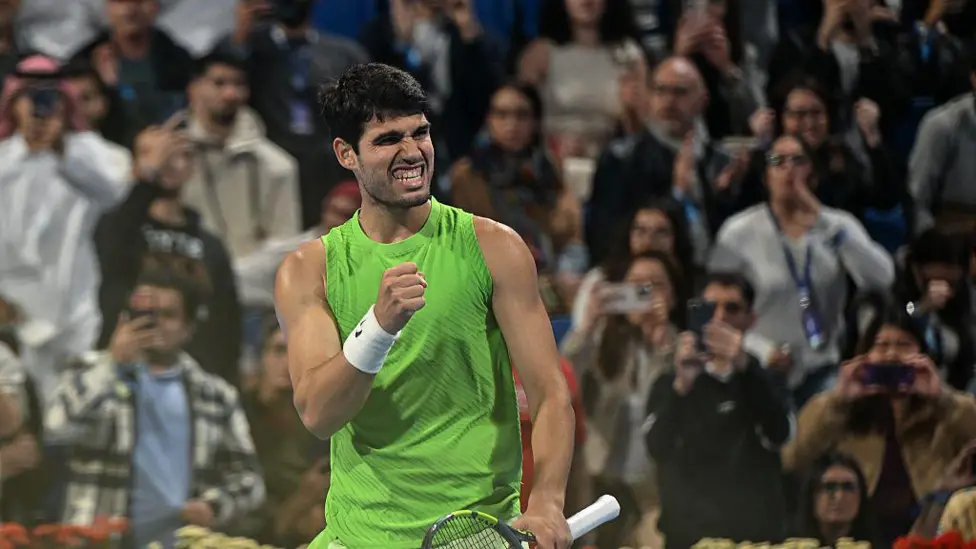
Carlos Alcaraz admitted he was relieved to overcome a series of challenging moments during his return to competitive action, as the Spanish star secured a hard-fought victory over Arthur Rinderknech in the opening round of the Qatar Open in Doha. The top seed produced a composed performance under pressure, eventually defeating the unseeded Frenchman 6-4, 7-6 (7-5) in what marked his first match since lifting the Australian Open title last month.
Coming into the tournament, expectations were naturally high for the 22-year-old, who had recently achieved a historic milestone by defeating Novak Djokovic in Melbourne to complete a career Grand Slam at an exceptionally young age. That victory further cemented his status as one of the dominant figures in modern tennis and set the tone for what has already been an impressive start to the 2026 season. However, his encounter with Rinderknech demonstrated that even the best players must navigate tense phases and momentum swings, particularly when facing unpredictable opponents early in tournaments.
Reflecting on the match afterward, Alcaraz openly acknowledged the difficulties he encountered, praising his opponent’s aggressive and dangerous playing style. He explained that Rinderknech is the type of player few top seeds want to face in the first round due to his powerful serve, fearless shot-making, and ability to seize opportunities under pressure. Despite those challenges, Alcaraz expressed satisfaction with both his performance level and his mental resilience, highlighting his ability to remain calm during the most testing passages of the match.
The Spaniard began the contest with confidence and clarity in his approach. Early in the first set, he showcased his trademark blend of speed, precision, and tactical awareness, breaking Rinderknech’s serve to establish a 3-2 lead. From that moment, he managed the set effectively, maintaining control from the baseline and using clever variation to disrupt his opponent’s rhythm. His movement around the court and sharp net play were particularly influential, and he eventually closed out the set 6-4 with a delicate volley that reflected both finesse and composure.
However, the second set proved significantly more demanding. Rinderknech raised his level and began to dictate points more aggressively, putting pressure on Alcaraz with powerful groundstrokes and improved serving accuracy. As the set progressed, the Frenchman’s confidence grew, and he managed to push the Spaniard into several tight service games. At 6-5, Rinderknech earned two crucial set points, threatening to level the match and shift the momentum entirely.
It was during this phase that Alcaraz’s mental strength became evident. Rather than panicking, he relied on his experience and shot-making ability to neutralize the danger. Producing a series of high-quality winners — 28 in total throughout the match — he saved both set points and forced a tie-break. His ability to raise his intensity at decisive moments ultimately made the difference, as he edged the tie-break 7-5 with a superb forehand down the line that sealed the victory and prevented the match from going to a deciding set.
The win not only secured his progression into the second round but also marked a significant personal milestone, as it was his 150th tour-level victory on hard courts. Furthermore, the result extended his unbeaten run at the start of the 2026 season to 8-0, underlining the consistency and form that have characterized his performances since the beginning of the year. Such statistics reinforce the growing perception that Alcaraz is entering a phase of sustained dominance on the ATP Tour.
His next challenge in Doha will come against France’s Valentin Royer, who advanced to the second round with an emphatic 6-0, 6-3 victory over compatriot Pierre-Hugues Herbert. While Royer may not carry the same ranking pedigree as some other competitors, his commanding win suggests he should not be underestimated, especially in a tournament environment where momentum and confidence can play decisive roles.
While Alcaraz’s success provided a highlight in Doha, events at the Dubai Tennis Championships were once again overshadowed by a wave of withdrawals and fitness concerns among players. The second round saw several competitors progress without stepping onto the court due to walkovers, raising further questions about the physical demands of the current tennis calendar.
Among those affected was rising star Mirra Andreeva, who advanced after her scheduled opponent, Daria Kasatkina, withdrew before their match. Similarly, ninth seed Belinda Bencic was granted a walkover when Sara Bejlek pulled out ahead of their encounter. These developments added to a growing list of retirements and withdrawals that have plagued the tournament, following multiple dropouts in the opening round as well.
In another notable match, Paula Badosa was forced to retire after losing the first set 6-4 against sixth seed Elina Svitolina, continuing a trend of injury-related setbacks for several players on the tour. Elsewhere, Ella Seidel also withdrew after dropping the opening set 6-0 to Jaqueline Cristian, further highlighting the physical toll that back-to-back tournaments can impose on athletes competing at the highest level.
The accumulation of withdrawals has drawn attention to the demanding nature of the professional tennis schedule, particularly during the Middle East swing, which takes place shortly after the Australian Open. With little recovery time between major events, players are often required to compete while managing fatigue, minor injuries, and the mental strain of continuous travel and high-stakes competition.
In response to these concerns, the Women’s Tennis Association (WTA) has announced the formation of a new governing body known as the Tour Architecture Council. This initiative aims to evaluate and improve various aspects of the women’s tour structure, including scheduling, commitments, and overall sustainability for players.
The council will be chaired by world number five Jessica Pegula and will include a diverse group of stakeholders, such as active players, tournament directors, and senior WTA officials. Notably, former world number one Victoria Azarenka is also part of the council, bringing valuable experience and insight into the challenges faced by elite athletes across the tour.
According to WTA leadership, the council has been established because the current calendar is increasingly viewed as unsustainable given the physical, professional, and personal pressures associated with competing at the highest level. The organization believes that a structured and collaborative review process will allow for meaningful reforms that benefit both players and the sport as a whole.
Pegula emphasized that the initiative represents an important opportunity to address immediate concerns while also laying the groundwork for long-term structural improvements. She noted that the council will focus on specific elements of the tour framework that can be adjusted in the short term, while continuing broader discussions aimed at shaping the future direction of the sport. Potential changes emerging from this process could be implemented as early as the 2027 season, depending on the outcomes of the council’s recommendations.
Overall, the developments across Doha and Dubai reflect two contrasting narratives within the tennis world. On one hand, Alcaraz’s composed victory and continued winning momentum highlight the emergence of a new generation of champions capable of performing under intense pressure. On the other hand, the recurring withdrawals and scheduling concerns underline the physical challenges players face in maintaining peak performance throughout a packed competitive calendar.
For Alcaraz, the immediate focus will remain on maintaining his unbeaten start to the season and building rhythm as he progresses deeper into the Qatar Open. His ability to navigate difficult moments against a dangerous opponent suggests he is well-prepared for tougher tests ahead, especially as the tournament advances into its later stages. If he continues to combine mental resilience with his already exceptional technical skills, he will remain a strong contender for the title in Doha and beyond.
For more latest tennis news and updates, visit: https://netsports247.com