

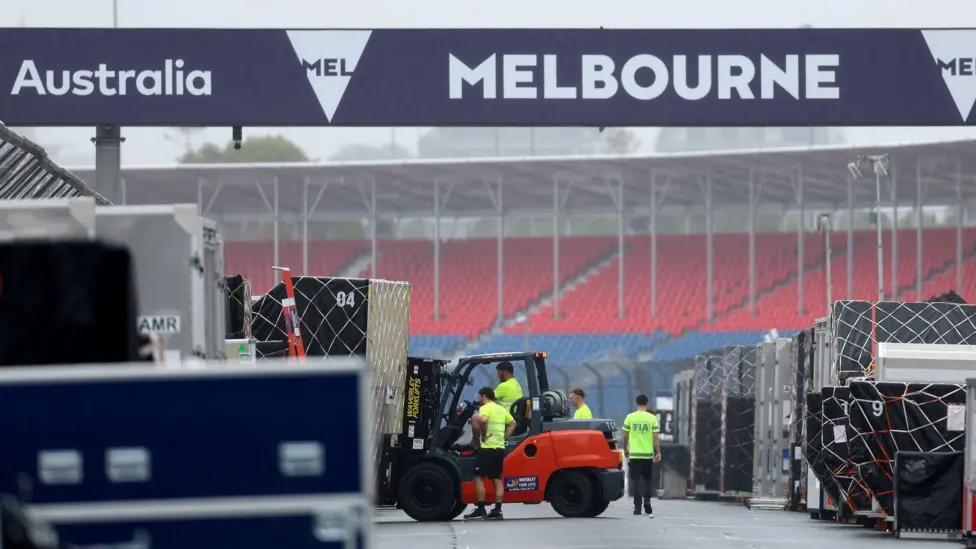
Organisers of the Australian Grand Prix have expressed strong confidence that ongoing geopolitical tensions in the Middle East will not disrupt the opening round of the 2026 Formula 1 season in Melbourne. Despite significant travel complications affecting hundreds of team personnel, officials insist that preparations remain firmly on track for race weekend.
The disruption follows military escalation involving the United States and Israel launching strikes against Iran, which then triggered retaliatory actions across the region. As a result, major air travel routes passing through key hubs such as Qatar and the United Arab Emirates have experienced interruptions, forcing airlines to reroute or cancel flights. This has had a direct impact on Formula 1’s extensive travelling workforce, many of whom are based in Europe.
Close to 1,000 Formula 1 staff members have been required to reorganise their travel arrangements ahead of the season opener in Melbourne. Reports indicate that approximately 500 of those personnel are now set to travel via specially arranged charter flights from Europe to Australia to ensure they arrive on time.
Australian Grand Prix Corporation chief executive Travis Auld reassured fans and stakeholders that contingency plans have been implemented effectively. Speaking earlier this week, Auld stated that while the past 48 hours required significant logistical adjustments, organisers are confident the event will proceed smoothly without noticeable impact.
According to Auld, Formula 1 centrally manages the complex travel requirements for teams, drivers, engineers, media personnel and technical staff. Given the global scale of the championship, such contingency planning is not unusual, though the current situation has required rapid coordination.
“The last couple of days have involved some reshuffling of flights,” Auld explained. “That is primarily handled by Formula 1 itself. They oversee all the teams, drivers and essential staff required to deliver the event. It’s a large operation, but everything is now locked in. Everyone will be here and ready for the race.”
To mitigate delays, three charter aircraft have reportedly been secured to transport around half of the affected personnel directly from Europe to Australia. This decisive step is expected to prevent staffing shortages and ensure that team preparations continue without disruption once on site.
Importantly, organisers have also confirmed that all freight and cargo — including race cars, equipment, spare parts and broadcasting infrastructure — has already arrived in Melbourne. Freight logistics in Formula 1 are meticulously scheduled well in advance, and in this instance, those shipments were not impacted by the airspace complications.
Auld reiterated that spectators attending the event should not notice any difference compared to previous years. Melbourne, which traditionally attracts large crowds for the season opener, is preparing as normal to host the curtain-raiser of what promises to be a groundbreaking campaign under new technical regulations.
Formula 1 itself has acknowledged the broader geopolitical developments and confirmed it is carefully monitoring the situation. While the immediate focus is on Australia, the championship calendar later includes races in the Middle East, specifically in Bahrain and Saudi Arabia during April.
An F1 spokesperson clarified that the next three rounds — Australia, China and Japan — are geographically removed from the conflict zone and therefore not currently at risk. The Bahrain Grand Prix, scheduled for 12 April, and the Saudi Arabian Grand Prix on 19 April, remain several weeks away.
“As always, we closely monitor any global developments and maintain communication with relevant authorities,” the spokesperson said. “Our immediate races are not located in the Middle East, and preparations continue as planned.”
Following the Australian round, Formula 1 travels to China and Japan — events that are not expected to face travel complications linked to the Middle East airspace disruptions. However, questions naturally arise about potential future scheduling adjustments should instability persist.
Auld acknowledged that while no immediate changes are necessary, contingency discussions are likely taking place behind the scenes. Formula 1 has demonstrated flexibility in recent years when faced with global challenges, including pandemic-related calendar reshuffles and regional conflicts.
“I’m sure they’re looking ahead and assessing all possible implications,” Auld said in a separate interview. “At the moment, there are no issues for us in Melbourne. But Formula 1 will always consider alternatives if adjustments to the calendar become necessary.”
The logistical scale of a Formula 1 season is immense. Teams travel with hundreds of staff members and tonnes of specialised equipment, relying on tightly coordinated global transport networks. Even minor disruptions can create significant challenges, particularly when races are scheduled on consecutive weekends.
Despite the complexity, organisers in Melbourne remain upbeat. The Albert Park circuit is ready, infrastructure is in place, and teams are expected to complete final preparations as soon as all personnel arrive.
For drivers and engineers, the focus remains firmly on competition. With sweeping new regulations debuting this season, teams are eager to gather critical data and establish early momentum in the championship fight. The opening race always carries added pressure, and ensuring full operational readiness is essential.
Fans travelling internationally to attend the event have also been reassured that commercial flights into Australia are operating normally. The travel disruptions have largely affected routes passing through specific Middle Eastern hubs rather than direct services into Melbourne.
While global events continue to evolve, Formula 1’s response demonstrates the sport’s ability to adapt swiftly to external challenges. By arranging charter flights and maintaining close coordination with authorities, the championship aims to shield teams and spectators from the broader turbulence.
As the lights prepare to go out in Melbourne, attention will soon shift from logistics to on-track action. The 2026 season promises major storylines, technical intrigue and fierce competition — and organisers are determined that external events will not overshadow the spectacle.
For more Formula 1 news and global sports coverage, visit:
https://netsports247.com