
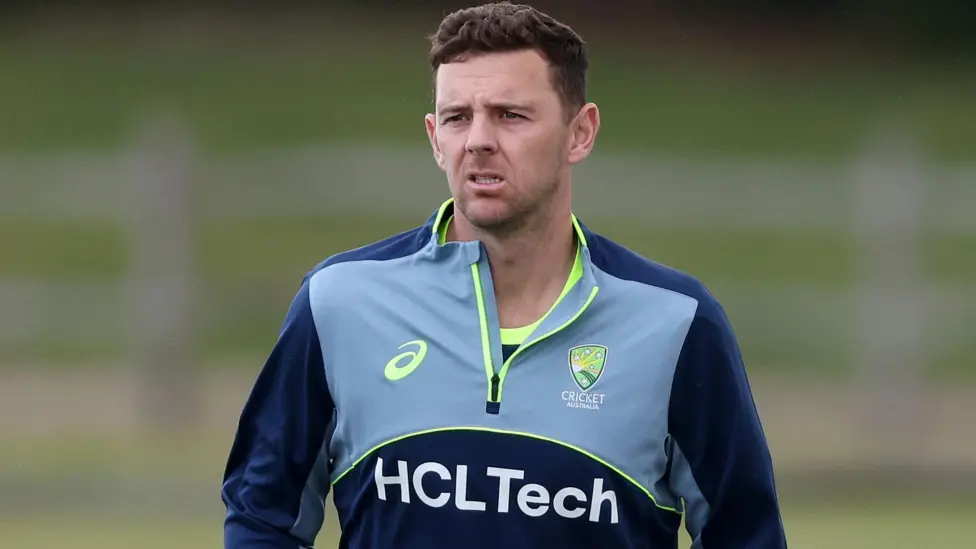
Josh Hazlewood Ruled Out of T20 World Cup as Australia Faces Injury Woes
Australia’s preparations for the upcoming men’s T20 World Cup have taken a hit as veteran fast bowler Josh Hazlewood has been officially ruled out of the tournament. The 35-year-old, renowned for his lethal seam bowling and remarkable consistency in all formats, has been absent from competitive cricket since mid-November, primarily due to ongoing issues with his hamstring and Achilles tendon. These injuries had already forced him to miss the Ashes series against England, depriving Australia of one of their most experienced pace bowlers in the high-profile five-match contest.
Initially, Cricket Australia had included Hazlewood in the 15-man World Cup squad, expressing hope that he might regain match fitness by the latter stages of the tournament. The management and medical team were optimistic that, with careful rehabilitation, he could feature in some of the crucial Super 8 games. His inclusion was seen as vital for Australia’s seam attack, particularly given that Pat Cummins, the regular Test captain and another leading fast bowler, has also been ruled out due to a back injury, which further complicates Australia’s pace resources.
However, Cricket Australia’s national selector, Tony Dodemaide, recently confirmed that pushing Hazlewood to return sooner than his body allows would involve significant risks. Dodemaide stressed that the medical and coaching teams had evaluated the situation closely and determined that any attempt to accelerate Hazlewood’s recovery could compromise both the bowler’s long-term fitness and the team’s stability. “We were hopeful Josh would be back to match fitness by the Super 8s stage,” Dodemaide said, “but the latest indications are that he is still some time away from being ready to play. Trying to rush his recovery now carries too much of a risk to both player and team.”
Hazlewood’s absence, while unfortunate, is part of a broader pattern of injury concerns for Australia’s squad ahead of the tournament, which is co-hosted by India and Sri Lanka. Pat Cummins, who has only recently returned to international cricket following a hamstring strain and a minor back issue, was ruled out of the T20 World Cup entirely. Cummins’ absence, alongside Hazlewood’s, has prompted questions about Australia’s depth in pace bowling, particularly when facing subcontinental conditions where variations in pace, bounce, and spin play a crucial role in tournament success.
The selectors have also considered Sean Abbott, a versatile bowling all-rounder, who had previously traveled with the squad as a reserve player. While Abbott could potentially cover some of the gaps left by Hazlewood, Cricket Australia has confirmed that no immediate formal replacement will be named. Dodemaide explained that the squad is adequately equipped to cover the initial games and that any decisions about adding players later in the tournament will be made based on priority needs at the time. This cautious approach reflects Cricket Australia’s strategy to balance the squad’s competitiveness with managing injury risks among key players.
Australia’s opening match of the tournament is scheduled against Ireland in Colombo on 11 February, and the management appears confident that the current squad can perform effectively, even without Hazlewood and Cummins. However, his absence will certainly be felt, particularly in the early stages, as Hazlewood is known for his disciplined line and length, ability to swing the ball both ways, and knack for taking wickets during crucial overs. His replacement will need to shoulder greater responsibility, and other members of the pace attack will be expected to step up under the intense scrutiny of World Cup conditions.
Injuries to senior players like Hazlewood and Cummins highlight the ongoing challenge of managing fast bowlers’ workloads in modern cricket, particularly with a congested international calendar. Hazlewood, who has been a stalwart for Australia across formats for over a decade, has experienced a series of fitness issues in recent years, which have occasionally interrupted his rhythm in key tournaments. This World Cup comes at a time when the team will rely heavily on both emerging talents and seasoned campaigners to maintain their competitive edge.
Despite the setback, Cricket Australia remains optimistic about the team’s overall composition and preparedness. The selectors and coaching staff have emphasized that Australia has a deep pool of players capable of adapting to different match situations, and the focus is on ensuring that the squad is ready for the unique conditions in Sri Lanka and India. These conditions, including slower pitches and variable bounce, can test even the most experienced bowlers, making squad depth and tactical flexibility essential.
Hazlewood’s exclusion also draws attention to the broader issue of player fitness and management in the lead-up to major ICC events. Teams are increasingly cautious about rushing injured players back into action, recognizing that premature returns can result in longer-term setbacks, including recurring injuries. For Hazlewood, prioritizing recovery now could extend his career and ensure he remains available for future international assignments, including Australia’s ongoing Test and ODI campaigns.
Meanwhile, the Australian team’s bowling responsibilities will fall more heavily on younger players and all-rounders, who will have to manage both the workload and the expectations of representing a powerhouse cricketing nation in one of the sport’s most high-profile tournaments. The early rounds of the T20 World Cup will be crucial for Australia to establish momentum and build confidence among the squad, particularly with the uncertainty surrounding fitness of key players like Hazlewood.
The Cricket Australia management has reassured fans that team strategy remains robust, and the focus is on balancing attacking and defensive plans in the absence of a senior bowler. Team leaders have also emphasized the importance of adaptability, noting that Australia’s strong bench strength provides options should injuries continue to affect the squad. This approach reflects lessons learned from previous tournaments, where depth, flexibility, and injury management have been decisive factors in success or failure.
In summary, Josh Hazlewood’s absence from the men’s T20 World Cup is a significant blow for Australia but not an insurmountable one. His ongoing hamstring and Achilles issues, combined with the need to avoid unnecessary risk to his long-term fitness, have led Cricket Australia to make a prudent decision. The team will now proceed with its remaining squad, relying on both established performers and emerging talents to secure a strong start in Colombo against Ireland, with subsequent games offering opportunities for squad rotation and tactical experimentation. While Hazlewood’s presence would have strengthened Australia’s bowling attack considerably, careful management now prioritizes player welfare and long-term sustainability.
For continuous updates and coverage of the T20 World Cup and Australia’s squad, visit:
👉 https://netsports247.com