

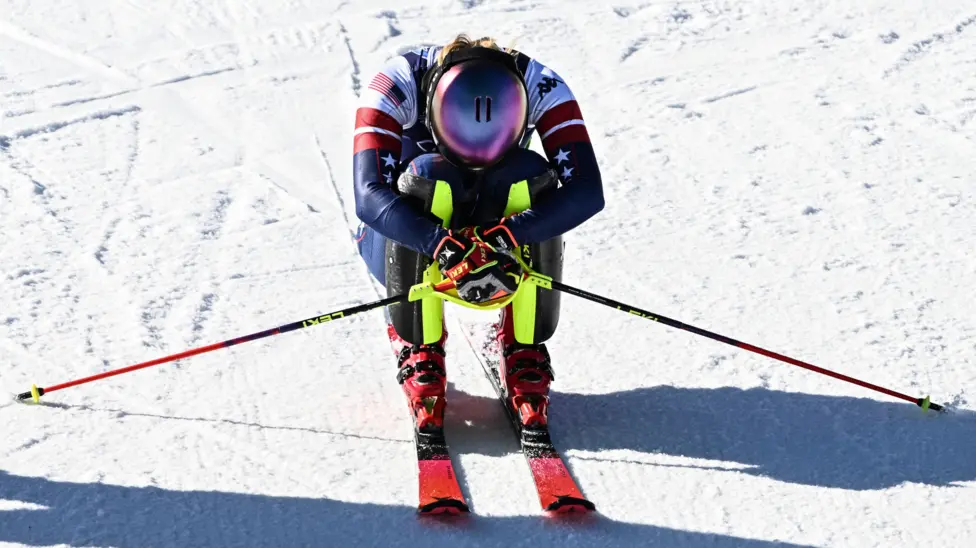
After securing a deeply emotional Olympic gold medal, Mikaela Shiffrin found her thoughts drifting not toward celebration alone, but toward someone who could not be there to witness the moment — her late father, Jeff. As she crossed the finish line to reclaim Olympic slalom glory, echoes of her first triumph as an 18-year-old in Sochi resurfaced. Yet this victory carried far greater emotional weight, shaped by years of grief, personal battles, and resilience.
When Shiffrin embraced her mother and coaching team at the finish area, the joy of the achievement was intertwined with a sense of absence. Her father, who passed away six years earlier, had played a pivotal role in her life and career. In the aftermath of her win, she openly acknowledged that the moment was as much about remembrance as it was about sporting success. She described the experience as one she had long dreamed of but also feared, knowing that reaching such a milestone without her father present would feel profoundly different.
She spoke candidly about how life changes after losing a loved one, explaining that every new achievement or experience feels unfamiliar and emotionally complex. For her, the Olympic gold represented not just athletic excellence but a personal step toward accepting a new reality — one where she continues to move forward while carrying the memory of her father. Instead of focusing solely on his absence, she allowed herself to pause and silently share the moment with him in spirit.
Following her father’s passing, Shiffrin stepped away from competitive skiing for nearly a year. She described the impact of grief as an “invisible injury,” one that affected her mental state as deeply as any physical setback. During that period, she also spoke openly about her struggles with mental health, emphasizing how emotional trauma can shape an athlete’s mindset and performance just as significantly as injuries or technical challenges.
Her victory in Italy, achieved by a commanding margin of 1.50 seconds, firmly reinforced her legacy as one of the greatest alpine skiers in history. Recording an overall time of 1:39.10, the 30-year-old became a three-time Olympic champion, adding to her earlier successes at the Sochi 2014 and Pyeongchang 2018 Games. However, the eight-year gap between Olympic medals was marked by significant personal and professional challenges that tested her resilience both on and off the slopes.
Despite the obstacles she faced over the years, Shiffrin revealed that her primary objective heading into the race was simply to “show up.” She acknowledged that preparing mentally for two intense runs required immense effort, especially when dealing with lingering doubts and emotional fatigue. At times, she admitted, even reaching the start gate felt overwhelming, but her focus remained on simplifying the process and blocking out distractions.
Entering the competition in Cortina as the overwhelming favourite, Shiffrin carried immense expectations. Her recent form had been exceptional, with seven victories in eight slalom World Cup races that season and a second-place finish in the other. These results helped her secure the overall title well before the end of the campaign, further underlining her dominance in the discipline.
Her career statistics are equally remarkable. With 108 World Cup race wins and dozens of additional podium finishes, she is widely regarded as the most successful alpine skier in history. She has also claimed the overall World Cup title multiple times, demonstrating consistent excellence across seasons and disciplines. Yet, despite her achievements, criticism lingered following her disappointing performance at the Beijing Olympics, where she failed to win a medal after crashing out early in key events.
Behind the scenes during that difficult period, Shiffrin was still grappling with grief and its psychological effects. She revealed that she even experienced memory issues, which made it difficult to recall course details — a critical aspect of competitive skiing. Over time, however, she worked to rebuild her mental strength, ultimately emerging more resilient and determined as both an athlete and a person.
Her journey back to peak form was not without further setbacks. In December 2024, she suffered a serious crash during a giant slalom race in Killington, sustaining a puncture wound and muscle damage to her stomach. The incident triggered renewed anxiety, including recurring visions of crashing again, which affected her confidence and mental well-being. Even during an otherwise successful season, those fears lingered in the background.
Questions remained about whether she could truly deliver on the Olympic stage again, especially after a mixed start to the Cortina Games. She finished 11th in the giant slalom and narrowly missed a medal in the team event, where she placed fourth alongside downhill champion Breezy Johnson. These results intensified the pressure, as observers wondered if she could reclaim her dominance in her signature event.
However, in the slalom — the discipline where she has accumulated an extraordinary 71 World Cup wins — Shiffrin rediscovered her rhythm and composure. She emphasized her desire to ski freely and unleash her full potential, something she had been striving to achieve through intense focus and preparation. Her performance reflected that mindset, combining technical precision with emotional clarity.
The foundation for her victory was laid in the first run, where she delivered a flawless descent in 47.13 seconds, creating a substantial lead over her competitors. Even during the break before the second run, her thoughts returned to her father. She described how she became emotional while resting, reflecting on the significance of the moment and the realization that she possessed all the tools necessary to perform at her best.
That realization provided a sense of calm and purpose. Standing at the start gate for the final run, she felt ready not just physically but mentally, believing she had earned the opportunity through years of perseverance and self-growth. Her second run, completed in 51.97 seconds, was effectively a showcase of her mastery, securing gold ahead of Switzerland’s Camille Rast and Sweden’s Anna Swenn Larsson.
During the emotional press conference that followed, Shiffrin spoke in depth about her ongoing journey through grief. She explained that, unlike some people who feel a strong spiritual presence from loved ones they have lost, her connection to her father exists more through memory and reflection. She thinks about him constantly and feels closest to him through conversations and shared recollections rather than a tangible sense of presence.
She also admitted that she sometimes felt frustrated hearing others describe feeling guided or supported spiritually by those they had lost. For her, grief has been quieter and more internal, lacking those moments of perceived closeness that others often describe. Nevertheless, she has gradually learned to accept that her way of coping is valid and meaningful in its own right.
Ultimately, her Olympic triumph was not just a sporting milestone but a deeply personal victory. It symbolized years of perseverance through grief, injury, doubt, and expectation. By embracing the moment and allowing herself to acknowledge both joy and sorrow, Shiffrin demonstrated remarkable emotional strength alongside her athletic brilliance.
Her gold medal in Cortina will be remembered not only for its dominant margin but also for the story behind it — a journey defined by resilience, vulnerability, and an unwavering commitment to growth. As one of the most decorated alpine skiers of all time, she once again proved her ability to perform under immense pressure, while also showing that true greatness extends beyond results to the courage required to overcome life’s most difficult challenges.
For more sports news and updates, visit: https://netsports247.com