

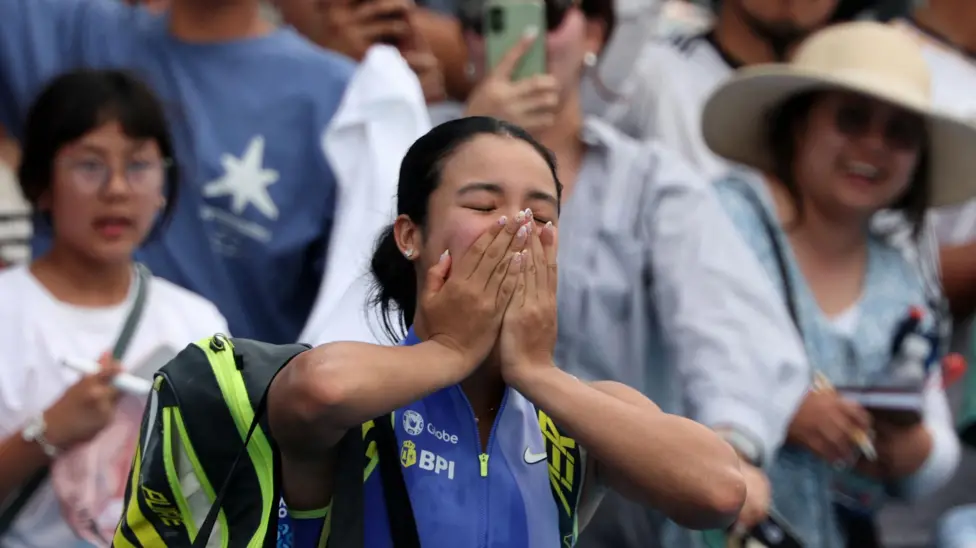
The Australian Open is no stranger to long queues. Fans regularly line up hours in advance to watch global superstars train, chase autographs from homegrown heroes, or simply grab the best food on offer around Melbourne Park. But this year, something entirely unexpected stopped people in their tracks.
It wasn’t Carlos Alcaraz fine-tuning his game on a practice court. It wasn’t an Australian favourite locked in a dramatic match. And it certainly wasn’t free food drawing crowds. Instead, thousands of fans gathered for a single reason: to catch a glimpse of Alexandra Eala.
Court six, usually a low-key venue tucked away from the main arenas, became the centre of attention. The queue outside it stretched hundreds of yards, creating congestion rarely seen at the tournament. Spectators packed the walkways, phones in hand, all hoping for a brief look at the world number 49 from the Philippines.
For the Australian Open, it was something entirely new.
Eala’s popularity is not limited to those physically present at Melbourne Park. Her pre-tournament press conference attracted an astonishing 171,000 online viewers. That figure far surpassed the numbers recorded by some of the biggest names in tennis. Carlos Alcaraz and Coco Gauff each drew around 29,000 viewers, while reigning champion Aryna Sabalenka attracted fewer than 10,000. The contrast was striking and raised a simple but powerful question: why is Alexandra Eala commanding such attention?
At just 20 years old, Eala has already become one of the most important sporting figures in Philippine history. Tennis has never been the country’s most prominent sport, traditionally overshadowed by basketball and boxing. Yet Eala has managed to capture the imagination of an entire nation, becoming a symbol of possibility for young athletes across Southeast Asia.
Her rise has been years in the making. Eala first caught international attention as a junior, where she showcased exceptional composure, intelligence, and court awareness. Her success at youth level laid the foundation for what was to come, and her decision to train abroad gave her exposure to elite competition from an early age.
One of the defining moments of her development came when she joined the Rafa Nadal Academy in Spain. Training under a system associated with one of the greatest players of all time sharpened her technical skills and mental strength. More importantly, it gave her belief that she belonged on the world stage.
As Eala transitioned into the professional ranks, her progress was steady rather than explosive. She worked her way through smaller tournaments, gaining experience against seasoned professionals. Each win added to her confidence, and each setback became part of a learning curve that prepared her for the biggest stages in tennis.
What sets Eala apart is not just her results, but the way she carries herself. Calm, articulate, and mature beyond her years, she has become a role model for young Filipinos who rarely see themselves represented in global tennis. Her success resonates deeply in a country hungry for international sporting heroes.
The Filipino diaspora has played a major role in her growing popularity. Australia is home to a large Filipino community, many of whom turned out in force to support her in Melbourne. Flags, homemade banners, and chants transformed a modest outer court into an atmosphere more commonly associated with a main stadium.
For many fans, watching Eala live was about more than tennis. It was about pride, representation, and seeing someone who looks like them succeed on one of the world’s biggest sporting stages. That emotional connection explains why so many were willing to queue for hours just to watch her warm up or practice.
Social media has amplified her reach even further. Clips of her matches, interviews, and behind-the-scenes moments spread rapidly online, particularly in the Philippines. News outlets, influencers, and sports fans track her every move, eager to share updates and celebrate milestones together.
Despite the growing attention, Eala has remained grounded. She has spoken openly about staying focused on her development and not letting external noise distract her from her goals. Coaches and analysts often praise her tactical intelligence, movement, and ability to problem-solve during matches, qualities that suggest her best years are still ahead of her.
At the Australian Open, the buzz surrounding Eala also highlighted a broader shift in tennis. The sport is becoming increasingly global, with talent emerging from regions once considered unlikely producers of elite players. Eala’s presence in Melbourne symbolised that change, proving that tennis success is no longer confined to traditional powerhouses.
Tournament organisers took notice as well. The unprecedented queues and online engagement showed that fans are eager for new stories and fresh faces. Eala’s popularity demonstrated how a single player can energise an entire community and bring new audiences to the sport.
As her career continues to unfold, expectations will naturally grow. But for now, Alexandra Eala represents hope, ambition, and the thrill of something new. Her impact at the Australian Open went far beyond rankings or results. She created moments, memories, and a sense of belonging for thousands of fans who saw themselves reflected in her journey.
The queues outside court six may eventually fade, but the significance of what happened in Melbourne will not. Alexandra Eala has arrived, and the tennis world is paying attention.
For more global tennis stories and breaking sports news, visit
https://netsports247.com