
With just over 100 days remaining until the 2026 World Cup kicks off in North America, a major geopolitical crisis has cast fresh uncertainty over what was already shaping up to be one of the most politically sensitive tournaments in football history. The United States, one of the co-hosts, has launched military strikes against Iran as part of a joint operation with Israel, prompting retaliatory attacks across the Middle East. The developments raise serious questions about Iran’s participation, Fifa’s position, and the broader political climate surrounding the tournament.
Will Iran Still Compete?
Iran had secured qualification for what would be their fourth consecutive World Cup appearance. They are scheduled to play group matches against New Zealand and Belgium in Los Angeles, followed by a fixture against Egypt in Seattle. However, the current escalation has led to speculation about whether Iran will ultimately take part.
Following the latest military action, comments attributed to Iranian football federation president Mehdi Taj suggested participation may no longer be guaranteed. While no official withdrawal has been confirmed, uncertainty surrounding Iran’s internal political situation — especially after the reported killing of Supreme Leader Ali Khamenei — complicates predictions about any decision-making process.
Middle East analysts suggest the current conflict represents a more profound and potentially prolonged crisis rather than a short-lived escalation. If the instability continues, Iran’s ability or willingness to travel to the United States could be affected.
Despite the uncertainty, Fifa has indicated it expects Iran to participate. General secretary Mattias Grafstrom stated that the governing body’s priority remains delivering a safe tournament “with everybody participating.” Privately, officials are said to anticipate Iran’s presence unless circumstances deteriorate further.
If Iran were to withdraw or boycott, questions would immediately arise about replacement teams. Under Asian Football Confederation (AFC) regulations, potential substitutes could include Iraq or the United Arab Emirates, depending on qualification standings and play-off outcomes. Fifa has not publicly clarified its contingency plan.
Meanwhile, Iran’s women’s national team continues preparations for the Asia Cup in Australia. The AFC confirmed it remains in regular contact with the squad and is offering full support during what it described as a “challenging period.”
Security and Political Tensions in the United States
The conflict intensifies scrutiny around tournament security. US President Donald Trump previously signed an executive order restricting entry for nationals from several countries, including Iran. Although exemptions apply to players and coaching staff for major sporting events, visa complications have already surfaced in the lead-up to the World Cup draw.
Should Iran participate, heightened security measures are almost inevitable, particularly in Los Angeles, which is home to one of the largest Iranian diaspora communities in the world. During the 2022 World Cup in Qatar, Iran’s matches took place amid significant political protests, and tensions between pro- and anti-government supporters were visible inside stadiums.
Given the current geopolitical climate, similar scenarios could unfold in 2026. Human rights groups warn that the combination of war, diaspora politics, and a highly visible US president may increase the likelihood of demonstrations or unrest around matches.
The broader environment in the United States also presents challenges. Tournament preparations have reportedly been affected by funding disputes linked to a partial government shutdown. Additionally, concerns have emerged about the potential involvement of Immigration and Customs Enforcement (ICE) officers during the event.
Relations between the US and its co-hosts — Canada and Mexico — have also experienced strain due to trade tariffs and border policy disputes. In Mexico, cartel-related violence has raised security concerns. These factors collectively contribute to an already complex hosting landscape.
The Spotlight on Fifa and Infantino
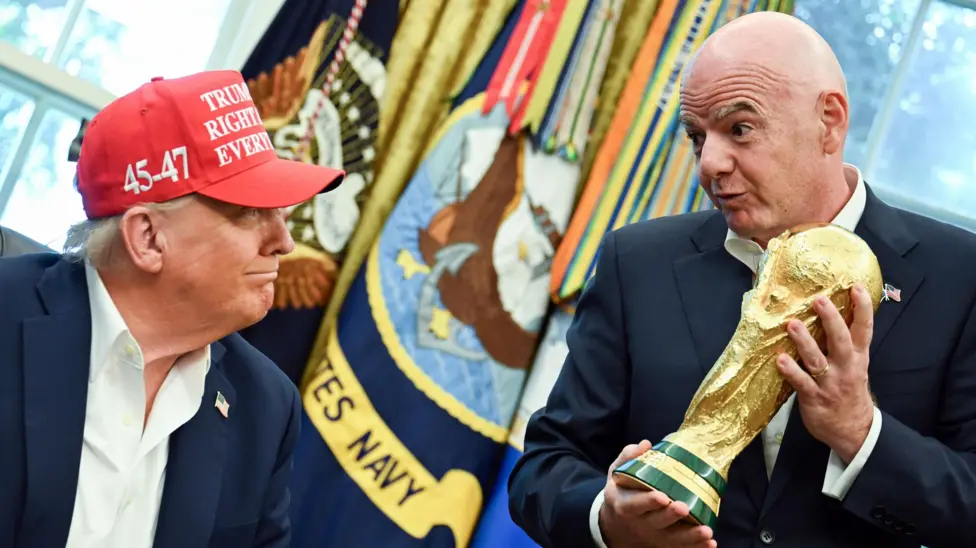
The unfolding crisis also puts renewed focus on Fifa president Gianni Infantino and his relationship with President Trump. In December, Fifa awarded Trump its inaugural “Peace Prize,” citing his role in facilitating ceasefire discussions in the Middle East. Since then, US military actions in Venezuela, Nigeria, and Iran have sparked criticism from various quarters.
Infantino has defended the award and Fifa’s approach, maintaining that the organisation must remain politically neutral. However, critics argue that close alignment with political leaders risks undermining that neutrality.
Calls for sporting sanctions have resurfaced. Earlier this year, members of the UK parliament signed a motion urging international sports bodies to consider excluding the United States from major competitions over alleged violations of international law. Similarly, a German football official suggested a potential boycott of the 2026 World Cup in response to US foreign policy actions.
While such proposals remain politically symbolic rather than imminent realities, the renewed conflict could amplify them. Gulf states affected by retaliatory strikes may also demand disciplinary measures against Iran.
Fifa’s historical precedents complicate the debate. The 2018 World Cup proceeded in Russia despite geopolitical controversies, including the annexation of Crimea. Russia was only suspended in 2022 following its invasion of Ukraine, after multiple European federations refused to compete against it. Recently, Infantino has expressed interest in reintegrating Russia into international competition.
There is currently no indication that Fifa would consider sanctioning the United States, even amid criticism. The governing body continues to assert that it cannot resolve geopolitical disputes and must focus solely on football.
A Tournament Under the Global Microscope
The 2026 World Cup was already poised to be historic: expanded to 48 teams and jointly hosted by three nations. It will also coincide with celebrations marking the 250th anniversary of the US Declaration of Independence, ensuring high-profile political visibility.
Now, with conflict escalating in the Middle East, the stakes have grown significantly. If Iran competes, security arrangements and political symbolism will be intense. If they withdraw, the tournament will face logistical and diplomatic complications.
Either scenario underscores how global sporting events cannot be separated from international politics. In the space of just 48 hours, the landscape surrounding the 2026 World Cup has become even more volatile.
For now, Fifa maintains that its focus remains on delivering a safe and inclusive tournament. But as tensions continue to evolve, the intersection of football and geopolitics will remain firmly in the spotlight.
For more international football news and updates, visit:
https://netsports247.com