
As Northern Ireland approach the final international window of the year, manager Michael O’Neill has once again highlighted a familiar concern within his squad: the centre-forward role. Speaking ahead of the decisive fixtures, O’Neill admitted that the iconic number nine position remains unresolved, describing it as the one area where he is still actively searching for a reliable solution.
Nearly three years into his second spell as Northern Ireland boss, and with a World Cup play-off semi-final just four months away, O’Neill’s team selections suggest a clear pattern. While much of his preferred starting XI appears settled, the striker position continues to rotate, reflecting uncertainty and an openness to new contenders staking their claim.
O’Neill has been transparent about his desire for a forward to seize the opportunity and make the role their own. “I would love someone to really step up,” he said earlier, underlining the importance of finding a consistent goal threat at international level. That opportunity presented itself once again in Monday night’s World Cup qualifier against Luxembourg, when Tottenham Hotspur attacker Jamie Donley was handed the chance to lead the line.
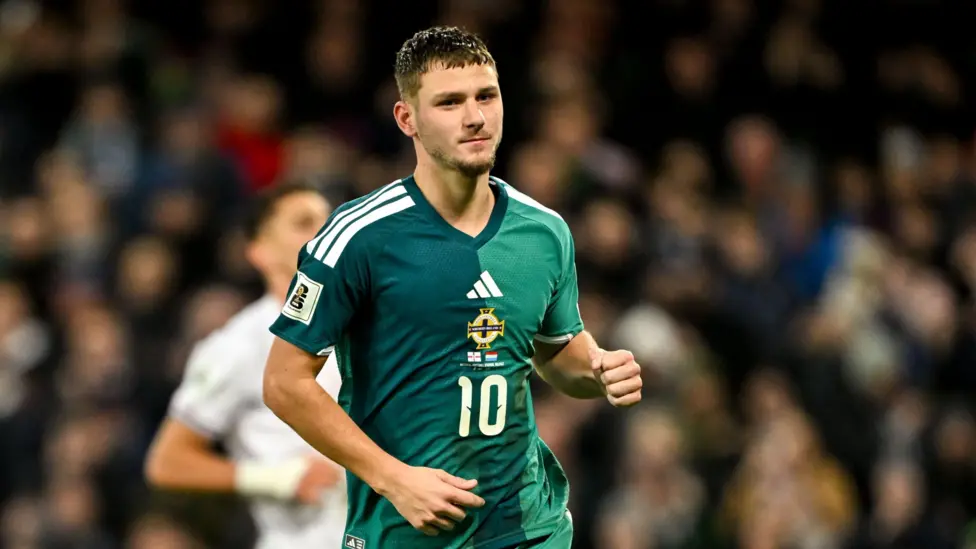
At just 20 years old, Donley became the third different player to start as the central striker in as many matches. Currently on loan at Stoke City, the young forward approached the game with confidence and maturity, delivering a performance that stood out even in a match that carried little competitive significance.
Northern Ireland’s campaign in Group A had already been decided, making the Luxembourg fixture a dead rubber. However, Donley ensured the match was far from forgettable for himself. He found the net from the penalty spot to secure victory and also had a goal ruled out earlier in the contest for offside, highlighting his constant involvement and attacking intent.
By the final whistle, Donley had arguably presented the strongest case yet for an extended run as Northern Ireland’s first-choice striker. O’Neill himself was full of praise, describing the young attacker as “the best player on the pitch” and acknowledging the impact he made throughout the game.
“I wanted to see him as a nine,” O’Neill explained after the match, as Northern Ireland concluded their Group A campaign with nine points from six matches, finishing third behind Germany and Slovakia. The manager made it clear that the experiment was deliberate, part of a broader effort to evaluate Donley’s suitability for a role that has long troubled the national side.
“There’s no secret that the number nine is a problem position for us,” O’Neill admitted candidly. “Jamie brings different attributes compared to some of the other strikers we’ve tried.” That difference, he suggested, could be exactly what Northern Ireland need as they prepare for the challenges ahead.
Rather than relying purely on physical presence or traditional target-man play, Donley impressed with his intelligence and technical ability. His movement off the ball caused problems for Luxembourg’s defence, while his link-up play allowed midfielders to join the attack more fluidly. These qualities stood out in a team that has often struggled to convert possession into clear-cut chances.
O’Neill highlighted Donley’s composure and footballing brain as key strengths. “He’s clever, his link-up play is good,” the manager said. “He is a very talented boy.” Such praise from a coach known for his pragmatic approach suggests Donley’s performance has genuinely caught the eye.
The broader context of Northern Ireland’s striker dilemma makes Donley’s emergence even more significant. Since O’Neill’s return, the team has experimented with several forwards, none of whom have fully convinced at international level. Injuries, inconsistency, and a lack of goals have all contributed to the ongoing search for a dependable centre-forward.
With a World Cup play-off looming, time is running out for players to establish themselves. O’Neill’s preference for stability elsewhere in the squad means that the striker role remains one of the few positions still genuinely up for grabs. Performances like Donley’s against Luxembourg could therefore prove pivotal.
Although one match alone will not determine the future, Donley’s display offered a glimpse of a possible solution. His confidence, work rate, and technical ability align with O’Neill’s vision of a forward who can both score goals and contribute to the team’s overall play.
As Northern Ireland shift their focus toward preparation for the play-offs, competition for places will intensify. For Donley, the challenge will be to build on this promising outing, replicate his form at club level with Stoke City, and continue proving that he belongs at the heart of the international attack.
Whether he ultimately becomes the long-term answer to Northern Ireland’s number nine problem remains to be seen. However, on a night when little was at stake in terms of qualification, Jamie Donley ensured that the biggest talking point was his own potential—and that may be exactly what Michael O’Neill has been hoping for.
🔗 Read more sports news at: https://netsports247.com