
England cricket has long been shaped by a variety of leaders, each bringing a unique style to the team. Michael Vaughan excelled as the man-manager, fostering unity and morale, while Sir Andrew Strauss combined strategic foresight with meticulous planning, carefully plotting England’s journey to success. Sir Alastair Cook and Heather Knight demonstrated leadership through sheer grit and resilience, showing that determination alone can guide a team to triumph. Ben Stokes, meanwhile, inspires through his presence and passion, leaving a lasting impact on teammates and fans alike.
Harry Brook may not yet possess Strauss’ tactical sophistication or Stokes’ commanding aura, but in Pallekele, he demonstrated that leadership is more than experience or presence—it is the ability to rise when the team needs it most. In a T20 international against Pakistan, Brook’s century not only secured England a dramatic victory but also ensured their progression to the Women’s World Cup semi-finals. It was a defining moment, signaling that Brook has emerged as a true leader on the international stage.
Brook’s recent winter had been turbulent. An altercation with a nightclub bouncer in Wellington, a disappointing Ashes series, and attempts to obscure the truth about off-field incidents had weighed heavily on him. Few England captains have carried such personal and professional baggage, yet Brook faced the scrutiny head-on. Thousands of England supporters had traveled to Australia for the Ashes, while millions more followed the series from home. Brook owed them a performance, and in Pallekele, he delivered spectacularly. His innings, mature and calculated, marked a dramatic turnaround from a winter of missteps.
Although Brook already possessed a T20 World Cup winner’s medal from 2022 and a Test triple century, questions lingered over whether he could produce a match-winning knock on the sport’s grandest stage. His highest score against Australia prior to this innings was 85 across ten Tests. Even his centuries against India last year came in losing efforts, including the second innings at The Oval, which opened the door for India to draw the series. His World Cup performances were similarly modest, with a top score of 66 in the last 50-over edition and 53 in the previous T20 tournament. Pallekele finally silenced these doubts.
England began the match poorly, losing Phil Salt first ball and quickly finding themselves at 58-4 in pursuit of 165. Brook’s response was remarkable. Against all pressure, he constructed a 51-ball century that balanced aggression with tactical intelligence. He hit boundaries when needed but also rotated the strike effectively, running nine twos to maintain momentum while ensuring wickets were not lost unnecessarily. Brook’s ability to pace an innings—accelerating at key moments and consolidating when needed—demonstrated a deep cricketing acumen.
Brook credited his preparation and mindset to lessons learned in previous years. After the death of his grandmother in 2022, he committed himself to a four-month fitness regimen, not for vanity, but to improve his on-field performance. The extra conditioning enabled him to run efficiently between wickets, an aspect that became crucial in the Pallekele innings, where calculated singles and twos allowed England to maintain pressure while chasing a competitive target.
This innings also showcased Brook’s ability to read the game and adjust to match situations. After the dismissal of Tom Banton, Brook took five consecutive singles to stabilize the innings, showing that his advice to batters not to be “too careful” does not equate to reckless hitting. It reflects a broader understanding of the game and a desire to put the opposition under continuous pressure while protecting his own team’s position.
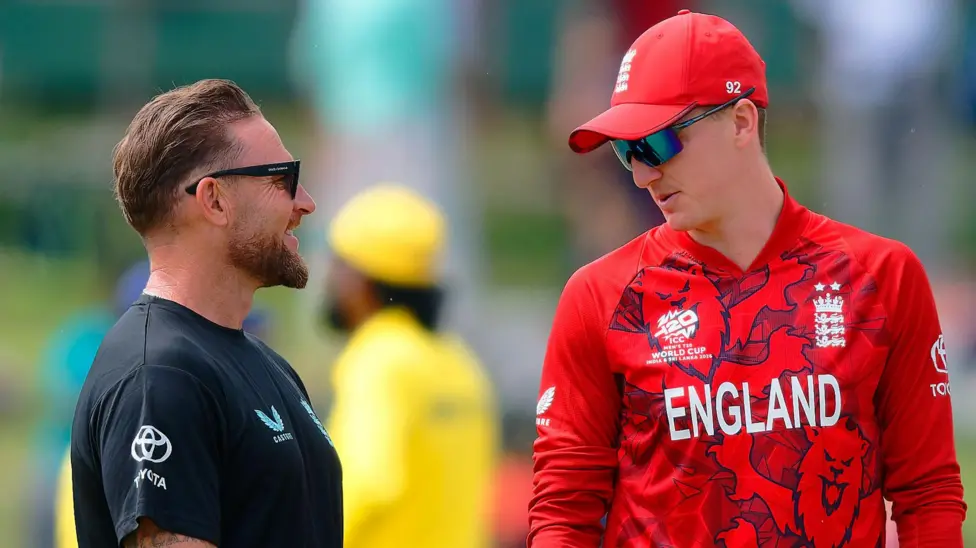
Brook also owed a performance to his coach, Brendon McCullum, whose confidence in him had not wavered despite the Ashes setbacks. McCullum, a pioneering figure in the Bazball approach, had promoted Brook from number five to number three on the morning of the match, less than 12 hours before the first ball was bowled. This strategic move maximized England’s powerplay potential and allowed Brook to play the innings he did. The pre-match tactical shift, executed with precision and communication, highlights both the coach’s insight and Brook’s ability to adapt and deliver under pressure.
The outcome of the match has strengthened England’s position in the tournament. They now face a clear path to the semi-finals, with matches against New Zealand and India providing further opportunities to assert their dominance. With defending champions India still in the mix and other contenders being eliminated, England is positioned as one of the strongest teams capable of lifting the World Cup. Brook’s performance, both as a batsman and as a leader, has been instrumental in creating this pathway.
Brook’s leadership style is distinctive. He combines tactical intelligence, adaptability, and resilience with a willingness to take calculated risks. His innings in Pallekele reflected not only skill but also strategic thinking: balancing aggression with prudence, taking responsibility when the team faltered, and ensuring his team had the best chance to succeed. His approach demonstrates that leadership is not always about charisma or seniority; sometimes it is about performing when the moment demands it and setting an example that inspires teammates.
His role as captain is further solidified by his close alignment with McCullum’s philosophy. Brook embodies the principles of Bazball, blending attacking intent with game awareness, and now he has added a layer of personal accountability. His on-field decisions, combined with his ability to motivate and manage the team, suggest a leader capable of guiding England to major tournament success.
Brook’s journey from a winter of misjudgments to a performance of extraordinary composure highlights a broader narrative of growth, maturity, and the emergence of leadership through action. He has demonstrated that experience is not the only measure of a leader; it is also the ability to deliver under pressure, make smart decisions, and inspire confidence in others. His Pallekele innings may well be remembered as the moment he transitioned from a talented player to a true leader of English cricket.
Looking ahead, Brook has a chance to cement his legacy. If England can navigate the remaining Super 8 match against New Zealand and the semi-final in India successfully, he will join an elite group of England men’s captains—Paul Collingwood, Eoin Morgan, and Jos Buttler—who have lifted World Cup trophies. Brook’s combination of tactical sharpness, batting prowess, and emerging leadership qualities suggests that he is fully capable of achieving this milestone.
In conclusion, Harry Brook’s century against Pakistan in Pallekele represents more than a personal milestone; it signifies the rise of a new leader in English cricket. His innings was a masterclass in timing, tactical awareness, and composure under pressure. It reinforced his credibility as a captain, demonstrated his cricketing intelligence, and provided the team with a platform to pursue World Cup success. Brook has shown that leadership is earned through action, resilience, and decision-making—qualities that make him an indispensable figure in England cricket’s present and future.
For more cricket news and updates, visit: https://netsports247.com