
Iran Responds to Donald Trump’s World Cup Comments Amid Rising Political Tensions
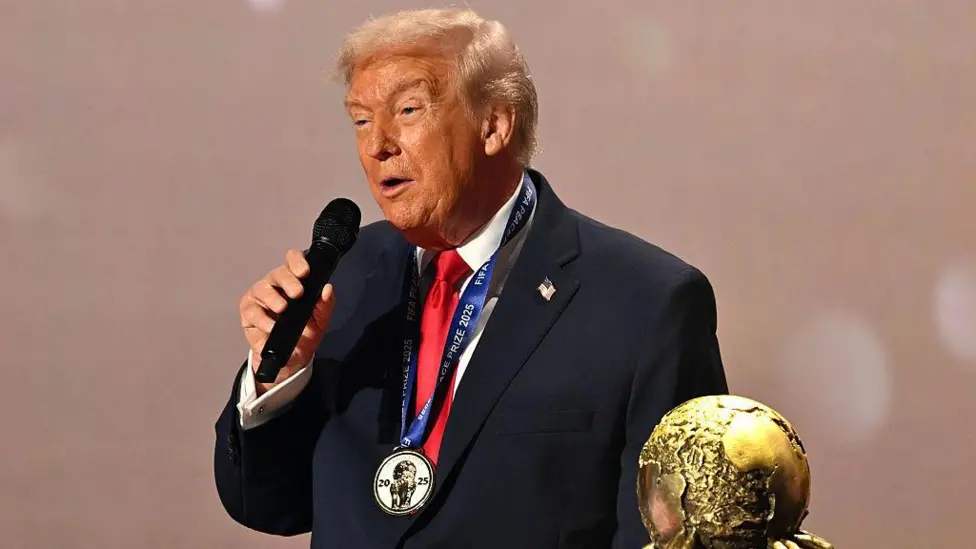
A diplomatic and sporting dispute has emerged after Donald Trump suggested that Iran national football team might not be able to safely participate in the upcoming 2026 FIFA World Cup.
Trump indicated that while Iran would technically be welcome to attend the tournament, it might not be “appropriate” for them to compete due to concerns about safety. His remarks triggered a strong reaction from Iranian officials and football authorities, who argued that the decision about participation should not depend on political opinions from the host country.
The 2026 World Cup will be jointly hosted by United States, Canada, and Mexico, with matches scheduled across several major cities. The tournament is set to begin on 11 June and will feature teams from around the world competing for football’s most prestigious prize.
Trump questions Iran’s participation
Trump shared his thoughts in a post on the social media platform Truth Social. In the message, he stated that Iran would technically be permitted to take part in the tournament.
However, he expressed doubts about whether their participation would be suitable, suggesting that security concerns could place Iranian players at risk.
Trump wrote that the Iranian team would be “welcome to the World Cup,” but added that he did not believe it would be appropriate for them to attend “for their own life and safety.”
His comments quickly attracted attention because the United States is one of the main hosts of the upcoming tournament.
Iranian response: FIFA decides, not one country
Officials connected to the Iranian national team responded strongly to the suggestion that their participation might be restricted.
A statement posted on the team’s Telegram channel emphasized that the competition is organized by FIFA and not controlled by any individual host country.
According to the message, the decision about which teams compete should be made solely by FIFA, based on sporting merit and qualification results.
The statement also made it clear that Iran qualified for the World Cup through strong performances during the qualification campaign and therefore earned their place in the tournament.
Iranian officials stressed that no external authority should have the power to remove them from the competition.
Political tensions escalate
The controversy surrounding Iran’s potential participation comes amid serious geopolitical tensions.
Recent military actions between Iran, the United States, and Israel have dramatically increased uncertainty in the region. According to reports, military strikes were launched against Iranian targets by the United States and Israel.
Those attacks reportedly resulted in the death of Iran’s supreme leader, Ayatollah Ali Khamenei, an event that significantly escalated tensions.
In response, Iran reportedly launched missiles and drones targeting Israel as well as several Gulf Arab nations that host American military bases.
Among the countries affected were Bahrain, Kuwait, Qatar, and the United Arab Emirates.
These developments have raised concerns about safety and security surrounding international events involving Iran.
Iran’s sports minister raises doubts
Earlier in the week, Ahmad Donyamali expressed uncertainty about whether Iran would be able to participate in the World Cup at all.
Speaking in an interview with the IRIB Sports Network, Donyamali suggested that the current political situation could make participation difficult.
He stated that the country was not currently in a position to compete, describing the situation as unsafe for Iranian athletes.
According to the minister, the killing of Iran’s supreme leader had created conditions in which participation in a global sporting event might not be possible.
“Our players are not safe,” he said, explaining that the circumstances surrounding the conflict had made international travel and competition extremely complicated.
Iran insists it will decide
Despite these concerns, the Iranian national team has not officially withdrawn from the tournament.
Instead, the message shared on Telegram indicated that the team intends to make its own decision rather than accepting pressure from other countries.
The statement emphasized that Iran earned its place at the World Cup through a strong qualification campaign that included multiple consecutive victories.
It also stated that removing Iran from the tournament would be unjustified.
“Certainly, no one can remove the Iranian national team from the World Cup,” the statement declared.
The message even suggested that if security concerns were truly an issue, the responsibility might lie with the host country.
It argued that a nation hosting the tournament should be capable of guaranteeing the safety of all participating teams.
FIFA’s position
The governing body responsible for organizing the World Cup, FIFA, has so far maintained that Iran is eligible to participate.
Gianni Infantino recently commented on the situation and said that Trump had previously indicated Iran would be welcome at the tournament.
Infantino has not suggested that Iran will be excluded from the competition, and FIFA has not issued any official statement indicating a change to the team’s qualification status.
Iran’s scheduled matches
If Iran ultimately participates in the tournament, the team already has several group-stage matches scheduled in the United States.
Their opening game is planned against New Zealand national football team in Los Angeles on 15 June.
They are then set to play Belgium national football team in Los Angeles on 21 June.
Iran’s final group-stage match is scheduled for 26 June in Seattle against the Egypt national football team.
These fixtures are part of the expanded 2026 tournament format, which will include more teams and matches than previous editions of the World Cup.
What happens if Iran withdraws?
If Iran ultimately decides not to participate, FIFA regulations give the organization the authority to choose a replacement team.
However, the rules do not clearly specify which team would take that place.
In past tournaments, replacement teams have sometimes been selected based on qualification results or rankings, but FIFA has broad discretion in making the final decision.
For now, the situation remains uncertain.
Iran has not withdrawn, FIFA has not removed them, and political tensions continue to influence discussions about the tournament.
A complex intersection of sports and politics
The controversy highlights how international sports events can become intertwined with political conflicts.
The World Cup is typically viewed as a global celebration of football, bringing together nations from different cultures and backgrounds.
However, when geopolitical tensions arise, they can affect participation, security planning, and diplomatic relations surrounding the tournament.
As the 2026 World Cup approaches, organizers will likely continue monitoring the situation closely.
Whether Iran ultimately competes or not could depend on a combination of political developments, security considerations, and decisions made by both the team and FIFA.
For more football news and sports updates, visit:
https://netsports247.com