
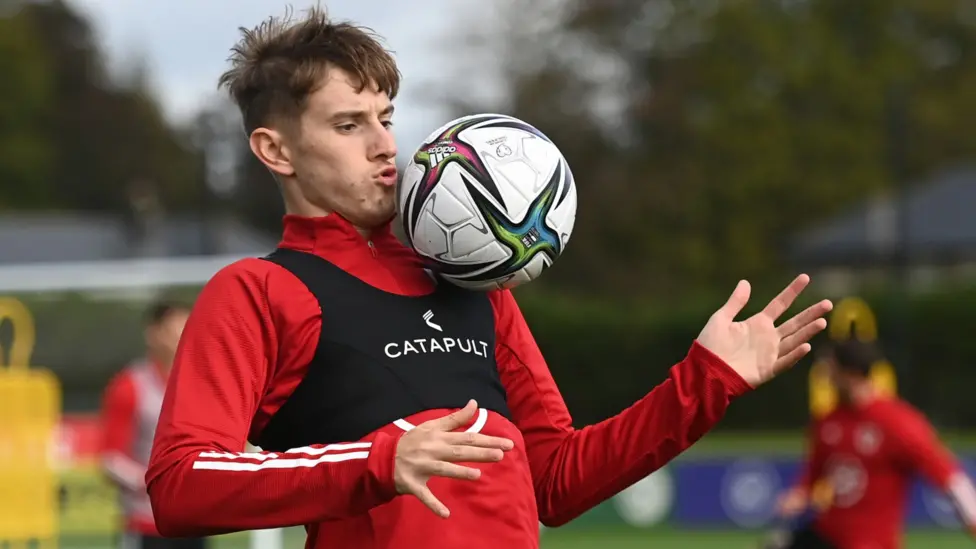
David Brooks stood in the crowd, arm raised in celebration, proudly wearing his national team’s shirt during the FIFA World Cup. To anyone watching, his smile suggested pure joy—but beneath that expression was a far more complex and emotional story.
The reality was that Brooks had never imagined experiencing such a moment from the stands. Like every professional footballer, his dream had always been to represent his country on the pitch, contributing directly to their historic return to the World Cup after 64 years. However, life had taken an unexpected and deeply challenging turn—one that no athlete could ever plan for.
In October 2021, while on international duty with Wales, Brooks received life-changing news. At just 24 years old, he was diagnosed with Stage Two Hodgkin lymphoma. What had started as mild symptoms—fatigue and a noticeable drop in his physical performance—quickly escalated into something far more serious.
Before the diagnosis, Brooks had sensed that something was wrong. During training sessions, he struggled to keep up with teammates, and his physical output had declined significantly. Even his club manager at the time, Scott Parker, questioned the drop in his performance metrics. Yet, Brooks himself couldn’t pinpoint the issue.
His close friend and Wales teammate Tom Lockyer vividly recalls the moment everything changed. Brooks had mentioned his symptoms to the team doctor, Jonathan Houghton, and was waiting for further evaluation. Lockyer was speaking to him over FaceTime when Brooks had to suddenly end the call after hearing a knock on his door.
When Brooks called back, the tone had shifted. He revealed that doctors wanted to run further tests, fearing something more serious. That moment marked the beginning of a difficult journey that would test not only his physical strength but also his mental resilience.
Chemotherapy treatment followed—intense, exhausting, and life-altering. For months, Brooks was unable to live a normal life, let alone think about football. Simple activities, like walking his dog on the beach, became impossible. The physical toll was immense, and by the time he completed treatment, he had gained around 20 kilograms and lost much of his athletic conditioning.
Despite these challenges, Brooks remained focused on recovery. His primary goal was to regain his health, something his teammates, including Chris Mepham, emphasized as the most important priority. Football, at that stage, was secondary.
In May 2022, Brooks received the all-clear—a moment of immense relief and hope. However, returning to professional football was far from guaranteed. The road back required rebuilding his fitness from scratch, overcoming both physical and psychological barriers.
As Wales prepared for the World Cup in Qatar later that year, Brooks was invited to join the squad during their qualification celebrations. Although he was present, there were doubts about whether he could recover in time to make the final tournament.
Determined to defy expectations, Brooks pushed himself hard in training. But in August 2022, his hopes were dealt another blow when he suffered a hamstring injury while playing for the under-23 side. That setback effectively ended any realistic chance of participating in the World Cup.
Watching the tournament from the stands was bittersweet. While he celebrated his teammates’ achievements, there was an undeniable sense of “what if.” According to Lockyer, Brooks would have found it difficult not being part of the action, especially knowing the impact he could have made.
Wales struggled during the tournament, failing to progress beyond the group stage. Many fans and observers believed Brooks’ creativity and intelligence on the ball could have made a difference. Known for his smooth dribbling and ability to find space, he had long been a key figure in the team.
Brooks’ football journey had always been impressive. After early spells, including a loan at Halifax, he earned a significant move from Sheffield United to AFC Bournemouth for £11.5 million. Under Eddie Howe, he quickly made an impact, even earning a nomination for the Premier League Young Player of the Year alongside stars like Trent Alexander-Arnold, Declan Rice, and Raheem Sterling.
Although injuries briefly slowed his progress, his talent was never in doubt. Teammates consistently praised his football intelligence—his ability to read the game, find space, and create opportunities for others.
His return to professional football in March 2023 was an emotional milestone. Coming off the bench for Bournemouth against Aston Villa, Brooks was met with applause from all sides of the stadium—a recognition of his courage and determination.
From there, he gradually rebuilt his career. A loan spell at Southampton helped him regain match fitness, and he later re-established himself as a key player at Bournemouth, even earning a new four-year contract.
Under manager Andoni Iraola, Brooks has thrived in a high-intensity system that demands constant movement and creativity. His performance data has improved significantly, with higher running metrics than before his illness.
Statistically, he has become one of the most effective players in the Premier League, ranking highly for expected assists and attacking contributions. His ability to carry the ball forward and create chances has made him a vital asset for both club and country.
Observers like Joe Partington have highlighted his influence on and off the pitch, noting his leadership qualities and consistency. Similarly, Kieffer Moore described his comeback as “remarkable,” given the physical and mental challenges he has faced.
Today, Brooks is not just back—he is arguably better than ever. His journey has transformed him into a symbol of resilience and determination. For Wales, as they once again push for World Cup qualification, he represents hope and inspiration.
For his friends and teammates, there is a shared desire to see him achieve what he missed out on in 2022—playing on the world’s biggest stage. Lockyer, in particular, has expressed how much it would mean, both personally and professionally, to see Brooks finally realize that dream.
Brooks’ story is not just about football. It is about overcoming adversity, maintaining belief in the face of uncertainty, and returning stronger than before. His journey serves as a reminder that even in the toughest moments, resilience can lead to extraordinary outcomes.
As Wales approach another crucial qualification campaign, Brooks stands ready—not as a spectator this time, but as a player determined to make his mark. And if he does step onto the World Cup stage, it will be a moment that carries far deeper meaning than most.
For more sports news, updates, and inspiring stories, visit: https://netsports247.com/