
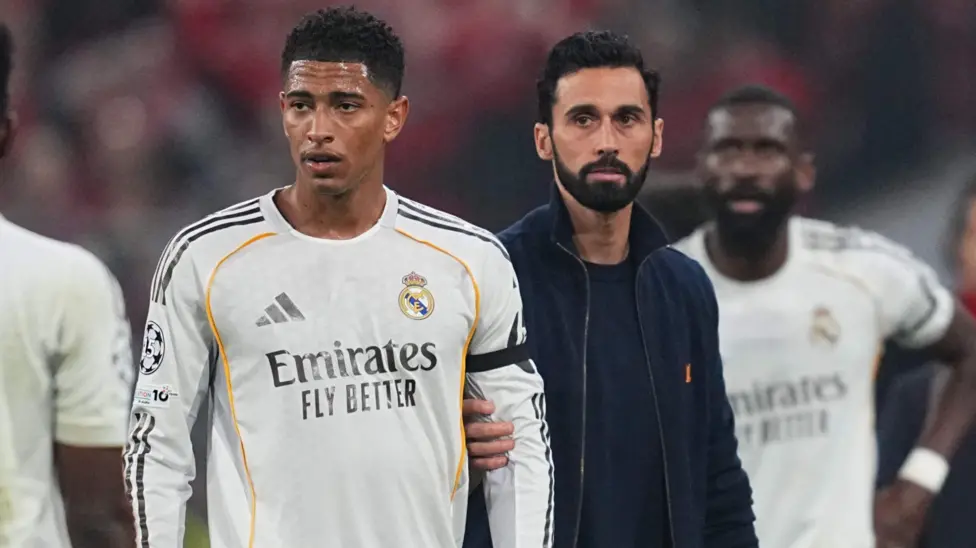
Real Madrid midfielder Jude Bellingham strongly criticised the decision to send off teammate Eduardo Camavinga during a dramatic 4–3 Champions League defeat to Bayern Munich, calling the red card “a joke” in an emotional post-match reaction.
The incident occurred late in the second leg of the quarter-final when Camavinga, who had only been on the pitch for 24 minutes after coming on as a substitute, received a second yellow card in the 86th minute. The booking came after he kicked the ball away and delayed a Bayern free-kick following a foul involving Harry Kane. That dismissal left Real Madrid down to 10 men at a crucial stage of the match, with the aggregate score finely balanced at 4–4 at that moment.
From there, the match swung decisively in Bayern’s favour. The German side capitalised quickly, scoring twice in the closing stages to secure a 6–4 aggregate victory and book their place in the semi-finals. The sending-off effectively ended Real’s resistance and shifted momentum firmly to the hosts.
As Bellingham walked past journalists on his way to the team bus in Munich, he was asked about the incident. Visibly frustrated, he responded in Spanish with a brief but pointed remark: “A joke… impossible that it is a red,” shaking his head as he left.
His reaction reflected the broader anger within the Real Madrid camp. Several players expressed disbelief at the decision both during and after the match. Defender Antonio Rüdiger avoided directly criticising the officials but made clear his dissatisfaction, questioning the need for such a punishment in a high-stakes moment.
Club captain Dani Carvajal, who did not play in the match, was seen confronting referee Slavko Vincic from the sidelines immediately after Camavinga was dismissed. Television footage showed him angrily gesturing and shouting in frustration, reportedly telling the official, “It’s your fault.”
Young forward Arda Güler, who had earlier scored twice for Real Madrid in the match, was also shown a red card after the final whistle following a heated reaction towards the referee. He later apologised on social media, admitting the disappointment but insisting the team would recover.
Real Madrid manager Álvaro Arbeloa also expressed strong disagreement with the decision, saying it effectively decided the tie. He argued that the booking was harsh and suggested there may have been confusion over Camavinga already being on a yellow card. In his view, the match had been evenly poised and entertaining until the dismissal changed its entire direction.
Arbeloa added that such a decision should not occur at that stage of a Champions League knockout match, especially when the aggregate score was level and both teams were competing intensely. He described the call as a “double mistake,” criticising both the second yellow card and the handling of the situation.
Spanish journalist Juan Castro echoed those sentiments, describing a sense of disbelief inside the Real Madrid camp. He reported that players and staff felt the decision had completely altered the balance of the game at a critical moment, turning a tightly contested match into a Bayern advantage.
The turning point came almost immediately after Camavinga’s dismissal. Bayern seized control and scored through Luis Díaz shortly afterwards, putting them ahead on aggregate. The momentum shift was decisive, with the German side then adding a third late goal through a brilliant strike from Michael Olise, sealing the tie and eliminating Real Madrid.
Despite the controversy, Bayern players defended the referee’s decision. Díaz said he had a clear view of the incident and believed the correct call was made, arguing that Camavinga deliberately slowed the restart by refusing to release the ball. He also suggested that the red card gave Bayern a psychological boost at a key moment in the match.
Striker Harry Kane also acknowledged the impact of the sending-off but focused on Bayern’s ability to capitalise on the opportunity. He said that while the dismissal helped shift momentum, his team still had to take their chances and finish the job, which they did in the final minutes.
Following the match, European football’s governing body UEFA confirmed that its disciplinary committee would review the referee’s report before deciding whether any further action is necessary. However, no immediate changes to the result are expected.
The defeat marks a painful exit for Real Madrid in a tie filled with goals, drama, and controversy. Bayern Munich now advance to the semi-finals, where they will face Paris Saint-Germain, while Real are left to reflect on what might have been in a match decided by fine margins and one highly disputed refereeing call.
For many observers, however, the focus will remain on Camavinga’s dismissal and the heated reactions it triggered, underlining once again how a single decision can define the outcome of elite European football.