
VAR drama at London Stadium could redefine Arsenal and West Ham’s seasons
One of the most dramatic and potentially season-defining moments in Premier League history unfolded at the London Stadium, where a Video Assistant Referee (VAR) decision took more than four minutes to resolve but may ultimately shape the futures of both Arsenal and West Ham United.
In a match already filled with tension and high stakes, Arsenal appeared to be heading toward a narrow but crucial 1-0 victory thanks to a late goal from Leandro Trossard. As stoppage time ticked away, the Gunners were on the brink of securing three vital points in their pursuit of the Premier League title. However, the game took a dramatic turn in the dying moments.
West Ham, desperate for a result to aid their fight against relegation, launched one final attack. From a crowded corner situation, substitute Callum Wilson managed to force the ball into the net amid chaos inside the penalty area. The stadium erupted in celebration as West Ham players and fans believed they had salvaged a vital equaliser.
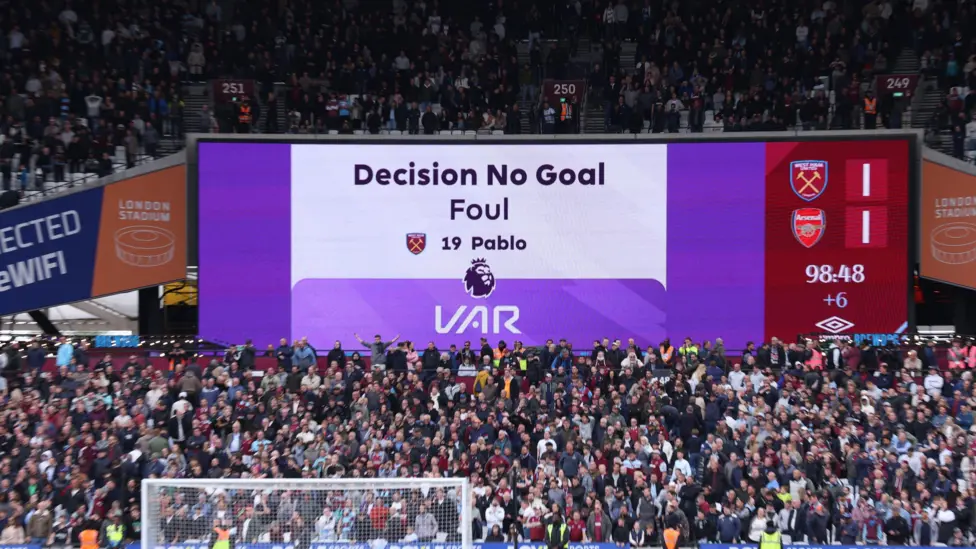
Yet, almost immediately, the celebrations were met with protests from Arsenal players. Their primary complaint centered on a potential foul on goalkeeper David Raya. Arsenal argued that Raya had been impeded in the build-up to the goal, specifically pointing to contact from West Ham’s Pablo, who appeared to restrict the goalkeeper’s movement.
As the on-field referee paused the game, attention shifted to the VAR official, Darren England, who was tasked with reviewing the incident. What followed was an agonizing wait of four minutes and eleven seconds—an eternity in football terms—while the footage was carefully examined from multiple angles.
The tension inside the stadium was palpable. West Ham supporters, who had just experienced the joy of a potential equaliser, were now left in suspense. Meanwhile, Arsenal fans anxiously awaited confirmation that their lead would stand.
England’s review process was thorough and deliberate. He assessed not only the contact between Pablo and Raya but also other possible infringements in the crowded penalty area, including challenges involving Trossard and Declan Rice. However, the key focus remained on whether Raya had been fouled before the ball crossed the line.
Eventually, England advised referee Chris Kavanagh to review the footage on the pitchside monitor. After an additional 75 seconds of scrutiny, Kavanagh delivered the decisive verdict: the goal was disallowed due to a foul on the goalkeeper.
With that announcement, the emotional pendulum swung dramatically. Arsenal players and fans celebrated as though they had scored a winning goal, while West Ham’s players and supporters reacted with anger and disbelief. What had seemed like a crucial equaliser was suddenly erased, leaving West Ham empty-handed.
The significance of this decision cannot be overstated. For Arsenal, it preserved a victory that strengthened their grip on the title race, putting them five points clear at the top, albeit having played one more game than their closest rivals. For West Ham, the decision dealt a severe blow to their survival hopes, leaving them in a precarious position near the bottom of the table.
Arsenal manager Mikel Arteta acknowledged the magnitude of the decision, praising the officials for their courage in making such a critical call under immense pressure. He emphasized the difficulty of refereeing in modern football, particularly when decisions can have far-reaching consequences for clubs competing at both ends of the table.
Arteta maintained that the correct decision had been made, explaining that the contact on Raya directly affected his ability to claim the ball. From his perspective, the foul was clear upon closer inspection, even if the initial moment was difficult to judge in real time.
In contrast, West Ham manager Nuno Espirito Santo expressed deep frustration and disappointment. While he refrained from directly criticizing the officials, he questioned the consistency of refereeing decisions, particularly regarding physical contact during set-pieces.
Nuno highlighted the ongoing confusion in football about what constitutes a foul in crowded penalty-area situations. He argued that the level of grappling and physicality often seen during corners has blurred the lines between acceptable play and infringement, making decisions like this increasingly contentious.
The incident also reignited broader debates about VAR and its role in modern football. Critics often argue that lengthy reviews undermine the flow of the game, while supporters contend that accuracy is paramount, especially in moments that can define an entire season.
From a technical standpoint, VAR official Darren England faced immense pressure. Having previously been involved in a high-profile officiating error earlier in his career, this moment represented both a challenge and an opportunity for redemption. His careful and methodical approach demonstrated the weight of responsibility placed on VAR officials in critical situations.
Analysis of the incident suggests that the decision ultimately hinged on the timing and impact of the foul. The contact between Pablo and Raya occurred before any other potential infringements, making it the primary offense influencing the outcome of the play. As such, the disallowed goal was deemed the correct decision under the rules.
Despite the controversy, the incident underscored the importance of precision in officiating. In matches where the stakes are so high, even the smallest details can have enormous consequences. The four-minute delay, while frustrating for many, reflected the officials’ determination to reach the correct outcome.
For Arsenal, the victory keeps them firmly on course for their first Premier League title in over two decades. However, the manner in which they secured the win highlights the fine margins that often define championship campaigns.
For West Ham, the result adds to their mounting challenges. The sense of injustice felt by players and fans alike could have lasting psychological effects as they continue their battle to avoid relegation.
Ultimately, this moment may be remembered as a turning point in the season—a single decision that influenced both the title race and the relegation battle. It serves as a powerful reminder of the impact VAR can have on modern football, for better or worse.
As the debate continues, one thing remains clear: in a sport where outcomes can hinge on split-second moments, the role of technology and the judgment of officials will remain under intense scrutiny.
For more football updates, visit: https://netsports247.com