

For many football fans, life can almost be measured through World Cups. Every four years marks another chapter—childhood excitement, teenage passion, and adult nostalgia—all tied together by unforgettable matches, legendary players, and most importantly, the iconic shirts they wore. These kits are more than just sportswear; they carry stories, emotions, and history that transcend generations.
Football jerseys often become symbols of unforgettable moments. They represent triumphs, heartbreaks, and the identity of nations. But what truly makes a kit iconic? According to designer Matthew Wolff, who created Nigeria’s hugely popular 2018 World Cup kits as well as designs for France and several major clubs, the answer lies in a mix of nostalgia, cultural relevance, and historical significance.
Wolff explains that many of his favorite kits come from his childhood during the 1990s and early 2000s. During that time, players felt like superheroes, and their kits seemed magical. Designs like Mexico 1998, USA 1994, Germany 1990 and 1994, and Japan 1998 stand out in his memory. He also recalls Nike’s bold designs from 2002 and Cameroon’s unforgettable sleeveless kit from the same year.
According to Wolff, a shirt becomes legendary not only because of its design but also because of the moments associated with it. Over time, the meaning and appreciation of a kit evolve, often becoming more cherished as nostalgia grows. However, he believes that in today’s era, achieving iconic status is much harder. With countless teams releasing new kits every season, the market has become saturated, making it difficult for any single design to stand out.
Despite this, football fans continue to celebrate the greatest kits of all time. When looking back, nostalgia plays a huge role, especially when revisiting designs from the late 1980s, 1990s, and early 2000s. To keep things balanced, only one kit per World Cup and one per country can be selected when discussing the most iconic jerseys.
One of the most memorable kits, despite never being worn at a World Cup, is Cameroon’s 2002 sleeveless shirt. Originally introduced at the Africa Cup of Nations, the bold design quickly became a fan favorite. However, FIFA later banned it for the World Cup, forcing Puma to add sleeves. The controversy only added to its legendary status, with players and fans alike embracing its uniqueness.
England’s red away kit from 1966 is another timeless classic. While simple in design, it carries immense historical significance as it was worn during England’s only World Cup victory. Images of Bobby Moore lifting the trophy at Wembley are forever tied to this jersey, making it instantly recognizable decades later.
France’s 1982 home kit is remembered not just for its stylish look but also for the dramatic matches it was part of. The semi-final clash against West Germany, filled with intense moments and emotions, cemented the shirt’s place in football history. The elegance of the design matched the flair of the French team during that era.
The Netherlands’ 1974 kit is iconic largely because of Johan Cruyff and the revolutionary “Total Football” style. Interestingly, Cruyff wore a slightly different version of the shirt due to a sponsorship conflict, reducing Adidas’ signature three stripes to two. This small detail added to the individuality and story behind the kit.
Croatia’s 1998 home jersey, with its distinctive red-and-white checkered pattern, became a symbol of national pride. It was worn during the country’s first World Cup appearance after independence, where they achieved an impressive third-place finish. The design remains one of the most recognizable in football.
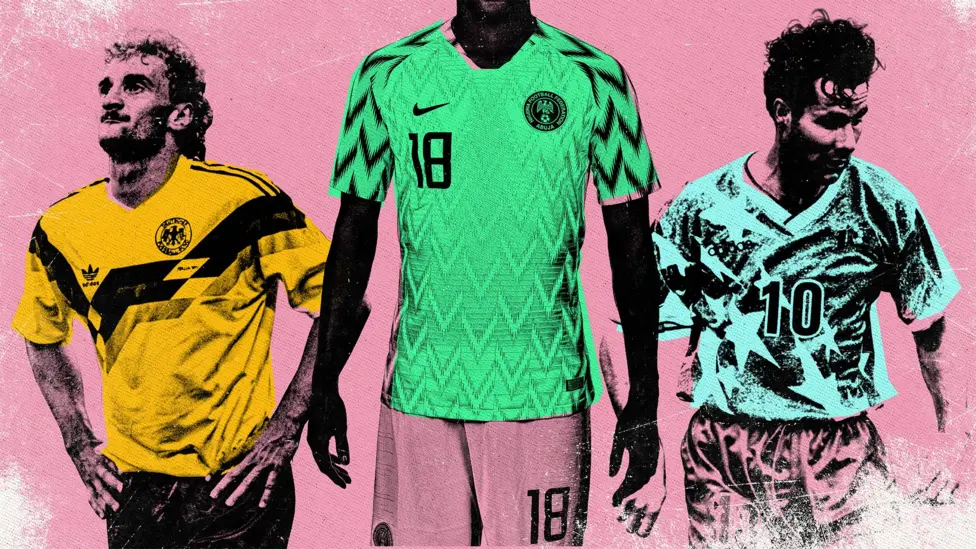
Nigeria’s 2018 kit stands out as a modern example of instant success. Unlike many classic shirts, its popularity was driven as much by fashion and culture as by football. Millions of fans pre-ordered it, and it became a global sensation. Wolff explains that the design drew inspiration from Nigeria’s past kits, blending heritage with contemporary style at the perfect moment.
Brazil’s 1970 yellow jersey is perhaps one of the most iconic of all time. Associated with legends like Pele and Carlos Alberto, it represents one of the greatest teams in football history. Even in old footage, the vibrant color and simple design continue to captivate fans.
The USA’s 1994 away kit, featuring bold star patterns and denim-inspired elements, was initially met with skepticism. However, its uniqueness eventually won over fans, turning it into a beloved classic. It symbolizes a time when football was still growing in popularity in the United States.
Argentina’s 1986 away shirt is forever linked to Diego Maradona’s brilliance. The quarter-final against England, where he scored both the “Hand of God” goal and his famous solo effort, elevated the shirt’s status. The story behind the jersey, reportedly sourced locally due to last-minute issues, adds another fascinating layer.
Topping the list is West Germany’s 1990 home kit. Its bold geometric design was revolutionary at the time, breaking away from the simpler styles of previous years. Worn during their World Cup victory, it has since become a benchmark for football shirt design and a favorite among collectors.
Ultimately, what makes a football kit iconic is not just its appearance but the memories and emotions attached to it. These jerseys serve as time capsules, capturing moments that define the sport. While modern designs continue to evolve, the classics remain unmatched in their ability to connect generations of fans.
For more sports stories, insights, and updates, visit https://netsports247.com/