

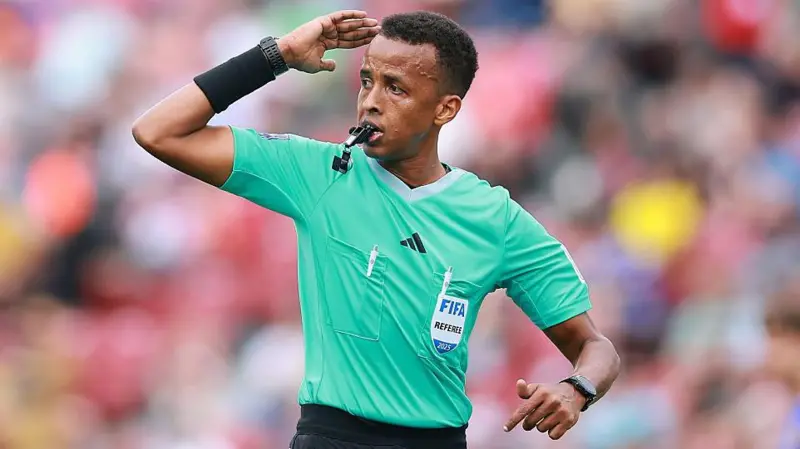
Somali referee Omar Abdulkadir Artan has spoken of his deep disappointment after being denied entry into the United States ahead of the FIFA World Cup, despite holding what he insists were valid travel documents. The decision not only prevented him from officiating at the tournament but also denied him the opportunity to make history as the first Somali referee to take charge of matches at a World Cup finals.
Artan revealed that his experience at Miami International Airport was both exhausting and distressing. Upon arrival, he underwent an extensive immigration interview that lasted approximately 11 hours. During this time, he was questioned by US authorities before ultimately being refused entry into the country. Following the lengthy interrogation, he was placed in a holding cell for several more hours before being deported on a flight back to Istanbul, Turkey.
The reasons behind the decision remain unclear. US immigration officials have not provided a specific explanation for denying him entry. However, it is widely noted that Somalia is among the countries affected by travel restrictions introduced under policies linked to former President Donald Trump. While these restrictions have evolved over time, their lingering effects continue to impact individuals from certain nations.
Artan expressed his frustration and heartbreak in interviews, explaining that officiating at the World Cup had been a lifelong ambition. He described the tournament as the pinnacle of his career and said he had worked tirelessly to reach that level. For him, the opportunity represented not just personal achievement but also a moment of pride for Somalia, a country rarely represented on football’s biggest stage.
FIFA, football’s global governing body, confirmed that Artan would not participate in the tournament. In an official statement, FIFA clarified that it has no authority over immigration processes in host countries and must rely on decisions made by local authorities. The organization acknowledged the situation but indicated that it could not intervene or alter the outcome.
Officials from Somalia have also weighed in on the matter. A senior adviser from the country’s Ministry of Youth and Sports confirmed that Artan had been traveling with legitimate documentation. Additionally, a representative from the Somali embassy in Nairobi explained that Artan had even been issued a diplomatic passport to facilitate his travel after earlier visa complications. These steps were taken specifically to ensure that he would face no issues entering the United States.
Despite these precautions, Artan’s entry was still denied. He maintains that he complied with all requirements and presented the correct paperwork. His repeated assertion that he had “the right visa” underscores his confusion and disappointment at the outcome.
The incident has drawn attention to the challenges faced by international officials and participants in global sporting events when navigating complex immigration systems. For events like the World Cup, where teams, officials, and staff travel from around the world, coordination between sporting bodies and host nations is crucial. However, this case highlights the limitations of such coordination when national immigration policies come into play.
Andrew Giuliani, who leads the White House Task Force on the World Cup, supported the decision made by US Customs and Border Protection. While he declined to provide detailed reasons, citing confidentiality, he stated that he believed the authorities had made the correct judgment based on the information available to them.
The situation also underscores the logistical challenges of hosting a multinational tournament across different countries. Although the 2026 World Cup will be jointly hosted by the United States, Canada, and Mexico, referees are required to be based in a centralized training camp in Miami, Florida. This hub, established by FIFA’s referees’ committee under the leadership of Pierluigi Collina, is designed to ensure consistency, preparation, and security for match officials.
Because all referees must attend training sessions and reside at this base, it is not feasible for someone to officiate matches solely in Canada or Mexico without entering the United States. This requirement effectively ruled out any alternative arrangement for Artan, making his participation impossible once he was denied entry.
For Artan, the experience has been both professionally and personally devastating. Beyond missing the tournament, he has also lost a historic opportunity to represent his country on a global stage. His story has resonated with many in the football community, highlighting the human impact of administrative decisions.
The broader implications of the incident continue to be debated. Some observers have raised concerns about fairness and inclusivity in international sport, particularly when geopolitical factors influence participation. Others emphasize the importance of national security and the sovereign right of countries to control their borders.
Artan himself has suggested that the decision may reflect broader tensions, stating that he feels there may be underlying issues affecting how individuals from his country are treated. While he stopped short of making direct accusations, his comments reflect a sense of frustration shared by many who face similar challenges.
As the World Cup approaches, the focus will inevitably shift back to the action on the field. However, stories like Artan’s serve as a reminder of the complex realities behind the scenes. They highlight the intersection of sport, politics, and global mobility, and the ways in which these factors can shape individual experiences.
For now, Artan returns home with unanswered questions and a dream deferred. Despite the setback, he remains hopeful that his journey in football is not over. His determination and resilience may yet see him achieve further success in the future, even if this particular opportunity has been lost.
For more latest sports updates and global football news, visit https://netsports247.com/